Center for Healthcare Organization and Implementation Research, VA Bedford Healthcare System, Bedford, MA, United States.
Department of Health Law Policy and Management, Boston University School of Public Health, Boston, MA, United States.
JMIR Mhealth Uhealth. 2021 Nov 15;9(11):e31037. doi: 10.2196/31037.
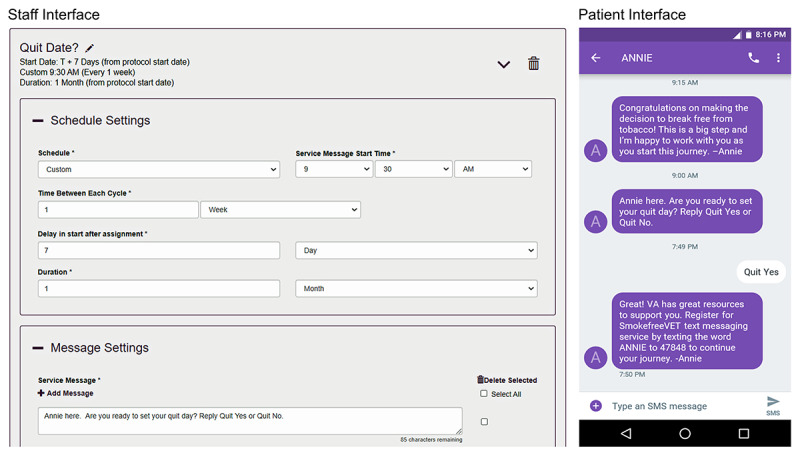
The Veterans Health Administration (VHA) is deploying an automated texting system (aTS) to support patient self-management.
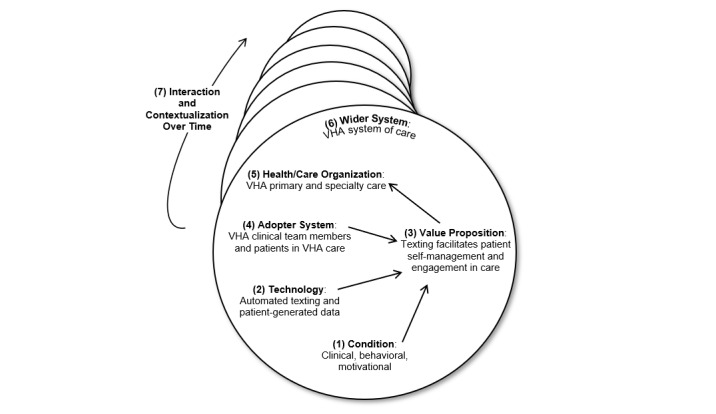
We conducted a qualitative evaluation to examine factors influencing national rollout of the aTS, guided by the Nonadoption, Abandonment, Scale-up, Spread, and Sustainability (NASSS) framework, which is intended to support the evaluation of novel technologies.
Semistructured interviews were conducted with 33 staff and 38 patients who were early adopters of the aTS. Data were analyzed following deductive and inductive approaches using a priori codes and emergent coding based on the NASSS.
We identified themes across NASSS domains: (1) Condition: The aTS was considered relevant for a range of patient needs; however, perceptions of patient suitability were guided by texting experience and clinical complexity rather than potential benefits. (2) Technology: Onboarding of the aTS presented difficulty and the staff had different opinions on incorporating patient-generated data into care planning. (3) Value: Supply-side value relied on the flexibility of the aTS and its impact on staff workload whereas demand-side value was driven by patient perceptions of the psychological and behavioral impacts of the aTS. (4) Adopters: Limited clarity on staff roles and responsibilities presented challenges in incorporating the aTS into clinical processes. (5) Organization: Staff were willing to try the aTS; however, perceptions of leadership support and clinic readiness hindered usage. (6) Wider system: Staff focused on enhancing aTS interoperability with the electronic medical record. (7) Embedding and adaptation over time: The interplay of aTS versatility, patient and staff demands, and broader societal changes in preferences for communicating health information facilitated aTS implementation.
VHA's new aTS has the potential to further engage patients and expand the reach of VHA care; however, patients and staff require additional support to adopt, implement, and sustain the aTS. The NASSS highlighted how the aTS can be better embedded into current practices, which patients might benefit most from its functionality, and which aspects of aTS messages are most relevant to self-management.
ClinicalTrials.gov NCT03898349; https://clinicaltrials.gov/ct2/show/NCT03898349.
退伍军人健康管理局(VHA)正在部署一个自动化短信系统(aTS)来支持患者自我管理。
我们进行了一项定性评估,以根据非采用、放弃、扩展、传播和可持续性(NASSS)框架来研究影响该系统在全国范围内推广的因素,该框架旨在支持对新技术的评估。
对 33 名工作人员和 38 名早期采用 aTS 的患者进行了半结构化访谈。根据 NASSS,采用演绎和归纳方法,使用预设代码和新兴代码对数据进行了分析。
我们在 NASSS 各领域中确定了主题:(1)条件:aTS 被认为与一系列患者需求相关;然而,对患者适用性的看法是基于短信经验和临床复杂性,而不是潜在的益处。(2)技术:aTS 的上线存在困难,工作人员对将患者生成的数据纳入护理计划存在不同意见。(3)价值:供应方的价值取决于 aTS 的灵活性及其对工作人员工作量的影响,而需求方的价值则由患者对 aTS 的心理和行为影响的看法驱动。(4)采用者:工作人员角色和责任的明确性有限,这给将 aTS 纳入临床流程带来了挑战。(5)组织:工作人员愿意尝试使用 aTS;然而,对领导支持和诊所准备情况的看法阻碍了其使用。(6)更广泛的系统:工作人员专注于增强 aTS 与电子病历的互操作性。(7)随着时间的推移进行嵌入和调整:aTS 的多功能性、患者和工作人员的需求以及社会偏好在沟通健康信息方面的变化相互作用,促进了 aTS 的实施。
VHA 的新型 aTS 有可能进一步吸引患者并扩大 VHA 护理的范围;然而,患者和工作人员需要额外的支持来采用、实施和维持 aTS。NASSS 强调了如何将 aTS 更好地嵌入当前实践中,哪些患者可能从其功能中受益最多,以及 aTS 消息的哪些方面与自我管理最相关。
ClinicalTrials.gov NCT03898349;https://clinicaltrials.gov/ct2/show/NCT03898349。