Massachusetts General Hospital, Harvard Medical School, Boston, MA, United States of America.
The Biostatistics Center, Milken Institute School of Public Health, The George Washington University, Rockville, MD, United States of America.
PLoS One. 2021 Nov 15;16(11):e0257154. doi: 10.1371/journal.pone.0257154. eCollection 2021.
We compared HbA1c values obtained from capillary blood collection kits versus venous whole blood collections in study participants with type 1 or type 2 diabetes.
A total of 122 subjects, 64 with type 2 diabetes participating in the Glycemia Reduction Approaches in Diabetes: A Comparative Effectiveness (GRADE) Study and 58 with type 1 diabetes from the Epidemiology of Diabetes Interventions and Complications (EDIC) Study, participated in the validation study. Capillary tubes were filled by fingerstick by the participants on the same day as the collection of venous whole blood samples in EDTA-containing test tubes and were mailed to the central laboratory. HbA1c in all samples was measured with the same high-performance liquid chromatography. GRADE participants also completed a questionnaire on the ease of performing capillary collections.
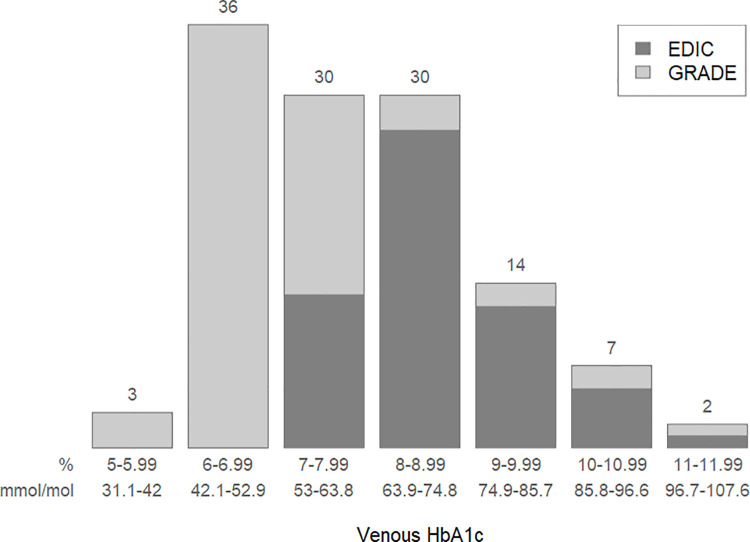
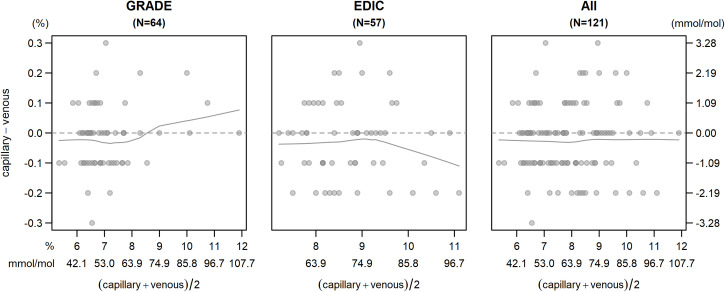
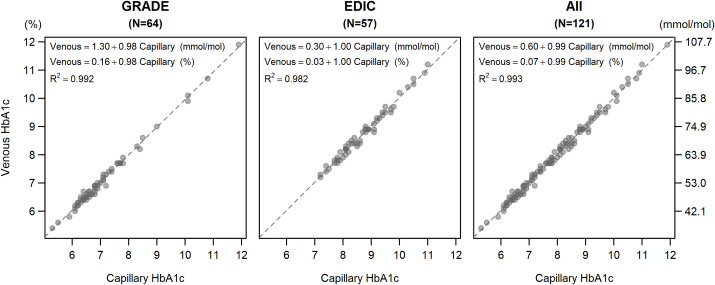
Participants from 22 clinical centers (GRADE n = 5, EDIC n = 17) were between 35 and 86 years of age, with 52% male and diverse race/ethnicities. Venous HbA1c results ranged between 5.4-11.9% (35.5-106.6 mmol/mol) with corresponding capillary results ranging between 4.2-11.9% (22.4-106.6 mmol/mol). The venous and capillary results were highly correlated (R2 = 0.993) and 96.7% differed by ≤0.2% (2.2 mmol/mol). Of participants surveyed, 69% indicated that the instructions and collection were easy to follow and 97% felt the collection method would be easy to do at home.
The capillary blood HbA1c results compared well with the conventional venous whole blood results. The capillary kits can be employed in other studies to reduce interruption of critical data collection and potentially to augment clinical care when in-person visits are not possible.
我们比较了 1 型或 2 型糖尿病患者采用毛细血管采血试剂盒和静脉全血采集的 HbA1c 值。
共有 122 名受试者参加了验证研究,其中 64 名 2 型糖尿病患者来自糖尿病血糖控制与并发症研究(GRADE),58 名 1 型糖尿病患者来自糖尿病及其并发症的流行病学研究(EDIC)。EDIC 受试者当日在含 EDTA 的试管中采集静脉全血样本的同时,由本人使用指尖进行毛细血管采血,采血管邮寄至中心实验室。所有样本的 HbA1c 均采用高效液相色谱法进行测定。GRADE 受试者还完成了一份关于毛细血管采集易用性的问卷。
来自 22 个临床中心(GRADE 组 n = 5,EDIC 组 n = 17)的受试者年龄在 35-86 岁之间,男性占 52%,种族/民族多样。静脉 HbA1c 结果为 5.4-11.9%(35.5-106.6mmol/mol),相应的毛细血管结果为 4.2-11.9%(22.4-106.6mmol/mol)。静脉和毛细血管结果高度相关(R2 = 0.993),96.7%的结果相差≤0.2%(2.2mmol/mol)。接受调查的受试者中,69%表示说明和采集过程易于遵循,97%认为采集方法易于在家中进行。
毛细血管血 HbA1c 结果与常规静脉全血结果比较吻合。毛细血管采血试剂盒可用于其他研究,在无法进行面对面就诊时,有助于减少关键数据采集的中断,并可能增强临床护理。