Vishnyakova M A, Vlasova E V, Egorova G P
Federal Research Center the N.I. Vavilov All-Russian Institute of Plant Genetic Resources (VIR), St. Petersburg, Russia.
Federal Horticultural Research Center for Breeding, Agrotechnology and Nursery, Moscow, Russia.
Vavilovskii Zhurnal Genet Selektsii. 2021 Oct;25(6):620-630. doi: 10.18699/VJ21.070.
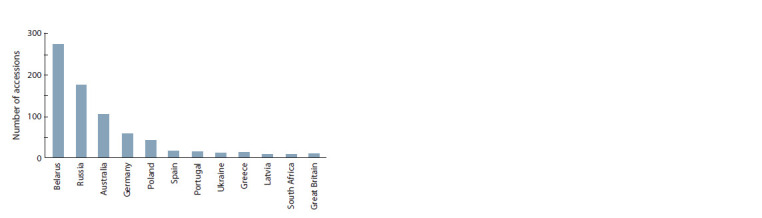
Narrow-leaved lupine (Lupinus angustifolius L.) is a cultivated multipurpose species with a very short history of domestication. It is used as a green manure, and for feed and food. This crop shows good prospects for use in pharmacology and as a source of f ish feeds in aquaculture. However, its genetic potential for the development of productive and adaptable cultivars is far from being realized. For crop species, the genetic base of the cultivated gene pool has repeatedly been shown as being much narrower than that of the wild gene pool. Therefore, eff icient utilization of a species' genetic resources is important for the crop's further improvement. Analyzing the information on the germplasm collections preserved in national gene banks can help perceive the worldwide diversity of L. angustifolius genetic resources and understand how they are studied and used. In this context, the data on the narrow-leaved lupine collection held by VIR are presented: its size and composition, the breeding status of accessions, methods of studying and disclosing intraspecif ic differentiation, the classif ications used, and the comparison of this information with available data on other collections. It appeared that VIR's collection of narrow-leaved lupine, ranking as the world's second largest, differed signif icantly from others by the prevalence of advanced cultivars and breeding material in it, while wild accessions prevailed in most collections. The importance of the wild gene pool for the narrow-leaved lupine breeding in Australia, the world leader in lupine production, is highlighted. The need to get an insight into the species' ecogeographic diversity in order to develop cultivars adaptable to certain cultivation conditions is shown. The data on the testing of VIR's collection for main crop characters valuable for breeders are presented. Special attention is paid to the study of accessions with limited branching as a promising gene pool for cultivation in relatively northern regions of Russia. They demonstrate lower but more stable productivity, and suitability for cultivation in planting patterns, which has a number of agronomic advantages. Analyzing the work with narrow-leaved lupine genetic resources in different national gene banks over the world helps shape the prospects of further activities with VIR's collection as the only source of promising material for domestic breeding.
窄叶羽扇豆(Lupinus angustifolius L.)是一种驯化历史非常短的多用途栽培物种。它被用作绿肥、饲料和食物。这种作物在药理学应用以及作为水产养殖中鱼类饲料来源方面展现出良好前景。然而,其在培育高产且适应性强品种方面的遗传潜力远未得到充分发挥。对于农作物物种而言,栽培基因库的遗传基础一再被证明比野生基因库的遗传基础狭窄得多。因此,有效利用物种的遗传资源对于作物的进一步改良至关重要。分析保存在国家基因库中的种质资源信息有助于了解窄叶羽扇豆遗传资源的全球多样性,并了解它们是如何被研究和利用的。在此背景下,介绍了全俄植物栽培研究所(VIR)保存的窄叶羽扇豆种质资源数据:其规模和组成、种质的育种状况、研究和揭示种内分化的方法、所采用的分类方法,以及将这些信息与其他种质资源库的现有数据进行比较。结果表明,全俄植物栽培研究所的窄叶羽扇豆种质资源库是世界第二大库,其中先进品种和育种材料的占比显著高于其他种质资源库,而大多数种质资源库中野生种质占主导。强调了野生基因库对澳大利亚窄叶羽扇豆育种的重要性,澳大利亚是羽扇豆生产的世界领先国家。还表明有必要深入了解该物种的生态地理多样性,以便培育出适应特定种植条件的品种。介绍了全俄植物栽培研究所种质资源库在对育种者有价值的主要作物性状方面的测试数据。特别关注对分枝有限的种质资源的研究,它们作为在俄罗斯相对北部地区种植的有前景的基因库。它们表现出较低但更稳定的生产力,以及适合特定种植模式的特性,具有许多农艺优势。分析世界各地不同国家基因库对窄叶羽扇豆遗传资源的研究工作,有助于展望以全俄植物栽培研究所的种质资源库作为国内育种唯一有前景材料来源的进一步活动前景。