Hypertension Center of People's Hospital of Xinjiang Uygur Autonomous Region, Xinjiang Hypertension Institute, National Health Committee Key Laboratory of Hypertension Clinical Research, Key Laboratory of Xinjiang Uygur Autonomous Region "Hypertension Research Laboratory, Xinjiang Clinical Medical Research Center for Hypertension (Cardio-Cerebrovascular) Diseases.
Xinjiang Medical University, Urumqi, Xinjiang, China.
J Hypertens. 2022 Mar 1;40(3):561-569. doi: 10.1097/HJH.0000000000003049.
The aim of this study was to evaluate the association between plasma aldosterone concentration (PAC) and renal impairment in patients with both hypertension and abnormal glucose metabolism (AGM).
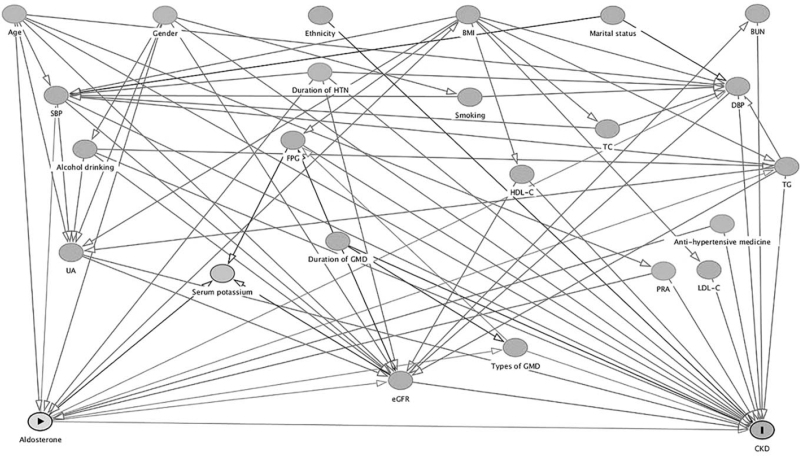
The longitudinal observational study included 2033 hypertensive individuals with AGM who did not have chronic kidney disease (CKD) at baseline. CKD was defined as estimated glomerular filtration rate (eGFR) less than 60 ml/min per 1.73 m2 and/or positive proteinuria. Directed acyclic graphs and LASSO regression analyses were applied to identify adjusted sets. Cox proportional hazard models and linear regression were used to evaluate the association of PAC with CKD and its components including decreased renal function (DRF) and proteinuria. Mediation analysis was used to examine the role of blood pressure (BP) in the association between the two.
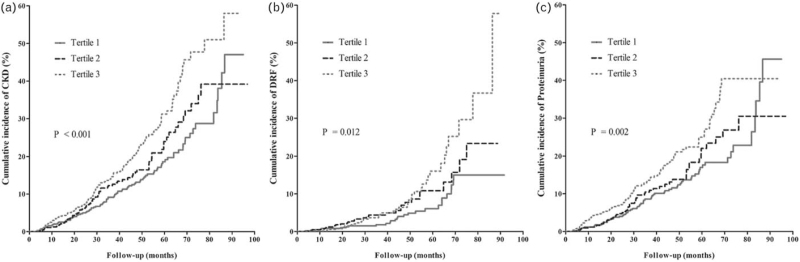
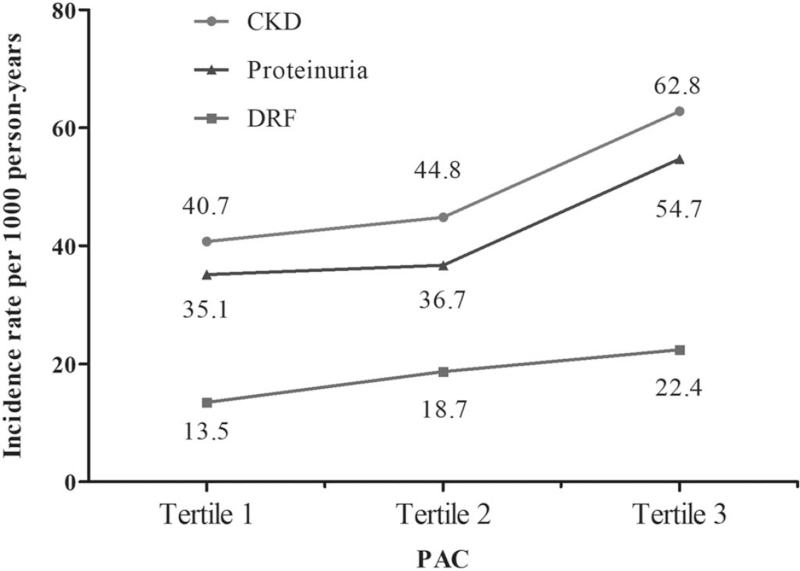
During total follow-up of 5951 person-years with a median follow-up of 31 months, 291 participants developed CKD. The incidence of CKD was increased with the elevation in tertile PAC. Multivariable Cox model showed that PAC was positively associated with increased CKD risk (hazard ratio = 1.76 for natural log-transformed PAC, P < 0.001), and with increased risk of DRF and proteinuria. SBP mediated 7.5-17.9% of the association between PAC and renal impairment. Overall results remained consistent and significant in sensitivity analysis by excluding those with suspicious primary aldosteronism, too short follow-up time and mineralocorticoid receptor antagonists use.
Higher PAC was associated with increased CKD risk in patients with hypertension and AGM, even in the absence of suspicious primary aldosteronism. The results indicate PAC may serve as a potential therapeutic target in this population.
本研究旨在评估高血压伴糖代谢异常(AGM)患者的血浆醛固酮浓度(PAC)与肾功能损害之间的关系。
本纵向观察性研究纳入了 2033 例基线时无慢性肾脏病(CKD)的高血压伴 AGM 患者。CKD 的定义为估算肾小球滤过率(eGFR)<60ml/min/1.73m2和/或蛋白尿阳性。采用有向无环图和 LASSO 回归分析来识别调整后的集合。Cox 比例风险模型和线性回归用于评估 PAC 与 CKD 及其组成部分(包括肾功能下降和蛋白尿)的相关性。中介分析用于检验 BP 在两者相关性中的作用。
在总随访时间为 5951 人年,中位随访时间为 31 个月的随访期间,291 例患者发生了 CKD。随着 PAC 三分位升高,CKD 的发生率增加。多变量 Cox 模型显示,PAC 与 CKD 风险增加呈正相关(自然对数值 PAC 的危险比为 1.76,P<0.001),并与肾功能下降和蛋白尿风险增加相关。SBP 介导了 PAC 与肾功能损害之间 7.5-17.9%的关联。在排除有可疑原发性醛固酮增多症、随访时间过短和使用盐皮质激素受体拮抗剂的患者后,敏感性分析的总体结果仍然一致且显著。
在高血压伴 AGM 患者中,较高的 PAC 与 CKD 风险增加相关,即使在没有可疑原发性醛固酮增多症的情况下也是如此。结果表明,PAC 可能成为该人群的潜在治疗靶点。