General practice Ottenhoff, B. Ottenhoffstraat 18, 6561 CM, Groesbeek, The Netherlands.
Radboud University Medical Center, Postbox 9101, 6500 HB, Nijmegen, The Netherlands.
BMC Fam Pract. 2021 Nov 18;22(1):232. doi: 10.1186/s12875-021-01580-z.
In the Netherlands, euthanasia has been regulated by law since 2002. In the past decade, a growing number of persons with dementia requested for euthanasia, and more requests were granted. A euthanasia request from a patient with advanced dementia (PWAD) can have a major impact on a general practitioner (GP). We aimed to get insights in the views of Dutch GPs on euthanasia concerning this patient group.
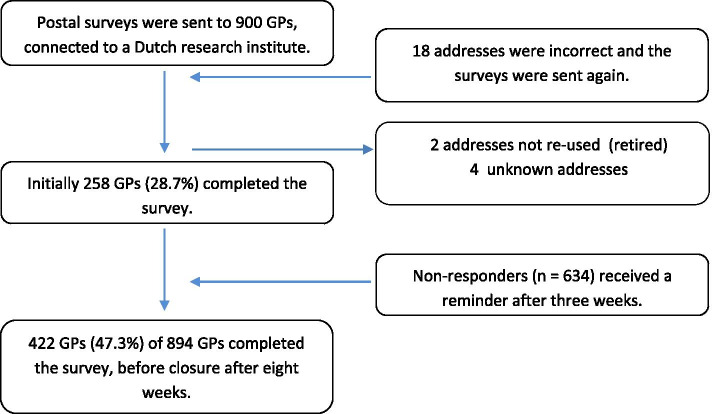
A postal survey was sent to 894 Dutch GPs. Questions were asked about a case vignette about a PWAD who was not able to confirm previous wishes anymore. Quantitative data were analyzed with descriptive statistics.
Of the 894 GPs approached, 422 (47.3%) completed the survey. One hundred seventy-eight GPs (42.2%) did not agree with the statement that an Advance Euthanasia Directive (AED) can replace an oral request if communication with the patient concerned has become impossible. About half of the respondents (209; 49.5%) did not agree that the family can initiate a euthanasia trajectory, 95 GPs (22.5%) would accept such a family initiative and 110 GPs (26.1%) would under certain conditions.
In case of a PWAD, when confirming previous wishes is not possible anymore, about half of the Dutch GPs would not accept an AED to replace verbal or non-verbal conformation nor consider performing euthanasia; a minority would. Our study shows that, probably due to the public debate and changed professional guidelines, conflicting views have arisen among Dutch GPs about interpretation of moral, ethical values considering AED and PWADs.
自 2002 年以来,荷兰已经通过法律对安乐死进行了规范。在过去的十年中,越来越多的痴呆症患者要求安乐死,并且有更多的请求得到了批准。一位患有晚期痴呆症的患者(PWAD)的安乐死请求可能会对全科医生(GP)产生重大影响。我们旨在了解荷兰全科医生对这一患者群体安乐死的看法。
我们向 894 名荷兰全科医生发送了一份邮寄调查。问题涉及到一位无法再确认先前意愿的 PWAD 的案例描述。使用描述性统计方法对定量数据进行了分析。
在联系的 894 名全科医生中,有 422 名(47.3%)完成了调查。178 名全科医生(42.2%)不同意“预先安乐死指令(AED)可以替代无法与患者沟通时的口头请求”的说法。约一半的受访者(209 名;49.5%)不同意家属可以启动安乐死过程,95 名全科医生(22.5%)会接受这种家属的主动,110 名全科医生(26.1%)会在某些条件下接受。
在 PWAD 情况下,当无法再确认先前的意愿时,大约一半的荷兰全科医生不会接受 AED 来替代口头或非口头的确认,也不会考虑实施安乐死;少数人会这样做。我们的研究表明,可能由于公众辩论和专业指南的改变,荷兰全科医生对 AED 和 PWAD 相关的道德、伦理价值观的解释产生了不同的看法。