Wang Yongqian, Huang Xufeng, Fan Hongzhen, An Huimei, Ma Ting, Zhang Qi, Zhao Wenxuan, Yun Yajun, Yang Wenshuang, Zhang Xiaolu, Wang Zhiren, Yang Fude
Beijing HuiLongGuan Hospital, Peking University HuiLongGuan Clinical Medical School, Beijing, China.
Illawarra Health and Medical Research Institute, School of Medicine, University of Wollongong, Wollongong, NSW, Australia.
Front Psychiatry. 2021 Nov 1;12:762656. doi: 10.3389/fpsyt.2021.762656. eCollection 2021.
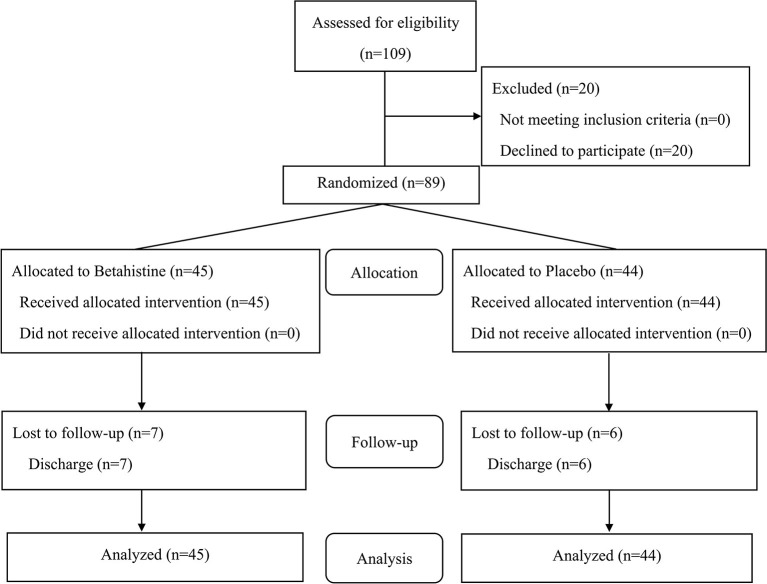
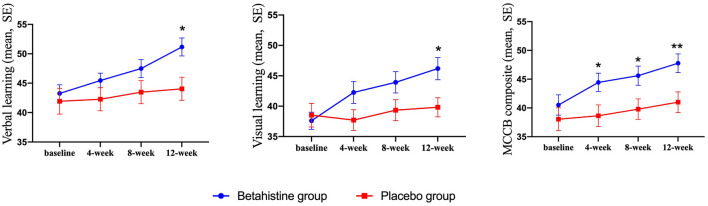
There is currently no effective treatment for cognitive impairment associated with schizophrenia (CIAS). Recent studies have shown that increased histamine levels in the brain may help to improve CIAS symptoms. Betahistine is an H1-receptor agonist and H3-receptor antagonist. This study evaluated the effect of high-dose betahistine on cognitive function as well as its safety in Chinese Han patients with schizophrenia. This randomized double-blind, placebo-controlled trial enrolled 89 patients with schizophrenia who were randomly administered betahistine (72 mg/d) or placebo for 12 weeks. At baseline and at 4, 8, and 12 weeks after commencing the intervention, we measured changes in cognitive function and clinical symptoms using the MATRICS Consensus Cognitive Battery (MCCB) and Positive and Negative Syndrome Scale (PANSS), respectively. Furthermore, we used the Treatment Emergent Symptom Scale (TESS) to assess the adverse effects of the patients' medications. Compared to the placebo group, the betahistine group showed significant improvements in the MCCB composite score after 12 weeks of treatment ( = 0.003) as well as improvements in MCCB verbal learning ( = 0.02) and visual learning ( = 0.001) domain scores. However, there were no significant improvements in the PANSS total scores or subscores ( > 0.05). Generally, high-dose betahistine treatment was considered safe in patients with schizophrenia. Additional use of high-dose betahistine can effectively improve cognitive function but not psychiatric symptoms in patients with schizophrenia. Betahistine (72 mg/d) is well tolerated by Chinese Han patients with schizophrenia. chictr.org.cn, identifier: ChiCTR1900021078. http://www.chictr.org.cn/edit.aspx?pid=35484&htm=4.
目前尚无针对精神分裂症相关认知障碍(CIAS)的有效治疗方法。最近的研究表明,大脑中组胺水平升高可能有助于改善CIAS症状。倍他司汀是一种H1受体激动剂和H3受体拮抗剂。本研究评估了高剂量倍他司汀对中国汉族精神分裂症患者认知功能的影响及其安全性。 这项随机双盲、安慰剂对照试验招募了89名精神分裂症患者,他们被随机给予倍他司汀(72毫克/天)或安慰剂,为期12周。在基线以及开始干预后的4周、8周和12周,我们分别使用MATRICS共识认知成套测验(MCCB)和阳性与阴性症状量表(PANSS)测量认知功能和临床症状的变化。此外,我们使用治疗中出现的症状量表(TESS)评估患者药物的不良反应。 与安慰剂组相比,倍他司汀组在治疗12周后MCCB综合评分有显著改善(=0.003),MCCB言语学习(=0.02)和视觉学习(=0.001)领域得分也有所改善。然而,PANSS总分或子分数没有显著改善(>0.05)。一般来说,高剂量倍他司汀治疗对精神分裂症患者被认为是安全的。额外使用高剂量倍他司汀可以有效改善精神分裂症患者的认知功能,但不能改善精神症状。倍他司汀(72毫克/天)在中国汉族精神分裂症患者中耐受性良好。 中国临床试验注册中心,标识符:ChiCTR1900021078。http://www.chictr.org.cn/edit.aspx?pid=35484&htm=4 。