Department of Gynecology, Affiliated Hospital of Nanjing University of Chinese Medicine, Nanjing, China.
The First School of Clinical Medicine, Nanjing University of Chinese Medicine, Nanjing, China.
Front Endocrinol (Lausanne). 2021 Nov 1;12:735954. doi: 10.3389/fendo.2021.735954. eCollection 2021.
Diet has been reported as the first-line management of polycystic ovary syndrome (PCOS). However, the relationship between diet and fertility in PCOS is still controversial. This meta-analysis aimed to evaluate whether diet could promote reproductive health in women with PCOS while providing evidence-based nutrition advice for clinical practice.
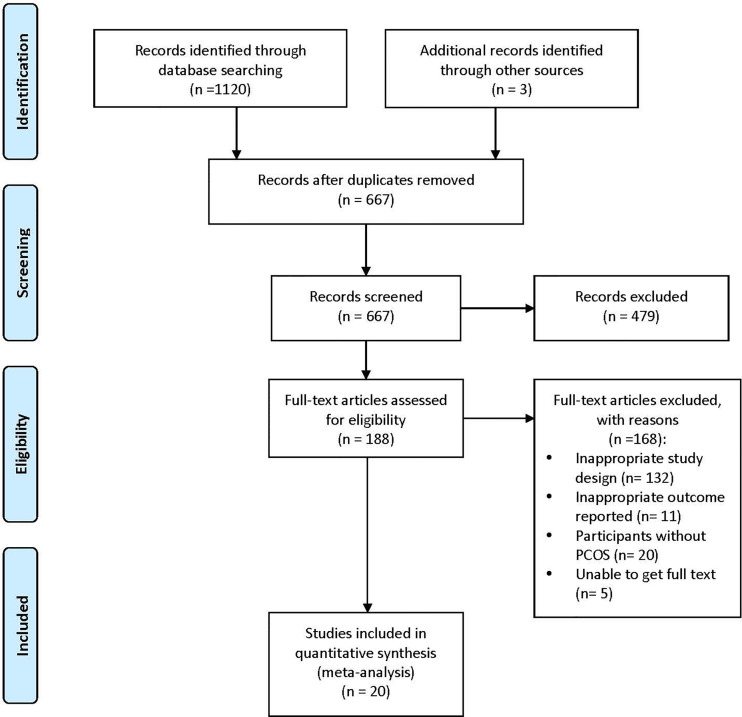
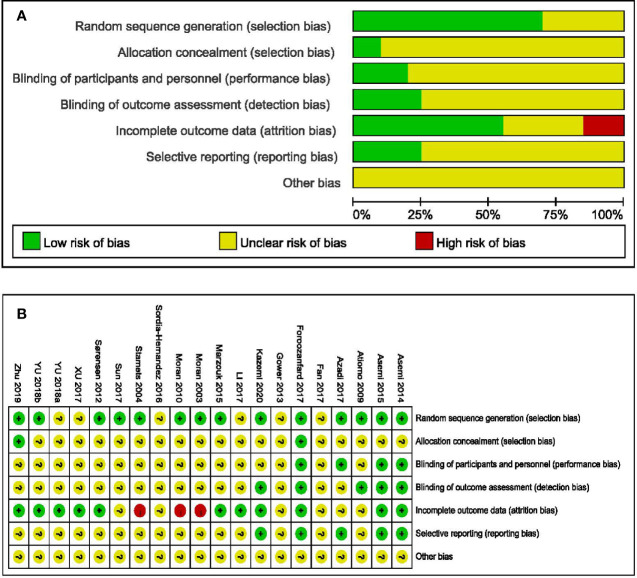
Seven databases, including Cochrane Central Register of Controlled Trials, PubMed, Embase, Web of Science, and some Chinese database, were searched up to January 31, 2021. Randomized controlled trials evaluating the effects of diet in women with PCOS were included. Based on a preregistered protocol (PROSPERO CRD42019140454), the systematic review was performed following the Preferred Reporting Items for Systematic Reviews and Meta-analyses (PRISMA) guidelines. Two reviewers made study selection, data extraction and bias assessment independently. Risk ratios and mean difference with 95% confidence intervals were assessed by a random-effects model. Statistical heterogeneity within comparisons was evaluated by Cochran's Q test and quantified by the I-squared ( ) statistic.
Twenty RCTs with 1113 participants were included. Results showed diet significantly related to improved fertility outcomes (increasing clinical pregnancy, ovulation and menstrual regularity rate; reducing miscarriage rate), reproductive endocrine [increasing sex hormone-binding globulin (SHBG); decreasing Anti-Müllerian Hormone (AMH), free androgen index (FAI), total testosterone (T)] and clinical hyperandrogenism (hirsutism assessed by Ferriman-Gallwey score) in PCOS. Specifically, subgroup analyses indicated low-carbohydrate diets were superior in optimizing reproductive outcomes and calorie restriction was critical in ameliorating hyperandrogenism. Additionally, the positive effects were associated with the treatment duration. The longer the duration, the greater the improvement was.
Overall, diet is an effective intervention for improving fertility health, thus professional and dynamic dietary advice should be offered to all PCOS patients, based on the changeable circumstances, personal needs and expectations of the individuals.
饮食已被报道为多囊卵巢综合征(PCOS)的一线治疗方法。然而,饮食与 PCOS 患者生育能力之间的关系仍存在争议。本荟萃分析旨在评估饮食是否可以改善 PCOS 女性的生殖健康,并为临床实践提供基于证据的营养建议。
截至 2021 年 1 月 31 日,我们检索了 7 个数据库,包括 Cochrane 对照试验中心注册库、PubMed、Embase、Web of Science 和一些中文数据库,纳入了评估饮食对 PCOS 女性影响的随机对照试验。基于预先注册的方案(PROSPERO CRD42019140454),我们按照系统评价和荟萃分析的首选报告项目(PRISMA)指南进行了系统评价。两名评审员独立进行研究选择、数据提取和偏倚评估。采用随机效应模型评估风险比和均数差值及其 95%置信区间。采用 Cochran's Q 检验评估组内的统计学异质性,并通过 I 平方( )统计量量化。
共纳入 20 项 RCT 研究,涉及 1113 名参与者。结果表明,饮食与改善生育结局(提高临床妊娠率、排卵率和月经规律率,降低流产率)、生殖内分泌[增加性激素结合球蛋白(SHBG);降低抗苗勒氏管激素(AMH)、游离雄激素指数(FAI)、总睾酮(T)]和临床高雄激素血症(用 Ferriman-Gallwey 评分评估的多毛症)显著相关。具体而言,亚组分析表明,低碳水化合物饮食在优化生育结局方面更具优势,而热量限制对于改善高雄激素血症至关重要。此外,这种积极作用与治疗持续时间有关,治疗时间越长,改善效果越明显。
总的来说,饮食是改善生育健康的有效干预措施,因此,应根据个体的变化情况、个人需求和期望,为所有 PCOS 患者提供专业和动态的饮食建议。