Liang Shuo, Yu Zhe, Ma Yu-Yan, Guo Chang-Feng, Lu Hong-Zhou, Xu Jin-Fu
Department of Respiratory and Critical Care Medicine, Shanghai Pulmonary Hospital, Tongji University School of Medicine, Shanghai, China.
Department of Nutrition, Shanghai Public Health Clinical Center, Shanghai, China.
Ann Transl Med. 2021 Oct;9(20):1584. doi: 10.21037/atm-21-5373.
Due to the ongoing pandemic of coronavirus disease 2019 (COVID-19) in foreign countries and regions, many overseas people arrive in China by air. Currently, most of the new cases of COVID-19 were imported from overseas. Here, we evaluated the predictive effect of the level of blood albumin (ALB) and serum prealbumin (PA) level in overseas-imported cases on the conversion of mild COVID-19 to moderate and its value in guiding nutritional support for these travelers.
We retrospectively analyzed serum levels of ALB and PA of 193 patients with imported COVID-19 admitted to the Shanghai Public Health Clinical Center at the time of admission on April 8, 2020.
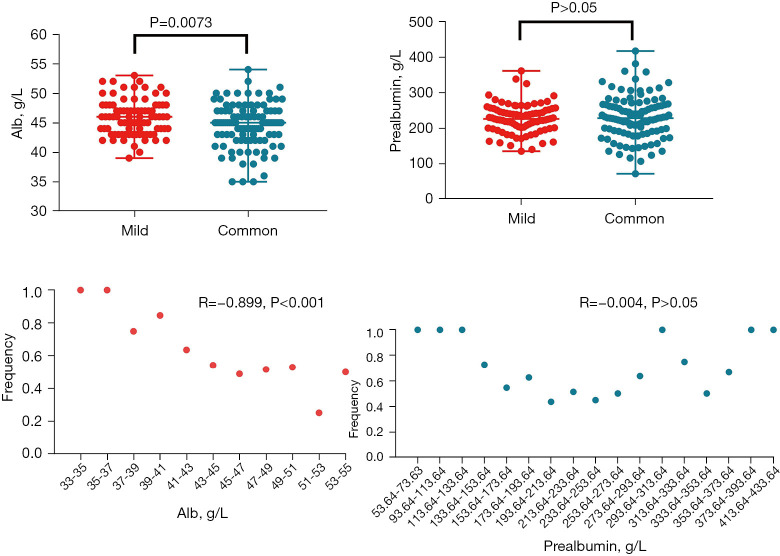
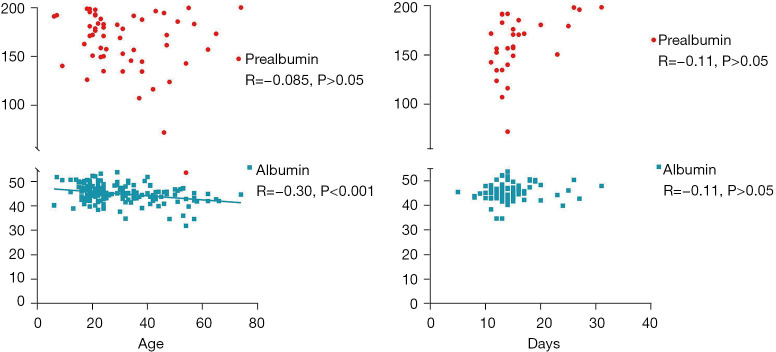
Since the first overseas-imported case was admitted to Shanghai on March 5, 2020, 195 overseas-imported cases have been treated in the Shanghai Public Health Clinical Center. The disease was mild or moderate. A total of 193 patients (111 males and 82 females) entered our analysis and the disease was moderate in 108 patients and mild in 85 patients. Patients were aged 6 to 66 years (mean: 28 years). There was a strong negative correlation between the proportion of moderate type and ALB (P=0.0073); thus, patients with a lower level of ALB were more likely to be diagnosed with moderate type. The correlation coefficient was close to 0 in the scatter plot, indicating that there was no linear correlation between PA and the diagnosis of moderate type (P>0.05). There was a strong negative correlation between age and ALB level (P<0.001), while length of hospital stay did not show a linear correlation with ALB or PB levels (both P>0.05). Therefore, older patients had lower levels of ALB and were more likely to develop moderate COVID-19.
The serum ALB level can be an early predictive indicator for the conversion of mild COVID-19 to moderate in cases imported overseas and may guide nutritional support.
由于国外和地区2019冠状病毒病(COVID-19)疫情持续,许多海外人员乘飞机抵达中国。目前,大多数COVID-19新病例是境外输入的。在此,我们评估了境外输入病例中血白蛋白(ALB)水平和血清前白蛋白(PA)水平对轻度COVID-19转为中度的预测作用及其在指导这些旅行者营养支持方面的价值。
我们回顾性分析了2020年4月8日入院时上海市公共卫生临床中心收治的193例输入性COVID-19患者的血清ALB和PA水平。
自2020年3月5日上海市首例境外输入病例入院以来,上海市公共卫生临床中心共收治195例境外输入病例。病情为轻度或中度。共有193例患者(男111例,女82例)纳入我们的分析,其中108例患者病情为中度,85例患者病情为轻度。患者年龄为6至66岁(平均:28岁)。中度类型比例与ALB之间存在强负相关(P=0.0073);因此,ALB水平较低的患者更有可能被诊断为中度类型。散点图中的相关系数接近0,表明PA与中度类型诊断之间无线性相关性(P>0.05)。年龄与ALB水平之间存在强负相关(P<0.001),而住院时间与ALB或PB水平均未显示线性相关性(均P>0.05)。因此,老年患者的ALB水平较低,更易发展为中度COVID-19。
血清ALB水平可作为境外输入病例中轻度COVID-19转为中度的早期预测指标,并可能指导营养支持。