Department of Physiology and Pharmacology, Cumming School of Medicine, University of Calgary, Calgary, Alberta, Canada.
Department of Obstetrics and Gynecology, Cumming School of Medicine, University of Calgary, Calgary, Alberta, Canada.
PLoS One. 2021 Nov 18;16(11):e0260115. doi: 10.1371/journal.pone.0260115. eCollection 2021.
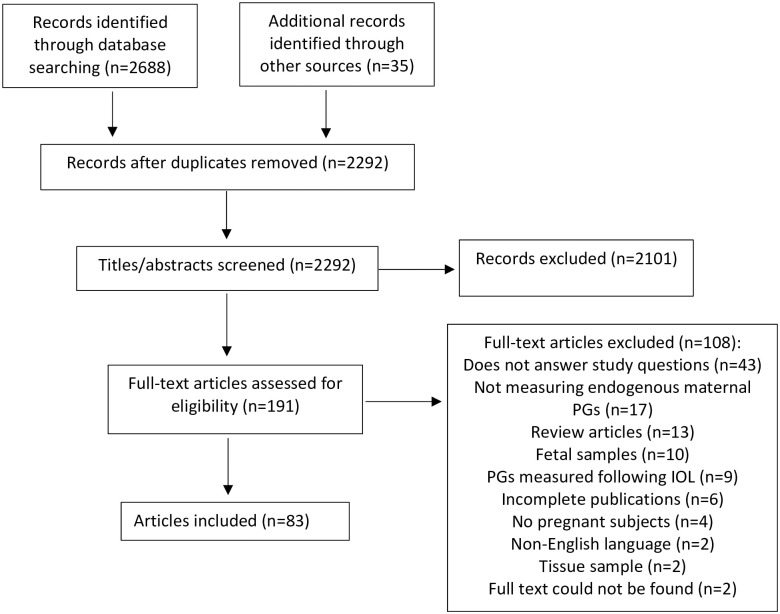
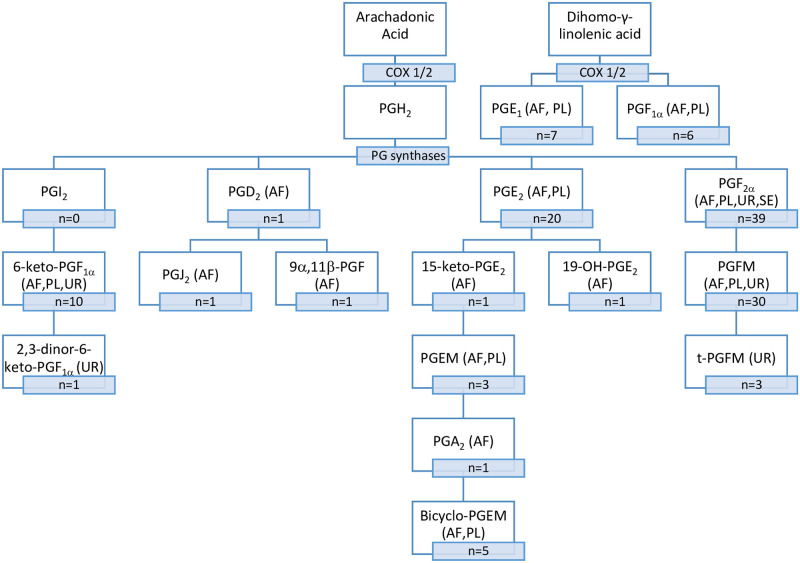
Prostaglandins are thought to be important mediators in the initiation of human labour, however the evidence supporting this is not entirely clear. Determining how, and which, prostaglandins change during pregnancy and labour may provide insight into mechanisms governing labour initiation and the potential to predict timing of labour onset. The current study systematically searched the existing scientific literature to determine how biofluid levels of prostaglandins change throughout pregnancy before and during labour, and whether prostaglandins and/or their metabolites may be useful for prediction of labour. The databases EMBASE and MEDLINE were searched for English-language articles on prostaglandins measured in plasma, serum, amniotic fluid, or urine during pregnancy and/or spontaneous labour. Studies were assessed for quality and risk of bias and a qualitative summary of included studies was generated. Our review identified 83 studies published between 1968-2021 that met the inclusion criteria. As measured in amniotic fluid, levels of PGE2, along with PGF2α and its metabolite 13,14-dihydro-15-keto-PGF2α were reported higher in labour compared to non-labour. In blood, only 13,14-dihydro-15-keto-PGF2α was reported higher in labour. Additionally, PGF2α, PGF1α, and PGE2 were reported to increase in amniotic fluid as pregnancy progressed, though this pattern was not consistent in plasma. Overall, the evidence supporting changes in prostaglandin levels in these biofluids remains unclear. An important limitation is the lack of data on the complexity of the prostaglandin pathway outside of the PGE and PGF families. Future studies using new methodologies capable of co-assessing multiple prostaglandins and metabolites, in large, well-defined populations, will help provide more insight as to the identification of exactly which prostaglandins and/or metabolites consistently change with labour. Revisiting and revising our understanding of the prostaglandins may provide better targets for clinical monitoring of pregnancies. This study was supported by the Canadian Institutes of Health Research.
前列腺素被认为是启动人类分娩的重要介质,但支持这一观点的证据并不完全清楚。确定前列腺素在怀孕期间和分娩期间如何变化以及哪些前列腺素发生变化,可能有助于深入了解控制分娩启动的机制,并有可能预测分娩开始的时间。本研究系统地搜索了现有的科学文献,以确定前列腺素在分娩前和分娩期间在整个怀孕期间生物体液中的水平如何变化,以及前列腺素及其代谢物是否可用于预测分娩。使用 EMBASE 和 MEDLINE 数据库搜索了在怀孕期间和/或自发性分娩期间在血浆、血清、羊水或尿液中测量前列腺素的英文文章。对研究进行了质量和偏倚风险评估,并对纳入的研究进行了定性总结。我们的综述确定了 83 项发表于 1968 年至 2021 年的符合纳入标准的研究。如羊水测量所示,与非分娩相比,PGE2 以及 PGF2α 和其代谢物 13,14-二氢-15-酮-PGF2α 的水平在分娩时更高。在血液中,只有 13,14-二氢-15-酮-PGF2α 在分娩时更高。此外,PGF2α、PGF1α 和 PGE2 的报道显示,随着妊娠的进展,在羊水中增加,尽管这种模式在血浆中并不一致。总的来说,支持这些生物液中前列腺素水平变化的证据仍不清楚。一个重要的限制是缺乏关于 PGE 和 PGF 家族以外的前列腺素途径复杂性的数据。未来使用能够同时评估多种前列腺素及其代谢物的新方法,在大型、明确界定的人群中进行的研究将有助于更深入地了解哪些前列腺素及其代谢物确实随着分娩而发生变化。重新审视和修改我们对前列腺素的理解可能为妊娠的临床监测提供更好的目标。本研究得到了加拿大卫生研究院的支持。