Division of Infectious Diseases and Hospital Epidemiology, Cantonal Hospital St. Gallen, St. Gallen, Switzerland.
Lung Center, Cantonal Hospital St. Gallen, St. Gallen, Switzerland.
Euro Surveill. 2021 Nov;26(46). doi: 10.2807/1560-7917.ES.2021.26.46.2001537.
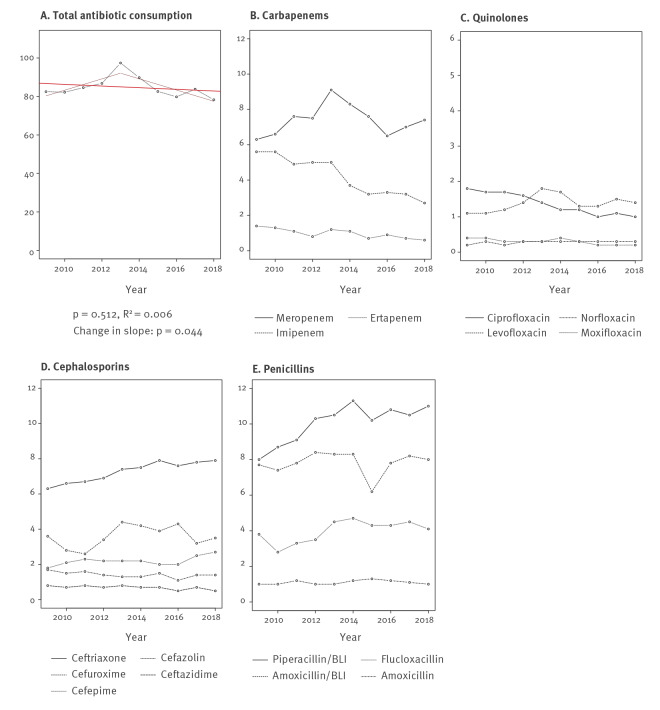
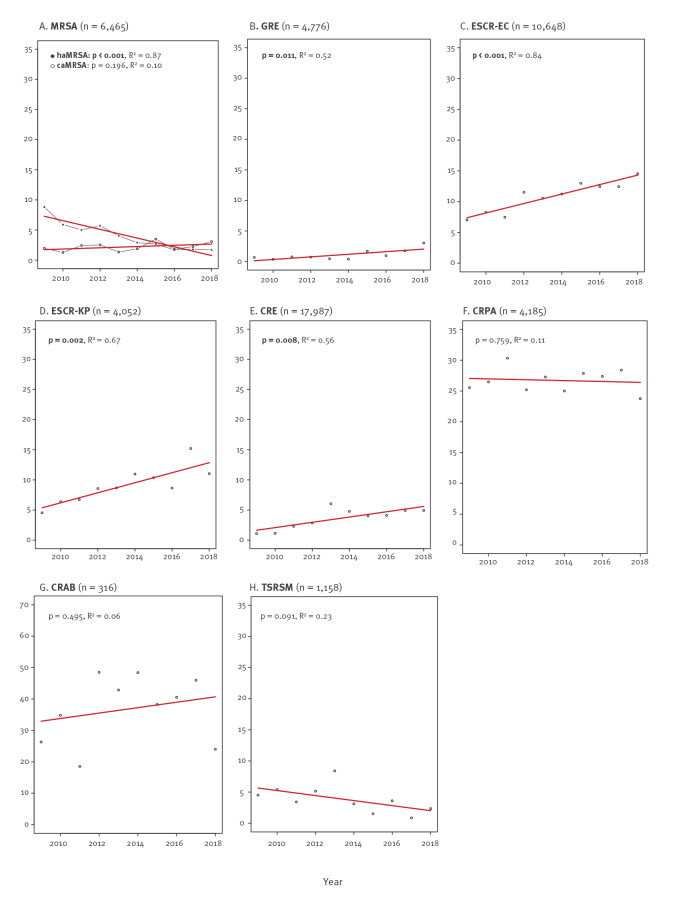
BackgroundIntensive care units (ICU) constitute a high-risk setting for antimicrobial resistance (AMR).AimWe aimed to describe secular AMR trends including meticillin-resistant (MRSA), glycopeptide-resistant (GRE), extended-spectrum cephalosporin-resistant (ESCR-EC) and (ESCR-KP), carbapenem-resistant (CRE) and (CRPA) from Swiss ICU. We assessed time trends of antibiotic consumption and identified factors associated with CRE and CRPA.MethodsWe analysed patient isolate and antibiotic consumption data of Swiss ICU sent to the Swiss Centre for Antibiotic Resistance (2009-2018). Time trends were assessed using linear logistic regression; a mixed-effects logistic regression was used to identify factors associated with CRE and CRPA.ResultsAmong 52 ICU, MRSA decreased from 14% to 6% (p = 0.005; n = 6,465); GRE increased from 1% to 3% (p = 0.011; n = 4,776). ESCR-EC and ESCR-KP increased from 7% to 15% (p < 0.001, n = 10,648) and 5% to 11% (p = 0.002; n = 4,052), respectively. CRE, mostly spp., increased from 1% to 5% (p = 0.008; n = 17,987); CRPA remained stable at 27% (p = 0.759; n = 4,185). Antibiotic consumption in 58 ICU increased from 2009 to 2013 (82.5 to 97.4 defined daily doses (DDD)/100 bed-days) and declined until 2018 (78.3 DDD/100 bed-days). Total institutional antibiotic consumption was associated with detection of CRE in multivariable analysis (odds ratio per DDD: 1.01; 95% confidence interval: 1.0-1.02; p = 0.004).DiscussionIn Swiss ICU, antibiotic-resistant have been steadily increasing over the last decade. The emergence of CRE, associated with institutional antibiotic consumption, is of particular concern and calls for reinforced surveillance and antibiotic stewardship in this setting.
背景
重症监护病房(ICU)是抗菌药物耐药性(AMR)的高风险环境。
目的
本研究旨在描述瑞士 ICU 中耐甲氧西林金黄色葡萄球菌(MRSA)、糖肽类耐药菌(GRE)、广谱头孢菌素耐药菌(ESCR-EC)和 ESCR-KP、碳青霉烯类耐药菌(CRE)和碳青霉烯类耐药肺炎克雷伯菌(CRPA)的耐药趋势。我们评估了抗生素消耗的时间趋势,并确定了与 CRE 和 CRPA 相关的因素。
方法
我们分析了瑞士抗微生物药物耐药性监测中心(Swiss Centre for Antibiotic Resistance)收到的瑞士 ICU 患者分离株和抗生素消耗数据(2009-2018 年)。使用线性逻辑回归评估时间趋势;使用混合效应逻辑回归确定与 CRE 和 CRPA 相关的因素。
结果
在 52 家 ICU 中,MRSA 从 14%降至 6%(p=0.005;n=6465);GRE 从 1%增至 3%(p=0.011;n=4776)。ESCR-EC 和 ESCR-KP 分别从 7%增至 15%(p<0.001,n=10648)和 5%增至 11%(p=0.002;n=4052)。CRE,主要是 spp.,从 1%增至 5%(p=0.008;n=17987);CRPA 保持在 27%(p=0.759;n=4185)。58 家 ICU 的抗生素消耗从 2009 年到 2013 年增加(82.5 至 97.4 日剂量/100 床日),并在 2018 年下降(78.3 日剂量/100 床日)。多变量分析显示,机构抗生素消耗与 CRE 的检出相关(每日剂量的优势比:1.01;95%置信区间:1.0-1.02;p=0.004)。
讨论
在瑞士 ICU 中,过去十年中,抗生素耐药菌一直在稳步增加。CRE 的出现与机构抗生素消耗有关,这令人特别关注,并呼吁在这种环境下加强监测和抗生素管理。