Breast Cancer Center, Hospital Zambrano Hellion TecSalud, Tecnologico de Monterrey, San Pedro Garza Garcia, Nuevo Leon, Mexico.
National Institute of Public Health, Center for Population Health Research, Cuernavaca, Mexico.
Eur J Cancer. 2022 Jan;160:243-260. doi: 10.1016/j.ejca.2021.10.014. Epub 2021 Oct 26.
Patients with cancer are considered a priority group for Severe Acute Respiratory Syndrome Coronavirus 2 (SARS-CoV-2) vaccination given their high risk of contracting severe Coronavirus Disease 2019 (COVID-19). However, limited data exist regarding the efficacy of immunisation in this population. In this study, we assess the immunologic response after COVID-19 vaccination of cancer versus non-cancer population.
PubMed, Cochrane Central Register of Controlled Trials (CENTRAL), and Web of Science databases were searched from 01st March 2020 through 12th August 12 2021. Primary end-points were anti-SARS-CoV-2 spike protein (S) immunoglobulin G (IgG) seroconversion rates, T-cell response, and documented SARS-CoV-2 infection after COVID-19 immunisation. Data were extracted following the Preferred Reporting Items for Systematic Reviews and Meta-analyses (PRISMA) guidelines. Overall effects were pooled using random-effects models.
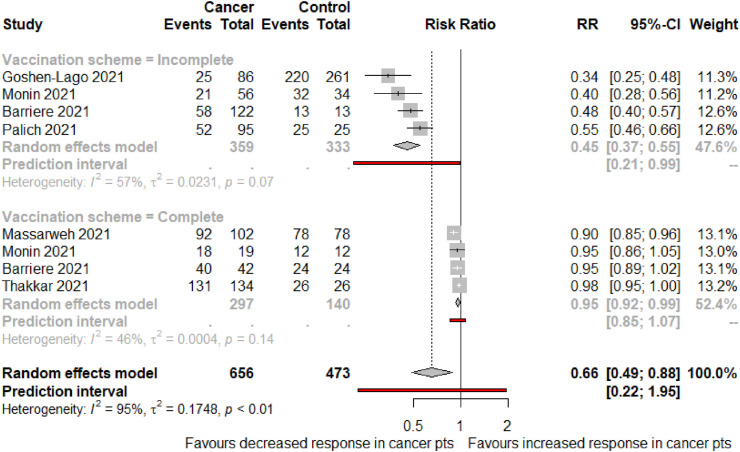
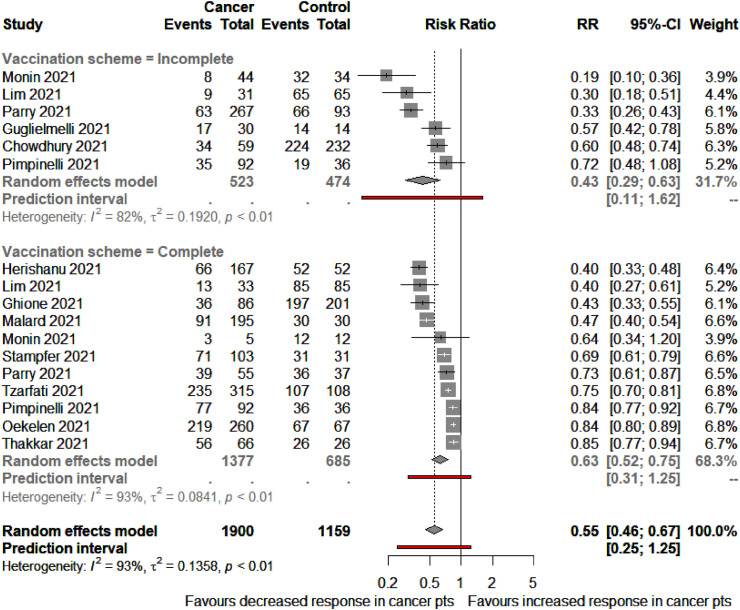
This systematic review and meta-analysis included 35 original studies. Overall, 51% (95% confidence interval [CI], 41-62) and 73% (95% CI, 64-81) of patients with cancer developed anti-S IgG above the threshold level after partial and complete immunisation, respectively. Patients with haematologic malignancies had a significantly lower seroconversion rate than those with solid tumours after complete immunisation (65% vs 94%; P < 0.0001). Compared with non-cancer controls, oncological patients were less likely to attain seroconversion after incomplete (risk ratio [RR] 0.45 [95% CI 0.35-0.58]) and complete (RR 0.69 [95% CI 0.56-0.84]) COVID-19 immunisation schemes. Patients with cancer had a higher likelihood of having a documented SARS-CoV-2 infection after partial (RR 3.21; 95% CI 0.35-29.04) and complete (RR 2.04; 95% CI 0.38-11.10) immunisation.
Patients with cancer have an impaired immune response to COVID-19 vaccination compared with controls. Strategies that endorse the completion of vaccination schemes are warranted. Future studies should aim to evaluate different approaches that enhance oncological patients' immune response.
由于癌症患者罹患严重 2019 冠状病毒病(COVID-19)的风险较高,因此被视为严重急性呼吸系统综合症冠状病毒 2(SARS-CoV-2)疫苗接种的优先群体。然而,关于该人群免疫接种的疗效数据有限。在这项研究中,我们评估了癌症患者与非癌症患者接种 COVID-19 疫苗后的免疫反应。
从 2020 年 3 月 1 日至 2021 年 8 月 12 日,我们在 PubMed、Cochrane 对照试验中心注册库(CENTRAL)和 Web of Science 数据库中进行了检索。主要终点为抗 SARS-CoV-2 刺突蛋白(S)免疫球蛋白 G(IgG)血清转化率、T 细胞反应和接种 COVID-19 疫苗后的 SARS-CoV-2 感染记录。研究数据按照系统评价和荟萃分析的 Preferred Reporting Items(PRISMA)指南进行提取。使用随机效应模型汇总总体效应。
这项系统评价和荟萃分析纳入了 35 项原始研究。总体而言,癌症患者分别有 51%(95%置信区间[CI],41-62)和 73%(95%CI,64-81)在部分和完全免疫接种后达到抗-S IgG 阈值水平。与实体肿瘤相比,血液恶性肿瘤患者在完全免疫接种后血清转化率显著较低(65%比 94%;P<0.0001)。与非癌症对照组相比,癌症患者在不完全(风险比[RR]0.45[95%CI0.35-0.58])和完全(RR0.69[95%CI0.56-0.84])COVID-19 免疫方案后更不可能达到血清转化率。与部分(RR3.21;95%CI0.35-29.04)和完全(RR2.04;95%CI0.38-11.10)免疫接种相比,癌症患者有更高的 SARS-CoV-2 感染记录。
与对照组相比,癌症患者对 COVID-19 疫苗接种的免疫反应受损。支持完成疫苗接种方案的策略是必要的。未来的研究应旨在评估增强癌症患者免疫反应的不同方法。