Department of Medical Oncology, University Medical Centre Groningen, University of Groningen, Groningen, Netherlands.
Department of Medical Oncology, Erasmus Medical Centre, Rotterdam, Netherlands; Department of Radiology and Nuclear Medicine, Erasmus Medical Centre, Rotterdam, Netherlands.
Lancet Oncol. 2021 Dec;22(12):1681-1691. doi: 10.1016/S1470-2045(21)00574-X. Epub 2021 Nov 9.
Patients with cancer have an increased risk of complications from SARS-CoV-2 infection. Vaccination to prevent COVID-19 is recommended, but data on the immunogenicity and safety of COVID-19 vaccines for patients with solid tumours receiving systemic cancer treatment are scarce. Therefore, we aimed to assess the impact of immunotherapy, chemotherapy, and chemoimmunotherapy on the immunogenicity and safety of the mRNA-1273 (Moderna Biotech, Madrid, Spain) COVID-19 vaccine as part of the Vaccination Against COVID in Cancer (VOICE) trial.
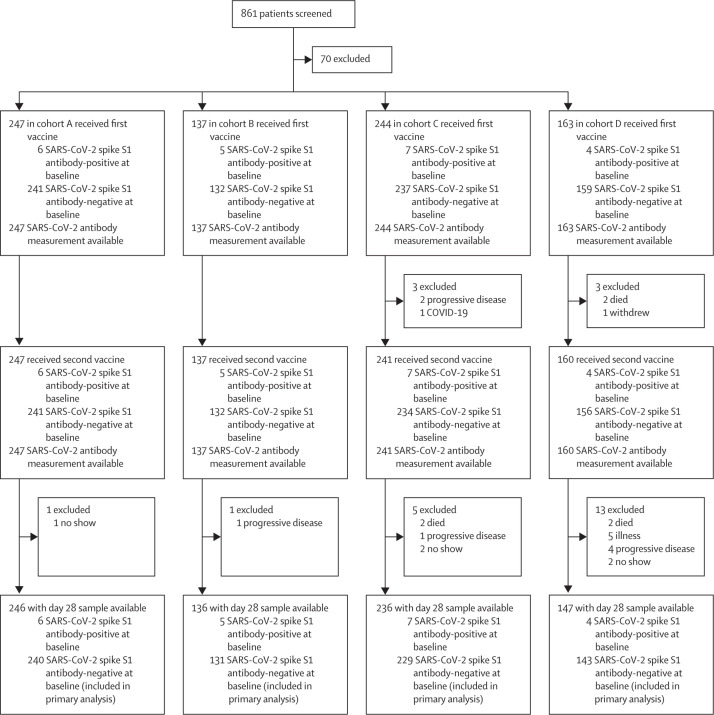
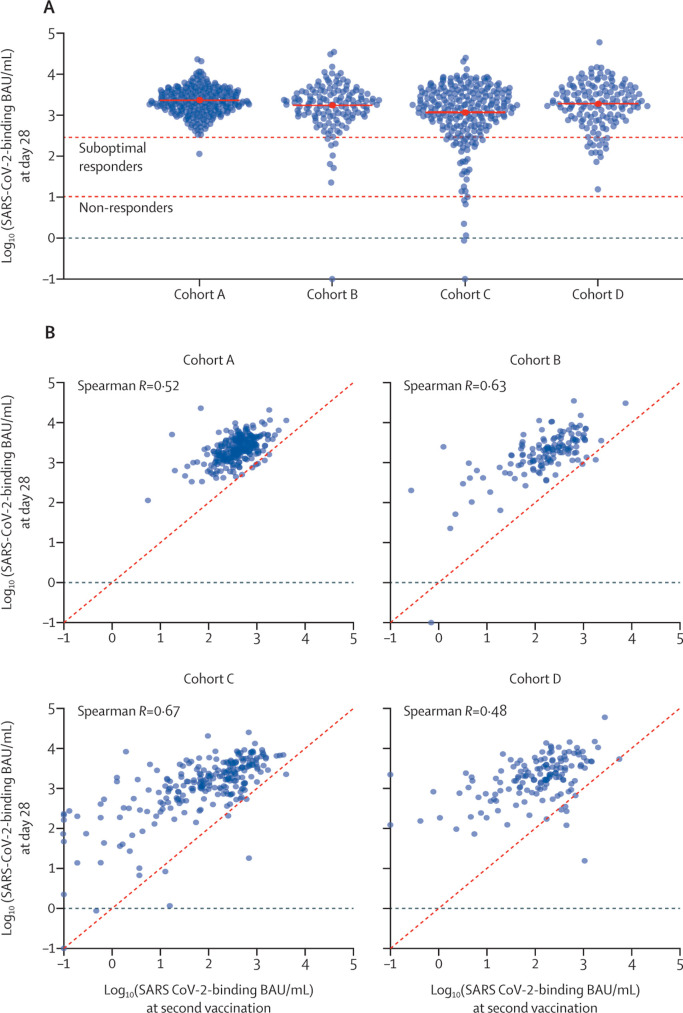
This prospective, multicentre, non-inferiority trial was done across three centres in the Netherlands. Individuals aged 18 years or older with a life expectancy of more than 12 months were enrolled into four cohorts: individuals without cancer (cohort A [control cohort]), and patients with solid tumours, regardless of stage and histology, treated with immunotherapy (cohort B), chemotherapy (cohort C), or chemoimmunotherapy (cohort D). Participants received two mRNA-1273 vaccinations of 100 μg in 0·5 mL intramuscularly, 28 days apart. The primary endpoint, analysed per protocol (excluding patients with a positive baseline sample [>10 binding antibody units (BAU)/mL], indicating previous SARS-CoV-2 infection), was defined as the SARS-CoV-2 spike S1-specific IgG serum antibody response (ie, SARS-CoV-2-binding antibody concentration of >10 BAU/mL) 28 days after the second vaccination. For the primary endpoint analysis, a non-inferiority design with a margin of 10% was used. We also assessed adverse events in all patients who received at least one vaccination, and recorded solicited adverse events in participants who received at least one vaccination but excluding those who already had seroconversion (>10 BAU/mL) at baseline. This study is ongoing and is registered with ClinicalTrials.gov, NCT04715438.
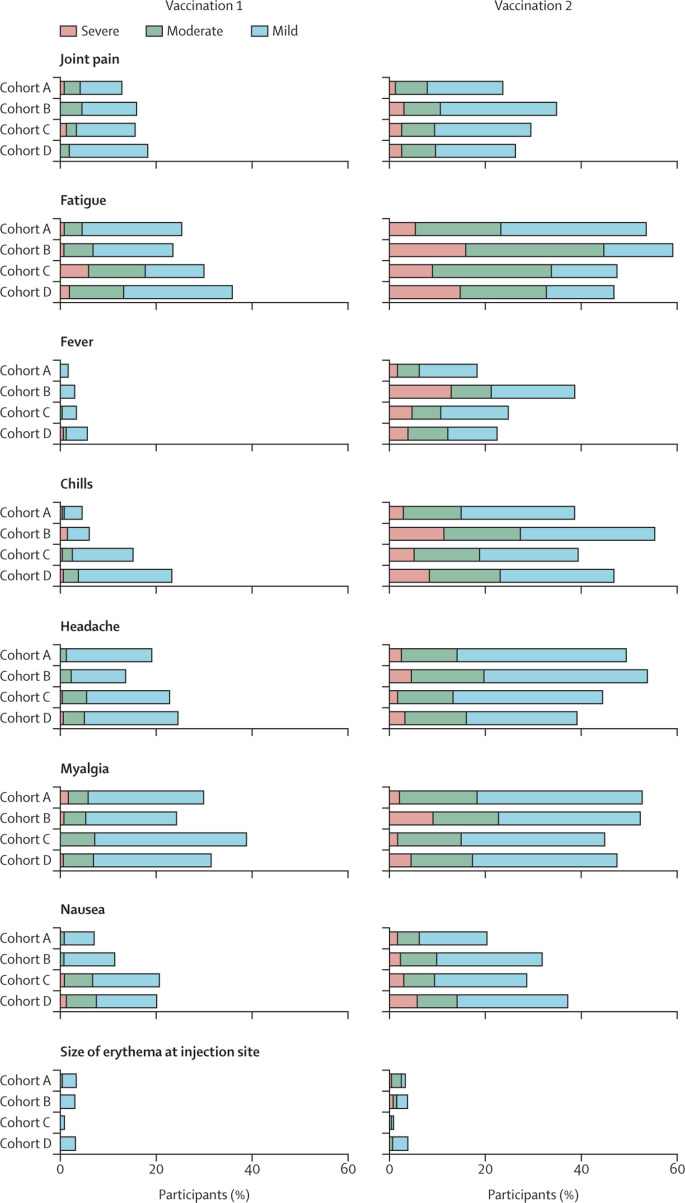
Between Feb 17 and March 12, 2021, 791 participants were enrolled and followed up for a median of 122 days (IQR 118 to 128). A SARS-CoV-2-binding antibody response was found in 240 (100%; 95% CI 98 to 100) of 240 evaluable participants in cohort A, 130 (99%; 96 to >99) of 131 evaluable patients in cohort B, 223 (97%; 94 to 99) of 229 evaluable patients in cohort C, and 143 (100%; 97 to 100) of 143 evaluable patients in cohort D. The SARS-CoV-2-binding antibody response in each patient cohort was non-inferior compared with cohort A. No new safety signals were observed. Grade 3 or worse serious adverse events occurred in no participants in cohort A, three (2%) of 137 patients in cohort B, six (2%) of 244 patients in cohort C, and one (1%) of 163 patients in cohort D, with four events (two of fever, and one each of diarrhoea and febrile neutropenia) potentially related to the vaccination. There were no vaccine-related deaths.
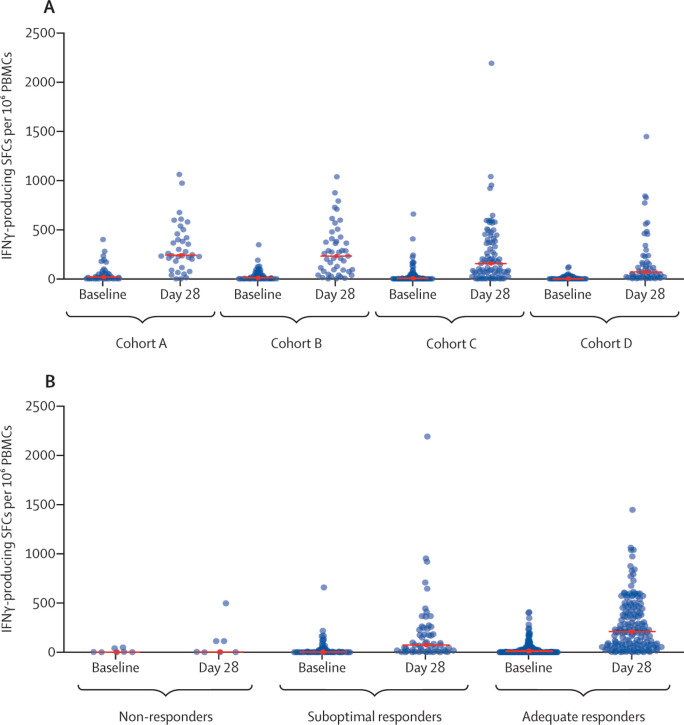
Most patients with cancer develop, while receiving chemotherapy, immunotherapy, or both for a solid tumour, an adequate antibody response to vaccination with the mRNA-1273 COVID-19 vaccine. The vaccine is also safe in these patients. The minority of patients with an inadequate response after two vaccinations might benefit from a third vaccination.
ZonMw, The Netherlands Organisation for Health Research and Development.
患有癌症的患者感染 SARS-CoV-2 后发生并发症的风险增加。建议接种疫苗以预防 COVID-19,但关于正在接受全身癌症治疗的实体瘤患者接种 COVID-19 疫苗的免疫原性和安全性的数据很少。因此,我们旨在评估免疫疗法、化疗和化疗免疫疗法对接受 mRNA-1273(马德里的 Moderna Biotech,西班牙)COVID-19 疫苗接种的免疫原性和安全性的影响,该疫苗是作为癌症患者疫苗接种(VOICE)试验的一部分。
这是一项在荷兰三个中心进行的前瞻性、多中心、非劣效性试验。招募了预期寿命超过 12 个月的年龄在 18 岁或以上的个体,分为四个队列:无癌症的个体(队列 A [对照队列]),以及无论分期和组织学如何,接受免疫治疗(队列 B)、化疗(队列 C)或化疗免疫治疗(队列 D)的实体瘤患者。参与者接受两次 100 μg 的肌肉内 mRNA-1273 疫苗接种,间隔 28 天。主要终点(排除基线时存在阳性样本[>10 个结合抗体单位(BAU)/mL]的患者,表明先前感染过 SARS-CoV-2)按方案(不包括具有>10 BAU/mL 的 SARS-CoV-2 刺突 S1 特异性 IgG 血清抗体反应(即 SARS-CoV-2 结合抗体浓度)的患者)进行定义,接种第二剂疫苗后 28 天。对于主要终点分析,采用了 10%的非劣效性设计。我们还评估了所有接受至少一次接种的患者的不良事件,并记录了至少接受一次接种但在基线时已发生血清转换(>10 BAU/mL)的参与者的不良反应。该研究正在进行中,并在 ClinicalTrials.gov 上注册,NCT04715438。
在 2021 年 2 月 17 日至 3 月 12 日期间,共招募了 791 名参与者,中位随访时间为 122 天(IQR 118-128)。在可评估的 240 名参与者(100%;95%CI 98-100)的队列 A、131 名可评估患者(99%;96-99)的队列 B、229 名可评估患者(97%;94-99)的队列 C 以及 143 名可评估患者(100%;97-100)的队列 D 中,均发现了 SARS-CoV-2 结合抗体反应。与队列 A 相比,每个患者队列的 SARS-CoV-2 结合抗体反应均非劣效。未观察到新的安全信号。在队列 A 中无 1 名参与者、队列 B 中 137 名患者(2%)、队列 C 中 244 名患者(2%)和队列 D 中 163 名患者(1%)发生 3 级或更严重的严重不良事件,其中 4 例事件(2 例发热,1 例腹泻,1 例发热性中性粒细胞减少症)可能与疫苗接种有关。没有疫苗相关死亡。
大多数正在接受化疗、免疫治疗或两者联合治疗实体瘤的癌症患者,对接受 mRNA-1273 COVID-19 疫苗接种产生了足够的抗体反应。该疫苗在这些患者中也是安全的。少数在两次接种后反应不足的患者可能受益于第三次接种。
ZonMw,荷兰健康研究与发展组织。