CONICET-IMCN, Instituto Y Museo de Ciencias Naturales-CIGEOBIO, Universidad Nacional de San Juan, Av. España 400 Norte, 5400, San Juan, Argentina.
CONICET-MEF, Museo Paleontológico Egidio Feruglio, Av. Fontana 140, Trelew, Chubut, Argentina.
Sci Rep. 2021 Nov 18;11(1):22534. doi: 10.1038/s41598-021-01120-w.
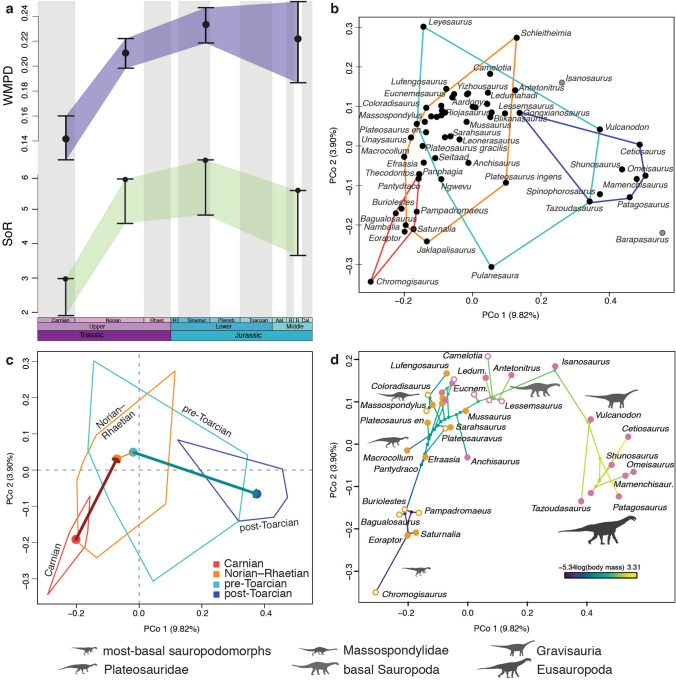
Sauropodomorph dinosaurs were the dominant medium to large-sized herbivores of most Mesozoic continental ecosystems, being characterized by their long necks and reaching a size unparalleled by other terrestrial animals (> 60 tonnes). Our study of morphological disparity across the entire skeleton shows that during the Late Triassic the oldest known sauropodomorphs occupied a small region of morphospace, subsequently diversifying both taxonomically and ecologically, and shifting to a different and broader region of the morphospace. After the Triassic-Jurassic boundary event, there are no substancial changes in sauropodomorph morphospace occupation. Almost all Jurassic sauropodomorph clades stem from ghost lineages that cross the Triassic-Jurassic boundary, indicating that variations after the extinction were more related to changes of pre-existing lineages (massospondylids, non-gravisaurian sauropodiforms) rather than the emergence of distinct clades or body plans. Modifications in the locomotion (bipedal to quadrupedal) and the successive increase in body mass seem to be the main attributes driving sauropodomorph morphospace distribution during the Late Triassic and earliest Jurassic. The extinction of all non-sauropod sauropodomorphs by the Toarcian and the subsequent diversification of gravisaurian sauropods represent a second expansion of the sauropodomorph morphospace, representing the onset of the flourishing of these megaherbivores that subsequently dominated in Middle and Late Jurassic terrestrial assemblages.
蜥脚形亚目恐龙是中生代大多数大陆生态系统中占主导地位的中大型草食动物,其特征是长脖子,体型之大无与伦比(超过 60 吨)。我们对整个骨骼形态差异的研究表明,在晚三叠世,最古老的蜥脚形亚目恐龙占据了形态空间的一小部分,随后在分类学和生态学上多样化,并转移到形态空间的不同和更广泛的区域。在三叠纪-侏罗纪边界事件之后,蜥脚形亚目恐龙的形态空间占据没有实质性变化。几乎所有的侏罗纪蜥脚形亚目恐龙都源自穿越三叠纪-侏罗纪边界的幽灵谱系,这表明灭绝后的变化更多地与现有谱系的变化(巨龙形类、非重力龙类蜥脚形类)有关,而不是独特谱系或身体计划的出现。运动方式(两足到四足)的改变和身体质量的连续增加似乎是驱动晚三叠世和早侏罗世蜥脚形亚目恐龙形态空间分布的主要因素。所有非蜥脚类蜥脚形亚目恐龙在托阿尔阶灭绝,随后重力龙类蜥脚形类的多样化代表了蜥脚形亚目恐龙形态空间的第二次扩张,标志着这些巨型草食动物的繁荣的开始,它们随后在中侏罗世和晚侏罗世的陆地组合中占据主导地位。