Cui Cathy K, Lewis Simon J G
ForeFront Parkinson's Disease Research Clinic, Brain and Mind Centre, School of Medical Sciences, The University of Sydney, Camperdown, NSW, Australia.
Front Hum Neurosci. 2021 Nov 2;15:741918. doi: 10.3389/fnhum.2021.741918. eCollection 2021.
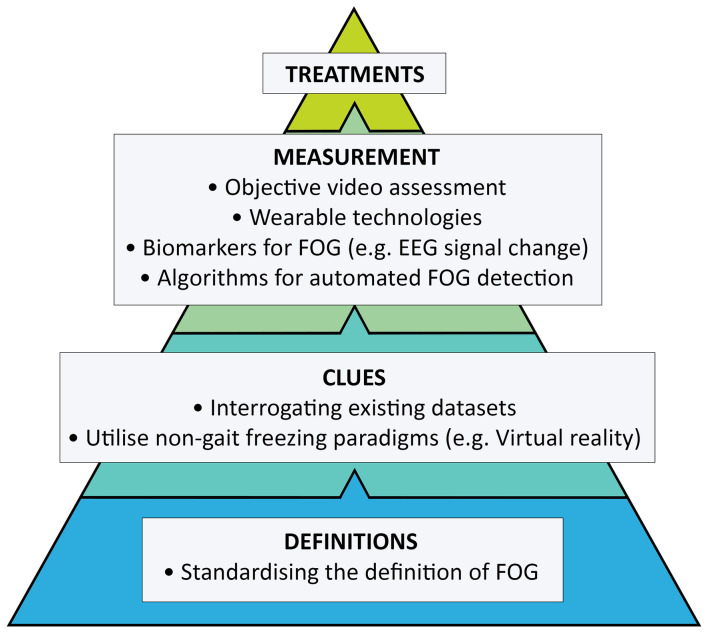
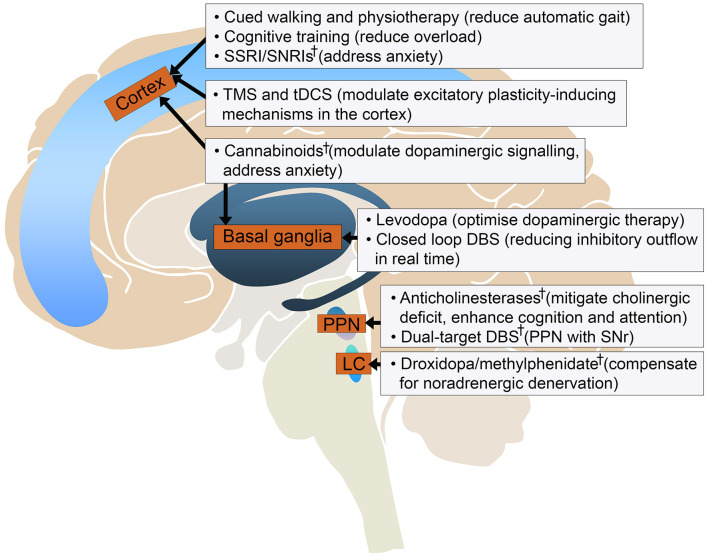
Freezing of gait (FOG) is a common and challenging clinical symptom in Parkinson's disease. In this review, we summarise the recent insights into freezing of gait and highlight the strategies that should be considered to improve future treatment. There is a need to develop individualised and on-demand therapies, through improved detection and wearable technologies. Whilst there already exist a number of pharmacological (e.g., dopaminergic and beyond dopamine), non-pharmacological (physiotherapy and cueing, cognitive training, and non-invasive brain stimulation) and surgical approaches to freezing (i.e., dual-site deep brain stimulation, closed-loop programming), an integrated collaborative approach to future research in this complex area will be necessary to systematically investigate new therapeutic avenues. A review of the literature suggests standardising how gait freezing is measured, enriching patient cohorts for preventative studies, and harnessing the power of existing data, could help lead to more effective treatments for freezing of gait and offer relief to many patients.
冻结步态(FOG)是帕金森病中一种常见且具有挑战性的临床症状。在本综述中,我们总结了对冻结步态的最新见解,并强调了改善未来治疗应考虑的策略。需要通过改进检测和可穿戴技术来开发个性化和按需治疗方法。虽然已经存在多种治疗冻结步态的方法,包括药理学方法(如多巴胺能及多巴胺以外的药物)、非药理学方法(物理治疗和提示、认知训练以及非侵入性脑刺激)和手术方法(即双部位深部脑刺激、闭环编程),但在这个复杂领域开展未来研究需要一种综合协作的方法,以便系统地研究新的治疗途径。文献综述表明,标准化步态冻结的测量方法、丰富用于预防性研究的患者队列以及利用现有数据的力量,有助于为冻结步态带来更有效的治疗方法,并为许多患者减轻痛苦。