Liu Miao, Liu Yu, Feng Hua, Jing Yixin, Zhao Shuang, Yang Shujia, Zhang Nan, Jin Shi, Li Yafei, Weng Mingjiao, Xue Xinzhu, Wang Fuya, Yang Yongheng, Jin Xiaoming, Kong Dan
Department of Pathology, Harbin Medical University, Harbin, China.
Department of Pathology, Beidahuang Industry Group General Hospital, Harbin, China.
Front Pharmacol. 2021 Nov 1;12:701487. doi: 10.3389/fphar.2021.701487. eCollection 2021.
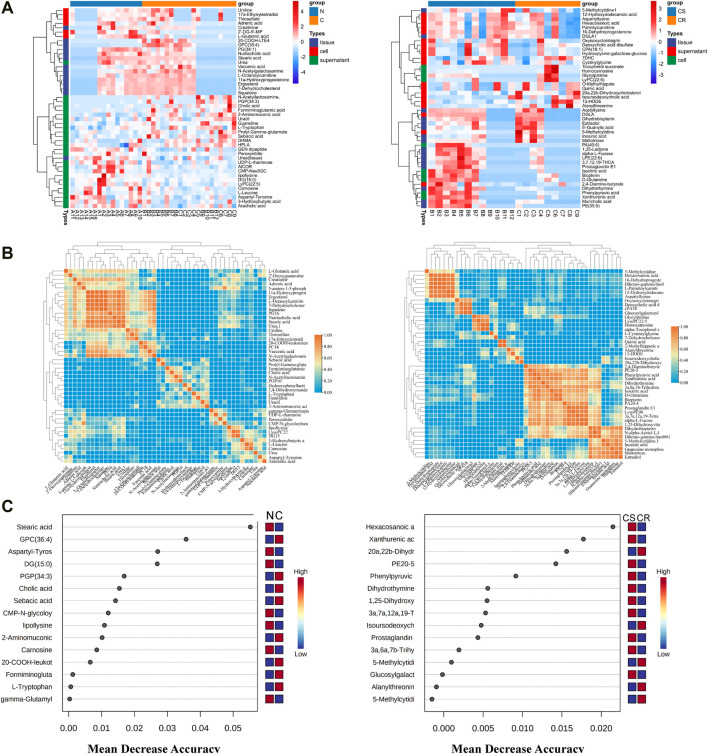
Tumor cells not only show a vigorous metabolic state, but also reflect the disease progression and prognosis from their metabolites. To judge the progress and prognosis of ovarian cancer is generally based on the formation of ascites, or whether there is ascites recurrence during chemotherapy after ovarian cancer surgery. To explore the relationship between the production of ascites and ovarian cancer tissue, metabolomics was used to screen differential metabolites in this study. The significant markers leading to ascites formation and chemoresistance were screened by analyzing their correlation with the formation of ascites in ovarian cancer and the clinical indicators of patients, and then provided a theoretical basis. The results revealed that nine differential metabolites were screened out from 37 ovarian cancer tissues and their ascites, among which seven differential metabolites were screened from 22 self-paired samples. Sebacic acid and 20-COOH-leukotriene E4 were negatively correlated with the high expression of serum CA125. Carnosine was positively correlated with the high expression of serum uric acid. Hexadecanoic acid was negatively correlated with the high expression of serum γ-GGT and HBDH. 20a,22b-Dihydroxycholesterol was positively correlated with serum alkaline phosphatase and γ-GGT. In the chemotherapy-sensitive and chemotherapy-resistant ovarian cancer tissues, the differential metabolite dihydrothymine was significantly reduced in the chemotherapy-resistant group. In the ascites supernatant of the drug-resistant group, the differential metabolites, 1,25-dihydroxyvitamins D3-26, 23-lactonel and hexadecanoic acid were also significantly reduced. The results indicated that the nine differential metabolites could reflect the prognosis and the extent of liver and kidney damage in patients with ovarian cancer. Three differential metabolites with low expression in the drug-resistant group were proposed as new markers of chemotherapy efficacy in ovarian cancer patients with ascites.
肿瘤细胞不仅呈现出旺盛的代谢状态,而且其代谢产物还能反映疾病的进展和预后。判断卵巢癌的进展和预后通常基于腹水的形成,或者卵巢癌手术后化疗期间是否有腹水复发。本研究采用代谢组学方法筛选卵巢癌组织与腹水之间的差异代谢物,以探讨腹水产生与卵巢癌组织的关系。通过分析这些差异代谢物与卵巢癌腹水形成及患者临床指标的相关性,筛选出导致腹水形成和化疗耐药的显著标志物,进而提供理论依据。结果显示,从37例卵巢癌组织及其腹水样本中筛选出9种差异代谢物,其中从22对自配对样本中筛选出7种差异代谢物。壬二酸和20-羧基白三烯E4与血清CA125高表达呈负相关。肌肽与血清尿酸高表达呈正相关。十六烷酸与血清γ-GGT和HBDH高表达呈负相关。20a,22b-二羟基胆固醇与血清碱性磷酸酶和γ-GGT呈正相关。在化疗敏感和化疗耐药的卵巢癌组织中,化疗耐药组的差异代谢物二氢胸腺嘧啶显著减少。在耐药组的腹水上清液中,差异代谢物1,25-二羟基维生素D3-26,23-内酯和十六烷酸也显著减少。结果表明,这9种差异代谢物可反映卵巢癌患者的预后以及肝肾损伤程度。提出3种在耐药组中低表达的差异代谢物作为卵巢癌腹水患者化疗疗效的新标志物。