Haidari Fatemeh, Shayesteh Forough, Mohammad-Shahi Majid, Jalali Mohammad-Taha, Ahmadi-Angali Kambiz
Department of Nutrition, Faculty of Paramedical Sciences, Nutrition and Metabolic Diseases Research Center, Ahvaz Jundishapur University of Medical sciences, Ahvaz 61357-15794, Iran.
Diabetes Research Center, Health Research Institute, Ahvaz Jundishapur University of Medical Sciences, Ahvaz 5794-61357, Iran.
Clin Nutr Res. 2021 Oct 31;10(4):314-329. doi: 10.7762/cnr.2021.10.4.314. eCollection 2021 Oct.
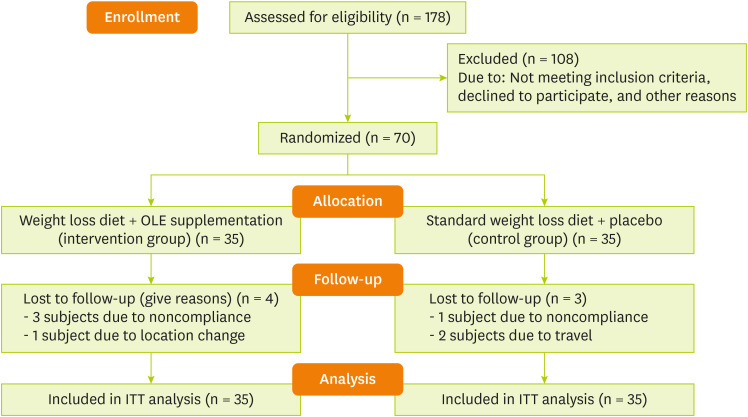
The present trial aims to evaluate a supplementation of the olive leaf extract (OLE) in adjunct with a weight loss diet on anthropometric indices, glycemic indices, lipid profile, as well as the level of adipokines, and free fatty acid in obese women. We carried out an 8-week randomized, placebo-controlled, double-blind, parallel-group, clinical trial. The participants were randomly stratified according to age and they were assigned to one of the two study groups: Standard weight loss diet (estimated daily energy requirements minus 500 kcal) + OLE supplementation (n = 35) in intervention group or Standard weight loss diet (estimated daily energy requirements minus 500 kcal) + placebo (n = 35) in placebo group. The study groups were homogeneous regarding the baseline age, height, weight, body mass index (BMI), waist circumferences, married status, and physical activity levels (p > 0.05). The results of analysis of covariance presented significant decreases in BMI, fat mass, and body weight in the OLE group compared to those in the placebo group (p < 0.05). At the end of the study, the serum levels of fasting blood sugar, insulin, low-density lipoprotein cholesterol, total cholesterol, leptin, fatty free acid, and homeostasis model assessment-insulin resistance significantly decreased, and serum levels of high-density lipoprotein cholesterol and adiponectin elevated in the intervention group (p < 0.05). Based on results it seems that the addition of OLE to a hypocaloric diet for 8-week compared with a hypocaloric diet alone may be more effective in modifying obesity and metabolic risk factors.
Iranian Registry of Clinical Trials Identifier: IRCT20190129042552N2.
本试验旨在评估在肥胖女性中,补充橄榄叶提取物(OLE)并结合减肥饮食对人体测量指标、血糖指标、血脂谱以及脂肪因子水平和游离脂肪酸的影响。我们进行了一项为期8周的随机、安慰剂对照、双盲、平行组临床试验。参与者根据年龄随机分层,并被分配到两个研究组之一:干预组为标准减肥饮食(估计每日能量需求减去500千卡)+ OLE补充剂(n = 35),安慰剂组为标准减肥饮食(估计每日能量需求减去500千卡)+ 安慰剂(n = 35)。两组在基线年龄、身高、体重、体重指数(BMI)、腰围、婚姻状况和身体活动水平方面具有同质性(p > 0.05)。协方差分析结果显示,与安慰剂组相比,OLE组的BMI、脂肪量和体重显著降低(p < 0.05)。在研究结束时,干预组的空腹血糖、胰岛素、低密度脂蛋白胆固醇、总胆固醇、瘦素、游离脂肪酸和稳态模型评估 - 胰岛素抵抗的血清水平显著降低,而高密度脂蛋白胆固醇和脂联素的血清水平升高(p < 0.05)。基于结果,与单独的低热量饮食相比,在低热量饮食中添加OLE 8周可能在改善肥胖和代谢危险因素方面更有效。
伊朗临床试验注册中心标识符:IRCT20190129042552N2。