Ferrari Davide, Siboni Stefano, Riva Carlo Galdino, Guerrazzi Guglielmo, Lovece Andrea, Bonavina Luigi
Division of General and Foregut Surgery, Department of Biomedical Sciences for Health, Istituto di Ricovero e Cura a Carattere Scientifico (IRCCS) Policlinico San Donato, University of Milan, Milan, Italy.
Front Med (Lausanne). 2021 Nov 2;8:645592. doi: 10.3389/fmed.2021.645592. eCollection 2021.
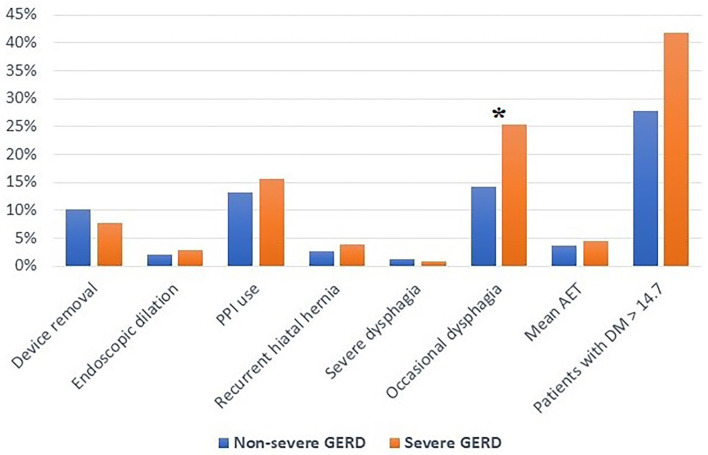
Outcomes of laparoscopic procedures for gastroesophageal reflux disease (GERD) are variable depending on surgical expertise and/or patient-related factors. Some procedures may be inadequate in patients with severe disease. Effectiveness of laparoscopic magnetic sphincter augmentation (MSA) has not been extensively tested in patients with severe disease. A prospectively collected database was analyzed to identify patients who underwent MSA at a single institution. Individuals who had previous esophago-gastric surgery were excluded. Severe GERD was defined as lower esophageal sphincter pressure <5 mmHg, distal esophageal amplitude <30 mmHg, Barrett's metaplasia, stricture or grade C-D esophagitis, and/or DeMeester score >50. Clinical characteristics and outcomes of patients with severe GERD were compared with those of patients with mild to moderate GERD who served as control group. Over the study period, a total of 336 patients met the inclusion criteria, and 102 (30.4%) had severe GERD. The median follow-up was 24 months (IQR = 75) in severe GERD patients and 32 months (IQR = 84) in those with non-severe GERD. Patients with severe GERD had a higher rate of dysphagia and higher GERD-HRQL scores. After the MSA procedure, symptoms, health-related quality of life scores, and proton-pump inhibitors consumption significantly decreased in both groups ( < 0.05). No difference between groups was found in the prevalence of severe post-operative dysphagia, the need for endoscopic dilation or device removal, and the DeMeester score. Laparoscopic MSA is safe and effective in reducing symptoms, PPI use, and esophageal acid exposure also in patients with severe GERD.
胃食管反流病(GERD)腹腔镜手术的结果因手术专业水平和/或患者相关因素而异。对于一些病情严重的患者,某些手术可能并不充分。腹腔镜磁括约肌增强术(MSA)在病情严重的患者中的有效性尚未得到广泛测试。对一个前瞻性收集的数据库进行分析,以确定在单一机构接受MSA手术的患者。排除既往有食管胃手术史的个体。严重GERD定义为食管下括约肌压力<5 mmHg、食管远端振幅<30 mmHg、巴雷特化生、狭窄或C-D级食管炎,和/或DeMeester评分>50。将严重GERD患者的临床特征和结果与作为对照组的轻至中度GERD患者进行比较。在研究期间,共有336例患者符合纳入标准,其中102例(30.4%)患有严重GERD。严重GERD患者的中位随访时间为24个月(IQR = 75),非严重GERD患者为32个月(IQR = 84)。严重GERD患者吞咽困难发生率较高,GERD-HRQL评分也较高。MSA手术后,两组患者的症状、健康相关生活质量评分和质子泵抑制剂的使用量均显著下降(<0.05)。两组在严重术后吞咽困难的发生率、内镜扩张或器械取出的必要性以及DeMeester评分方面均未发现差异。腹腔镜MSA在减轻严重GERD患者症状、减少PPI使用和食管酸暴露方面也是安全有效的。