Kishida Kohei, Tsuda Masami, Waite Polly, Creswell Cathy, Ishikawa Shin-Ichi
Faculty of Psychology, Doshisha University, Kyoto, Japan; Organization for Research Initiatives and Development, Doshisha University, Kyoto, Japan.
Graduate School of Psychology, Doshisha University, Kyoto, Japan.
Psychiatry Res. 2021 Dec;306:114276. doi: 10.1016/j.psychres.2021.114276. Epub 2021 Nov 8.
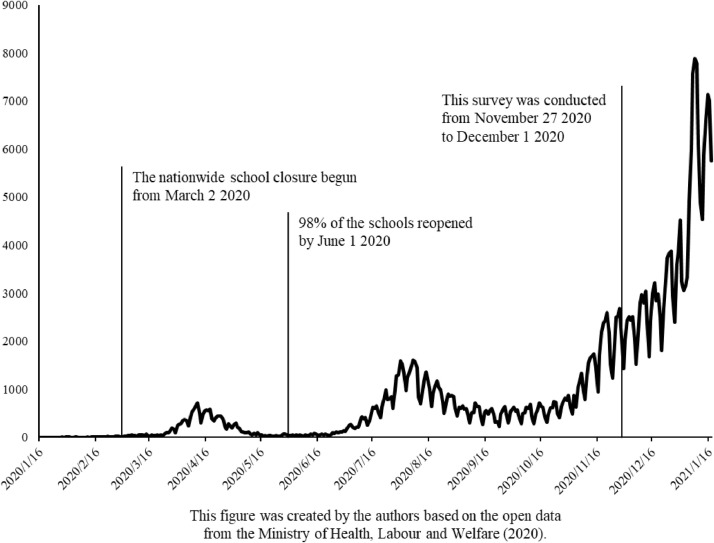
The widespread impacts of COVID-19 have affected both child and parent mental health worldwide. This study aimed to investigate the relationship between school closures due to COVID-19 and child and parent mental health in Japan. A sample of 1,984 Japanese parents with children and adolescents aged 6-15 years participated. The parents responded to online questionnaires about their own mental health and that of their children cross-sectionally. Participants were divided into three school situations based on the past week: full school closure, partial school closure, and full school open. Results indicated that 2.02% (n = 40) of the participants were in full school closure and 5.95% (n = 118) of the participants were in partial school closure. The results indicated that, after controlling for other variables regarding the pandemic, full school closure was associated with much higher scores in both child and parent mental health problems compared to full school open. Moderately higher scores were found only for anxiety symptoms in both children and parents under partial school closure compared to where schools were fully open. Consideration of the needs of families is necessary in the context of both full and partial school closures to prevent deteriorating mental health.
新冠疫情的广泛影响已波及全球儿童和家长的心理健康。本研究旨在调查日本因新冠疫情导致学校停课与儿童及家长心理健康之间的关系。共有1984名育有6至15岁子女的日本家长参与了此次研究。家长们通过在线问卷对自己及子女的心理健康状况进行了横断面调查。根据过去一周的学校情况,参与者被分为三种类型:学校完全关闭、部分关闭和完全开放。结果显示,2.02%(n = 40)的参与者所在学校完全关闭,5.95%(n = 118)的参与者所在学校部分关闭。结果表明,在控制了与疫情相关的其他变量后,与学校完全开放相比,学校完全关闭与儿童和家长心理健康问题的得分均显著更高。与学校完全开放相比,仅在学校部分关闭的情况下,儿童和家长的焦虑症状得分略有升高。在学校完全关闭和部分关闭的情况下,都有必要考虑家庭的需求,以防止心理健康状况恶化。