Department of Biostatistics, The University of Texas MD Anderson Cancer Center, Houston, Texas, USA.
Insitro, South San Francisco, California, USA.
J Immunother Cancer. 2021 Nov;9(11). doi: 10.1136/jitc-2021-003323.
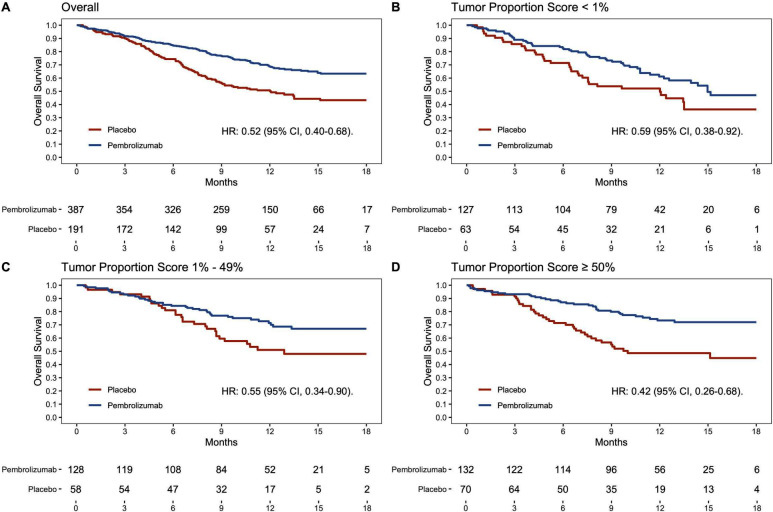
In a comparative oncology study with progression-free or overall survival as the endpoint, the primary or key secondary analysis is routinely stratified by patients' baseline characteristics when evaluating the treatment difference. The validity of a conventional strategy such as a stratified HR analysis depends on stringent model assumptions that are unlikely to be met in practice, especially in immunotherapy studies. Thus, the resulting summary is generally neither valid nor interpretable. This article discusses issues with conventional stratified analyses and presents alternatives using data from KEYNOTE-189, a recent immunotherapy trial for treating patients with metastatic, non-squamous, non-small-cell lung cancer.
在以无进展生存期或总生存期为终点的肿瘤比较研究中,当评估治疗差异时,通常根据患者的基线特征对主要或关键次要分析进行分层。传统策略(如分层 HR 分析)的有效性取决于严格的模型假设,而这些假设在实践中不太可能得到满足,尤其是在免疫治疗研究中。因此,得到的总结通常既无效也不可解释。本文讨论了传统分层分析存在的问题,并使用 KEYNOTE-189 (最近的免疫治疗试验,用于治疗转移性非鳞状非小细胞肺癌患者)的数据提出了替代方法。