Department of Hematology, Launceston General Hospital, WP Holman Clinic, Level 1. PO Box 1963, Launceston, Tasmania, Australia.
Crit Rev Oncol Hematol. 2021 Dec;168:103529. doi: 10.1016/j.critrevonc.2021.103529. Epub 2021 Nov 17.
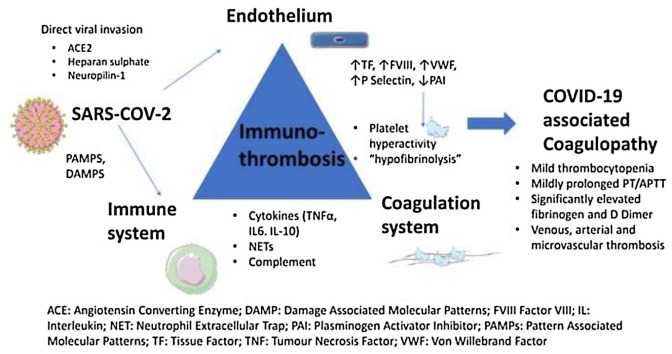
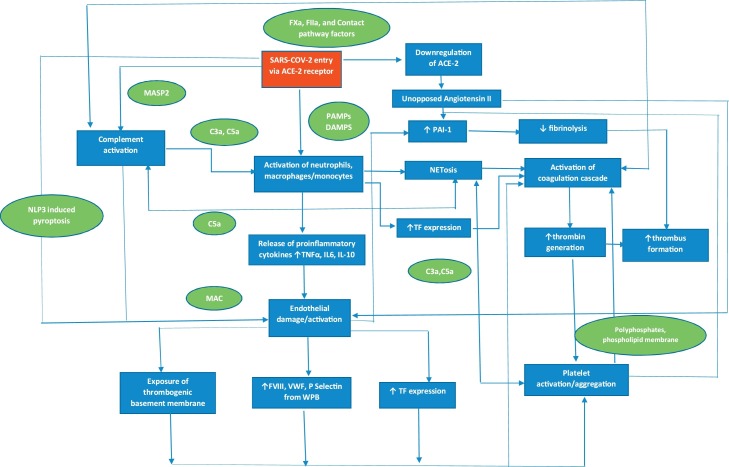
The coagulopathy of COVID-19 is characterised by significantly elevated D Dimer and fibrinogen, mild thrombocytopenia and a mildly prolonged PT/APTT. A high incidence of thrombotic complications occurs despite standard thromboprophylaxis. The evidence to date supports immunothrombosis as the underlying mechanism for this coagulopathy which is triggered by a hyperinflammatory response and endotheliopathy. A hypercoagulable state results from endothelial damage/activation, complement activation, platelet hyperactivity, release of Extracellular Neutrophil Traps, activation of the coagulation system and a "hypofibrinolytic" state. Significant cross-talk occurs between the innate/adaptive immune system, endothelium and the coagulation system. D dimer has been shown to be the most reliable predictor of disease severity, thrombosis, and overall survival. In this context, targeting pathways upstream of coagulation using novel or repurposed drugs alone or in combination with other anti-thrombotic agents may be a rational approach to prevent the mortality/morbidity due to COVID-19 associated coagulopathy.
COVID-19 的凝血功能障碍表现为 D-二聚体和纤维蛋白原显著升高,血小板轻度减少,PT/APTT 轻度延长。尽管采用了标准的血栓预防措施,但仍会发生很高的血栓并发症发生率。目前的证据支持免疫性血栓形成是这种凝血功能障碍的潜在机制,这种凝血功能障碍是由过度炎症反应和血管内皮病变引发的。内皮损伤/激活、补体激活、血小板过度活跃、细胞外中性粒细胞陷阱的释放、凝血系统的激活以及“低纤维蛋白溶解”状态导致高凝状态。先天/适应性免疫系统、内皮细胞和凝血系统之间存在显著的相互作用。D-二聚体已被证明是预测疾病严重程度、血栓形成和总体生存率的最可靠指标。在这种情况下,使用新型或重新定位的药物单独或与其他抗血栓药物联合靶向凝血上游途径可能是预防 COVID-19 相关凝血功能障碍导致的死亡率/发病率的合理方法。