
(-)-T-杜松醇——一种从杨柳科植物中分离出的倍半萜烯——具有活性并导致[具体细胞名称]膜电位超极化。 (注:原文中括号处信息不完整,翻译时根据语境补充了“杨柳科植物”和“[具体细胞名称]”)
(-)-T-Cadinol-a Sesquiterpene Isolated From (Salicaceae)-Displayed Activity and Causes Hyperpolarization of the Membrane Potential of .
作者信息
Dos Santos Augusto L, Amaral Maiara, Hasegawa Flavia Rie, Lago João Henrique G, Tempone Andre G, Sartorelli Patricia
机构信息
Instituto de Ciências Ambientais, Químicas e Farmacêuticas, Universidade Federal de São Paulo, Diadema, Brazil.
Centro de Parasitologia e Micologia, Instituto Adolfo Lutz, Santo André, Brazil.
出版信息
Front Pharmacol. 2021 Nov 3;12:734127. doi: 10.3389/fphar.2021.734127. eCollection 2021.
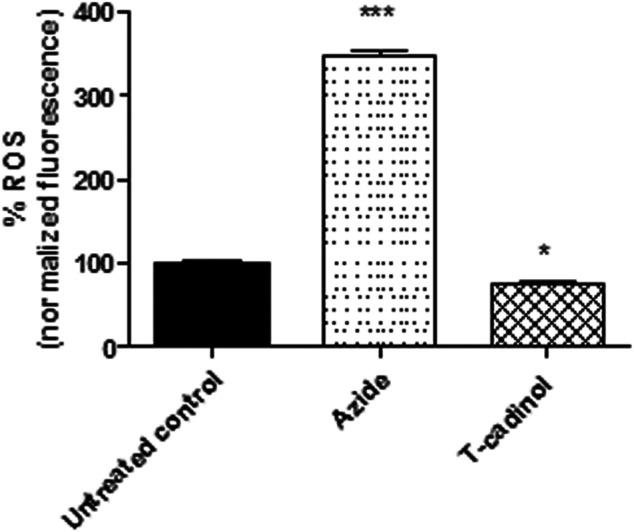
Chagas disease is caused by the protozoan parasite and affects 6-8 million people worldwide, mainly from developing countries. The treatment is limited to two approved nitro-derivatives, nifurtimox and benznidazole, with several side effects and reduced efficacy. has been used in folk medicine as an antiseptic and cicatrizing in skin diseases. In the present work, the hexane phase from the MeOH extract from the leaves of afforded a fraction composed by the sesquiterpene T-cadinol, which was chemically characterized by NMR and HRMS. The activity of T-cadinol was evaluated against , and IC values of 18 (trypomastigotes) and 15 (amastigotes) µM were established. The relation between the mammalian toxicity and the antiparasitic activity resulted in a selectivity index >12. Based on this promising activity, the mechanism of action was investigated by different approaches using fluorescent-based techniques such as plasma membrane permeability, plasma membrane electric potential, mitochondrial membrane electric potential, reactive oxygen species, and the intracellular calcium (Ca) levels. The obtained results demonstrated that T-cadinol affected neither the parasite plasma membrane nor the electric potential of the membrane. Nevertheless, this compound induced a mitochondrial impairment, resulting in a hyperpolarization of the membrane potential, with decreased levels of reactive oxygen species. No alterations in Ca levels were observed, suggesting that T-cadinol may affect the single mitochondria of the parasite. This is the first report about the occurrence of T-cadinol in , and our data suggest this sesquiterpene as an interesting hit compound for future optimizations in drug discovery studies for Chagas disease.
恰加斯病由原生动物寄生虫引起,全球约600万至800万人受其影响,主要来自发展中国家。治疗方法仅限于两种已获批的硝基衍生物,即硝呋替莫和苯硝唑,它们有多种副作用且疗效降低。[某种植物]在民间医学中一直被用作防腐剂及治疗皮肤病的促进愈合剂。在本研究中,[某种植物]叶片甲醇提取物的己烷相得到了一个由倍半萜T - 杜松醇组成的馏分,通过核磁共振(NMR)和高分辨质谱(HRMS)对其进行了化学表征。评估了T - 杜松醇对[某种寄生虫]的活性,确定其对滋养体的半数抑制浓度(IC)值为18 μM,对无鞭毛体为15 μM。哺乳动物毒性与抗寄生虫活性之间的关系导致选择性指数大于12。基于这种有前景的活性,采用基于荧光的技术,如质膜通透性、质膜电位、线粒体膜电位、活性氧物种和细胞内钙(Ca)水平等不同方法研究了其作用机制。所得结果表明,T - 杜松醇既不影响寄生虫的质膜,也不影响膜电位。然而,该化合物会导致线粒体损伤,导致膜电位超极化,活性氧物种水平降低。未观察到钙水平的变化,这表明T - 杜松醇可能影响寄生虫的单个线粒体。这是关于T - 杜松醇在[某种植物]中存在的首次报道,我们的数据表明这种倍半萜是恰加斯病药物发现研究中未来优化的一个有吸引力的先导化合物。


 Zotero 插件