Resente Giulia, Gillert Alexander, Trouillier Mario, Anadon-Rosell Alba, Peters Richard L, von Arx Georg, von Lukas Uwe, Wilmking Martin
Institute of Botany and Landscape Ecology, Ernst Moritz Arndt University Greifswald, Greifswald, Germany.
Fraunhofer-Institut für Graphische Datenverarbeitung IGD, Rostock, Germany.
Front Plant Sci. 2021 Nov 4;12:767400. doi: 10.3389/fpls.2021.767400. eCollection 2021.
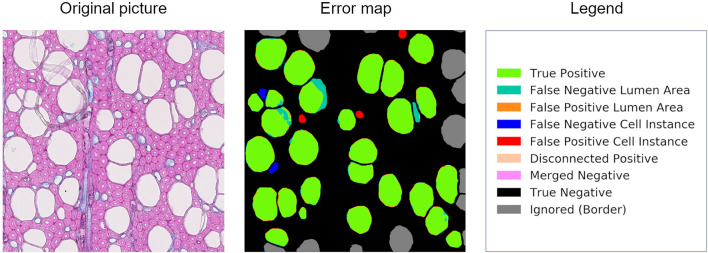
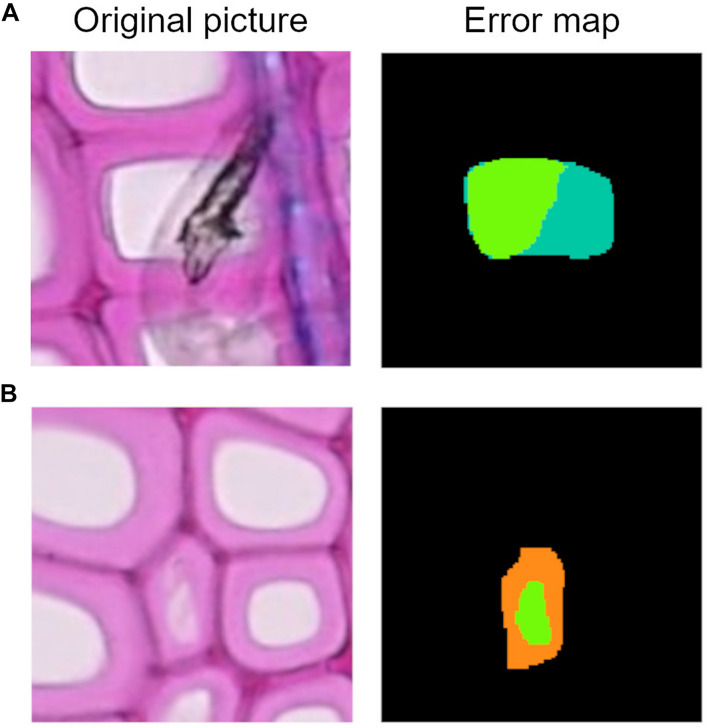
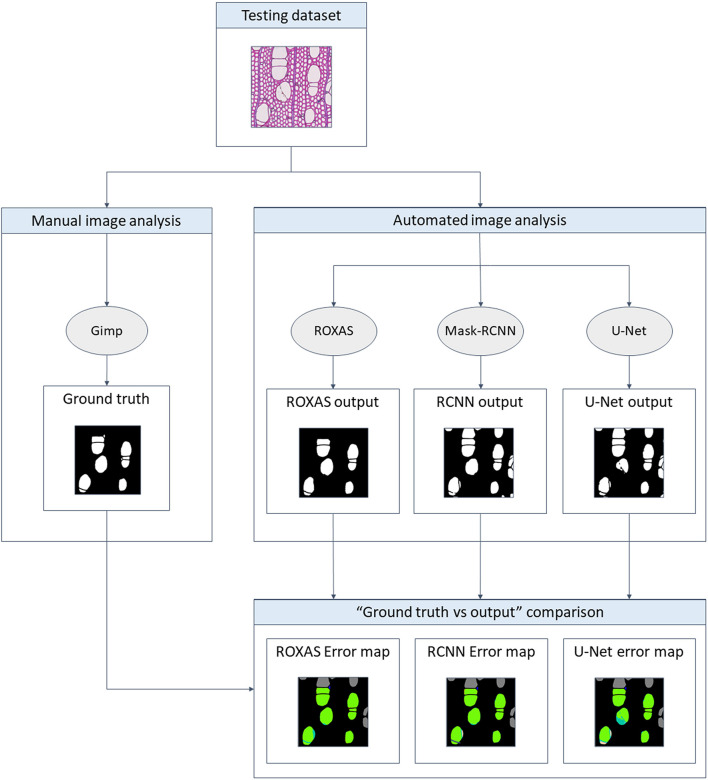
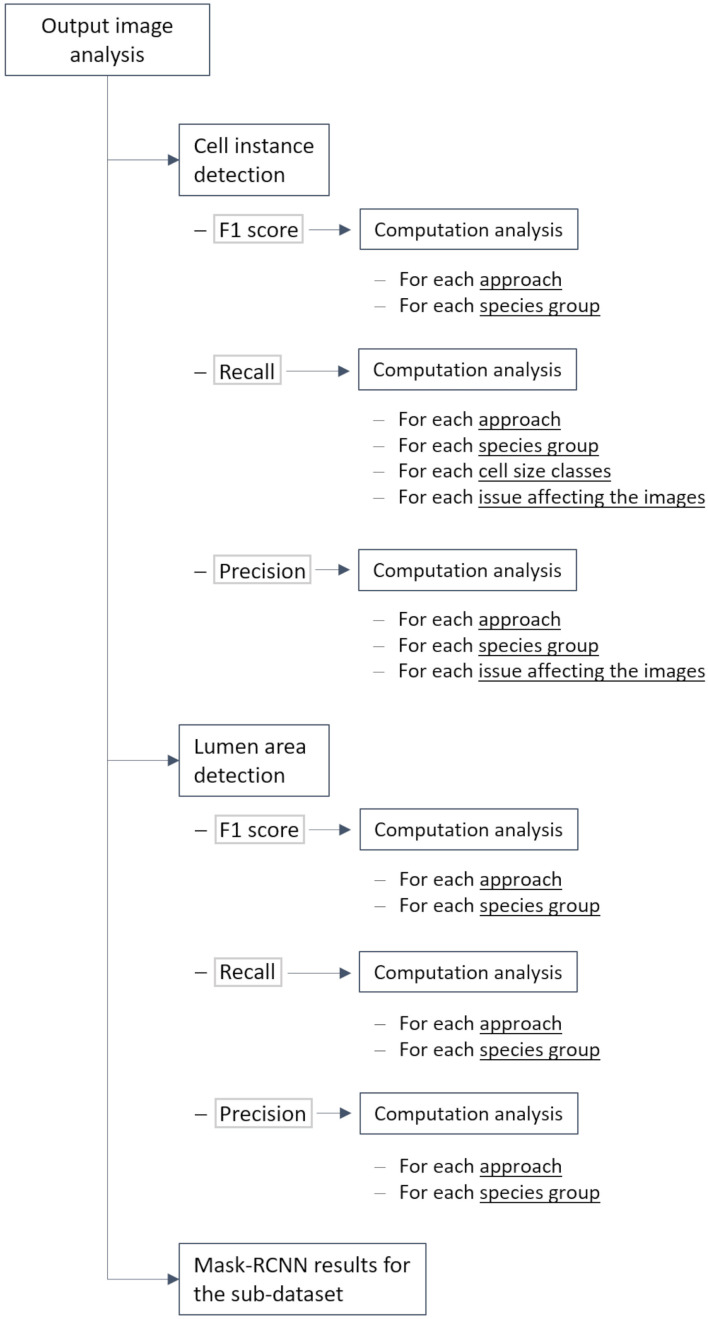
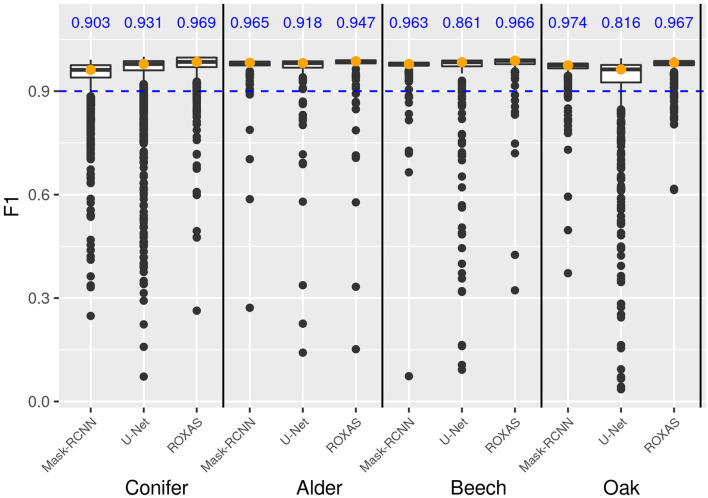
The recent developments in artificial intelligence have the potential to facilitate new research methods in ecology. Especially Deep Convolutional Neural Networks (DCNNs) have been shown to outperform other approaches in automatic image analyses. Here we apply a DCNN to facilitate quantitative wood anatomical (QWA) analyses, where the main challenges reside in the detection of a high number of cells, in the intrinsic variability of wood anatomical features, and in the sample quality. To properly classify and interpret features within the images, DCNNs need to undergo a training stage. We performed the training with images from transversal wood anatomical sections, together with manually created optimal outputs of the target cell areas. The target species included an example for the most common wood anatomical structures: four conifer species; a diffuse-porous species, black alder ( L.); a diffuse to semi-diffuse-porous species, European beech ( L.); and a ring-porous species, sessile oak ( Liebl.). The DCNN was created in Python with Pytorch, and relies on a Mask-RCNN architecture. The developed algorithm detects and segments cells, and provides information on the measurement accuracy. To evaluate the performance of this tool we compared our Mask-RCNN outputs with U-Net, a model architecture employed in a similar study, and with ROXAS, a program based on traditional image analysis techniques. First, we evaluated how many target cells were correctly recognized. Next, we assessed the cell measurement accuracy by evaluating the number of pixels that were correctly assigned to each target cell. Overall, the "learning process" defining artificial intelligence plays a key role in overcoming the issues that are usually manually solved in QWA analyses. Mask-RCNN is the model that better detects which are the features characterizing a target cell when these issues occur. In general, U-Net did not attain the other algorithms' performance, while ROXAS performed best for conifers, and Mask-RCNN showed the highest accuracy in detecting target cells and segmenting lumen areas of angiosperms. Our research demonstrates that future software tools for QWA analyses would greatly benefit from using DCNNs, saving time during the analysis phase, and providing a flexible approach that allows model retraining.
人工智能的最新发展有可能推动生态学新研究方法的发展。特别是深度卷积神经网络(DCNN)已被证明在自动图像分析方面优于其他方法。在此,我们应用DCNN来促进定量木材解剖学(QWA)分析,其中主要挑战在于大量细胞的检测、木材解剖特征的内在变异性以及样本质量。为了正确分类和解释图像中的特征,DCNN需要经历一个训练阶段。我们使用横向木材解剖切片的图像以及手动创建的目标细胞区域的最佳输出进行训练。目标物种包括最常见木材解剖结构的示例:四种针叶树物种;一种散孔材物种,黑桤木(L.);一种散孔至半散孔材物种,欧洲山毛榉(L.);以及一种环孔材物种,无梗花栎(Liebl.)。DCNN是用Python和Pytorch创建的,依赖于Mask - RCNN架构。所开发的算法可检测和分割细胞,并提供测量精度信息。为了评估该工具的性能,我们将Mask - RCNN的输出与U - Net(一项类似研究中使用的模型架构)以及ROXAS(一个基于传统图像分析技术的程序)进行了比较。首先,我们评估了正确识别的目标细胞数量。接下来,我们通过评估正确分配给每个目标细胞的像素数量来评估细胞测量精度。总体而言,定义人工智能的“学习过程”在克服QWA分析中通常手动解决的问题方面发挥着关键作用。当出现这些问题时,Mask - RCNN是能更好地检测出表征目标细胞特征的模型。一般来说,U - Net未达到其他算法的性能,而ROXAS在针叶树方面表现最佳,Mask - RCNN在检测目标细胞和分割被子植物的管腔区域方面显示出最高的准确性。我们的研究表明,未来用于QWA分析的软件工具将极大地受益于使用DCNN,在分析阶段节省时间,并提供一种允许模型重新训练的灵活方法。