Babin Lise, Cormier Isabelle, Champagne Sylvie, MacIntosh Jason, Saucier Dany, Thibault Véronique, Barrieau André, Bélanger Mathieu
Université de Sherbrooke, Québec, Canada.
Vitalité Health Network, New Brunswick, Canada.
Can Med Educ J. 2021 Nov 1;12(5):40-47. doi: 10.36834/cmej.70991. eCollection 2021 Nov.
Although participation of patients is essential for completing the training of medical residents, little is known about the relationships among patients' level of knowledge about the role and responsibilities of medical residents, their confidence in residents' abilities, and their acceptance toward receiving care from residents. The study sought to clarify if and how these three patient-resident relationship components are interrelated.
This is a cross-sectional study using a self-administered questionnaire distributed in 2016 to a convenience sample of adult patients (≥ 18 years old) visiting a family medicine teaching clinic. Proportions and chi-square statistics were used to describe and compare groups, respectively.
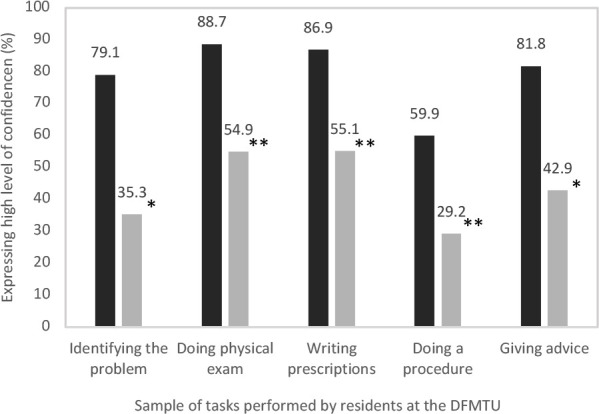
Of the 471 patients who answered the questionnaire, only 28% were found to be knowledgeable about the role of family medicine residents. Between 54% and 83% of patients reported being highly confident in the ability of residents to perform five routine tasks. Of the patients surveyed, 69% agreed to see a resident during their next appointments. Patients with a high level of confidence in residents' abilities were more likely to agree to see a resident during future appointments (p <0.0001). There was no significant association between level of knowledge and either confidence or acceptance.
Although the majority of patients had poor knowledge about the role of residents, this was not related to their acceptance of being cared for by residents. A higher level of confidence in residents' ability to perform certain tasks was associated with greater acceptance toward seeing a resident during future appointments.
尽管患者的参与对于完成住院医师培训至关重要,但对于患者对住院医师角色和职责的了解程度、对住院医师能力的信心以及对接受住院医师治疗的接受度之间的关系,我们知之甚少。本研究旨在阐明这三个医患关系组成部分是否以及如何相互关联。
这是一项横断面研究,于2016年使用自填式问卷对前来家庭医学教学诊所就诊的成年患者(≥18岁)的便利样本进行调查。分别使用比例和卡方统计来描述和比较各组。
在471名回答问卷的患者中,只有28%的患者了解家庭医学住院医师的角色。54%至83%的患者表示对住院医师执行五项常规任务的能力高度自信。在接受调查的患者中,69%的患者同意下次就诊时由住院医师诊治。对住院医师能力高度自信的患者更有可能同意在未来就诊时由住院医师诊治(p<0.0001)。了解程度与信心或接受度之间均无显著关联。
尽管大多数患者对住院医师的角色了解不足,但这与他们接受住院医师治疗无关。对住院医师执行某些任务的能力有更高的信心与未来就诊时更愿意接受住院医师诊治相关。