Engstrom Tyler, Clinger Jonathan A, Spoth Katherine A, Clarke Oliver B, Closs David S, Jayne Richard, Apker Benjamin A, Thorne Robert E
MiTeGen, LLC, PO Box 3867, Ithaca, NY 14850-3867, USA.
Physics Department, Cornell University, Ithaca, NY 14853, USA.
IUCrJ. 2021 Sep 7;8(Pt 6):867-877. doi: 10.1107/S2052252521008095. eCollection 2021 Nov 1.
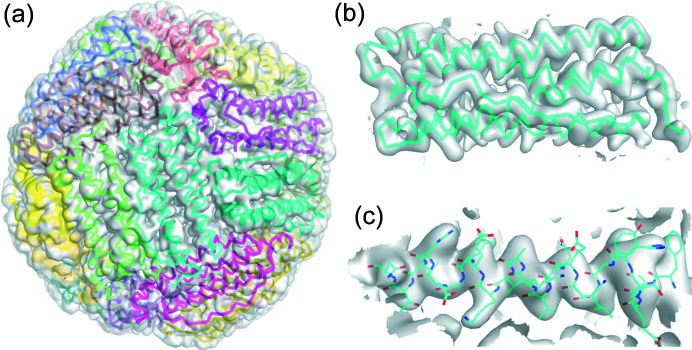
Based on work by Dubochet and others in the 1980s and 1990s, samples for single-particle cryo-electron microscopy (cryo-EM) have been vitrified using ethane, propane or ethane/propane mixtures. These liquid cryogens have a large difference between their melting and boiling temperatures and so can absorb substantial heat without formation of an insulating vapor layer adjacent to a cooling sample. However, ethane and propane are flammable, they must be liquified in liquid nitro-gen immediately before cryo-EM sample preparation, and cryocooled samples must be transferred to liquid nitro-gen for storage, complicating workflows and increasing the chance of sample damage during handling. Experiments over the last 15 years have shown that cooling rates required to vitrify pure water are only ∼250 000 K s, at the low end of earlier estimates, and that the dominant factor that has limited cooling rates of small samples in liquid nitro-gen is sample precooling in cold gas present above the liquid cryogen surface, not the Leidenfrost effect. Using an automated cryocooling instrument developed for cryocrystallography that combines high plunge speeds with efficient removal of cold gas, we show that single-particle cryo-EM samples on commercial grids can be routinely vitrified using only boiling nitro-gen and obtain apoferritin datasets and refined structures with 2.65 Å resolution. The use of liquid nitro-gen as the primary coolant may allow manual and automated workflows to be simplified and may reduce sample stresses that contribute to beam-induced motion.
基于20世纪80年代和90年代杜博谢等人的工作,单颗粒冷冻电子显微镜(cryo-EM)的样品已使用乙烷、丙烷或乙烷/丙烷混合物进行玻璃化处理。这些液态制冷剂的熔点和沸点之间存在很大差异,因此可以吸收大量热量而不会在冷却样品附近形成绝缘蒸汽层。然而,乙烷和丙烷易燃,在进行冷冻电镜样品制备前必须立即在液氮中液化,并且冷冻冷却后的样品必须转移到液氮中储存,这使工作流程变得复杂,并增加了处理过程中样品受损的几率。过去15年的实验表明,使纯水玻璃化所需的冷却速率仅约为250000K/s,处于早期估计的下限,并且限制液氮中小样品冷却速率的主要因素是液氮表面上方冷气体中的样品预冷,而非莱顿弗罗斯特效应。使用为冷冻晶体学开发的自动化冷冻冷却仪器,该仪器结合了高浸入速度和高效的冷气体去除功能,我们表明商业网格上的单颗粒冷冻电镜样品可以仅使用沸腾液氮常规地进行玻璃化处理,并获得分辨率为2. Å的脱铁铁蛋白数据集和精制结构。使用液氮作为主要冷却剂可能会简化手动和自动化工作流程,并可能减少导致束流诱导运动的样品应力。