Department of Microbiology, University of Illinois at Urbana-Champaigngrid.35403.31, Champaign, Illinois, USA.
Lewis Thomas Laboratory, Department of Molecular Biology, Princeton Universitygrid.16750.35, Princeton, New Jersey, USA.
mBio. 2021 Dec 21;12(6):e0295921. doi: 10.1128/mBio.02959-21. Epub 2021 Nov 23.
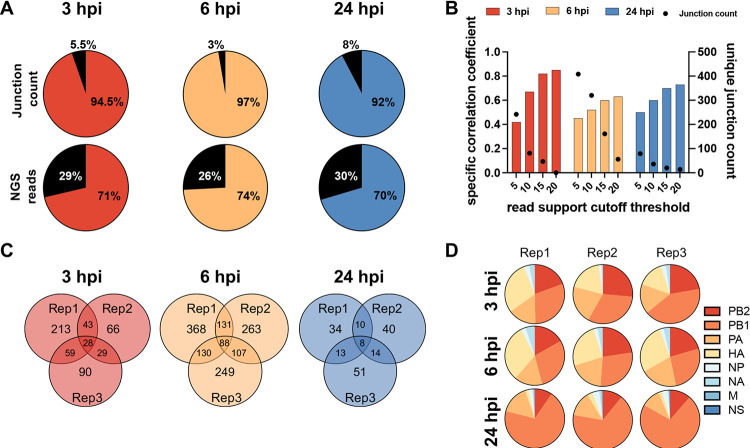
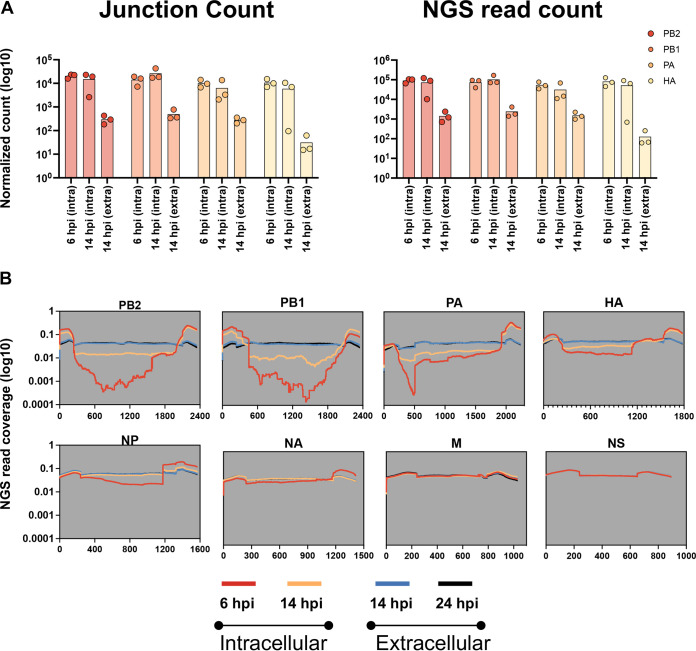
Deletion-containing viral genomes (DelVGs) are commonly produced during influenza A virus infection and have been implicated in influencing clinical infection outcomes. Despite their ubiquity, the specific molecular mechanisms that govern DelVG formation and their packaging into defective interfering particles (DIPs) remain poorly understood. Here, we utilized next-generation sequencing to analyze DelVGs that form early during infection, prior to packaging. Analysis of these early DelVGs revealed that deletion formation occurs in clearly defined hot spots and is significantly associated with both direct sequence repeats and enrichment of adenosine and uridine bases. By comparing intracellular DelVGs with those packaged into extracellular virions, we discovered that DelVGs face a significant bottleneck during genome packaging relative to wild-type genomic RNAs. Interestingly, packaged DelVGs exhibited signs of enrichment for larger DelVGs suggesting that size is an important determinant of packaging efficiency. Our data provide the first unbiased, high-resolution portrait of the diversity of DelVGs that are generated by the influenza A virus replication machinery and shed light on the mechanisms that underly DelVG formation and packaging. Defective interfering particles (DIPs) are commonly produced by RNA viruses and have been implicated in modulating clinical infection outcomes; hence, there is increasing interest in the potential of DIPs as antiviral therapeutics. For influenza viruses, DIPs are formed by the packaging of genomic RNAs harboring internal deletions. Despite decades of study, the mechanisms that drive the formation of these deletion-containing viral genomes (DelVGs) remain elusive. Here, we used a specialized sequencing pipeline to characterize the first wave of DelVGs that form during influenza virus infection. This data set provides an unbiased profile of the deletion-forming preferences of the influenza virus replicase. In addition, by comparing the early intracellular DelVGs to those that get packaged into extracellular virions, we described a significant segment-specific bottleneck that limits DelVG packaging relative to wild-type viral RNAs. Altogether, these findings reveal factors that govern the production of both DelVGs and DIPs during influenza virus infection.
缺失型病毒基因组(DelVGs)在甲型流感病毒感染过程中普遍产生,并与影响临床感染结果有关。尽管它们无处不在,但控制 DelVG 形成及其包装成缺陷干扰颗粒(DIPs)的具体分子机制仍知之甚少。在这里,我们利用下一代测序技术分析了在包装之前感染早期形成的 DelVGs。对这些早期 DelVGs 的分析表明,缺失的形成发生在明确界定的热点,与直接重复序列和腺苷和尿嘧啶碱基的富集显著相关。通过比较细胞内 DelVGs 与包装到细胞外病毒粒子中的 DelVGs,我们发现 DelVGs 在基因组包装过程中相对于野生型基因组 RNA 面临着显著的瓶颈。有趣的是,包装的 DelVGs 表现出更大的 DelVGs 富集的迹象,表明大小是包装效率的重要决定因素。我们的数据提供了甲型流感病毒复制机制产生的 DelVGs 多样性的第一个无偏、高分辨率的图像,并阐明了 DelVG 形成和包装的基础机制。缺陷干扰颗粒(DIPs)是 RNA 病毒普遍产生的,并与调节临床感染结果有关;因此,人们越来越关注 DIPs 作为抗病毒治疗的潜力。对于流感病毒,DIPs 是由包装含有内部缺失的基因组 RNA 形成的。尽管经过几十年的研究,驱动这些含有缺失的病毒基因组(DelVGs)形成的机制仍然难以捉摸。在这里,我们使用专门的测序管道来描述在流感病毒感染过程中形成的第一批 DelVGs。这个数据集提供了流感病毒复制酶形成缺失的偏好的无偏概览。此外,通过比较早期的细胞内 DelVGs 与那些包装到细胞外病毒粒子中的 DelVGs,我们描述了一个显著的片段特异性瓶颈,该瓶颈限制了 DelVG 相对于野生型病毒 RNA 的包装。总之,这些发现揭示了在流感病毒感染过程中控制 DelVG 和 DIP 产生的因素。