Shamiri Institute, Nairobi, Kenya.
Department of Psychology, Harvard University, Cambridge, MA, USA.
Trials. 2021 Nov 22;22(1):829. doi: 10.1186/s13063-021-05736-1.
Treatments for youth mental disorders are a public health priority, especially in sub-Saharan Africa (SSA), where treatment options remain limited due to high cost, elevated stigma, and lack of trained mental health professionals. Brief, accessible, and non-stigmatizing community-based interventions delivered by lay providers may help address treatment needs in SSA. One such intervention, the Shamiri Intervention, consisting of three elements (growth mindset, gratitude, and value affirmation) has been tested in randomized controlled trials with school-going Kenyan adolescents. This three-element Shamiri Intervention has been shown to significantly reduce depression and anxiety symptoms and improve social support and academic performance relative to a control group. In this trial, we aim to investigate the effects of each element of the Shamiri Intervention.
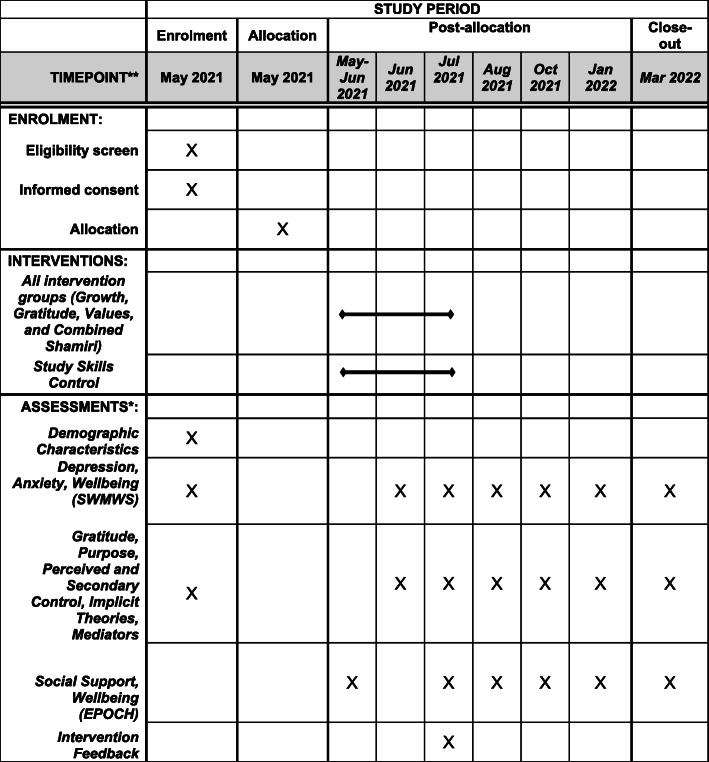
In this five-arm randomized controlled trial, we will test each of the intervention components (growth mindset, gratitude, and value affirmation) against the full Shamiri Intervention and against a study skills control intervention. Students (N = 1288) at participating secondary schools who are interested in participating in this universal intervention will be randomized in equal numbers into the five groups. The students will meet in groups of 8-15 students led by local high school graduate lay providers. These lay providers will receive a brief training, plus expert supervision once a week throughout the intervention delivery. Multi-level models will be used to compare trajectories over time of the primary outcomes (depressive symptoms, anxiety symptoms, academic performance, and wellness) and secondary outcomes in each intervention group to the control group. Multi-level models will also be used to compare trajectories over time of the primary outcomes (depressive symptoms, anxiety symptoms, academic performance, and wellness) and secondary outcomes of participants in the single-element interventions compared to the full Shamiri Intervention. Finally, effect sizes (calculated as mean gain scores) will be used to compare all groups on all measures.
This trial will shed light on the mechanisms and outcomes targeted by each individual intervention, helping prioritize which mental health interventions are most important to disseminate.
PACTR Trial ID: PACTR202104716135752 . Approved on 4/19/2021.
青少年精神障碍的治疗是公共卫生的重点,特别是在撒哈拉以南非洲(SSA),由于成本高、污名化严重以及缺乏训练有素的心理健康专业人员,治疗选择仍然有限。由非专业人员提供的简短、易于获得且无污名化的基于社区的干预措施可能有助于满足 SSA 的治疗需求。Shamiri 干预措施就是这样一种干预措施,它由三个元素(成长心态、感恩和价值观肯定)组成,已经在肯尼亚在校青少年的随机对照试验中进行了测试。与对照组相比,这种三元素 Shamiri 干预措施显著降低了抑郁和焦虑症状,改善了社会支持和学业成绩。在这项试验中,我们旨在研究 Shamiri 干预措施的每个元素的效果。
在这项五臂随机对照试验中,我们将测试 Shamiri 干预措施的每个组成部分(成长心态、感恩和价值观肯定)与完整的 Shamiri 干预措施以及学习技能对照干预措施进行对比。有兴趣参与这种普遍性干预的参与中学的学生(N=1288)将被平均随机分配到五个组中。学生将在由当地高中毕业生非专业人员领导的 8-15 名学生的小组中会面。这些非专业人员将在整个干预过程中接受简短的培训和每周一次的专家监督。多级模型将用于比较每个干预组的主要结果(抑郁症状、焦虑症状、学业成绩和健康状况)和次要结果随时间的轨迹与对照组。多级模型还将用于比较单元素干预组的主要结果(抑郁症状、焦虑症状、学业成绩和健康状况)和次要结果与完整 Shamiri 干预组的随时间的轨迹。最后,将使用效应量(计算为平均增益分数)来比较所有组在所有测量上的结果。
这项试验将阐明每个单独干预措施的目标机制和结果,有助于确定优先传播哪些心理健康干预措施最重要。
PACT 试验 ID:PACTR202104716135752。于 2021 年 4 月 19 日批准。