Soneson Emma, Howarth Emma, Ford Tamsin, Humphrey Ayla, Jones Peter B, Thompson Coon Jo, Rogers Morwenna, Anderson Joanna K
University of Cambridge Department of Psychiatry, Herchel Smith Building, Forvie Site, Robinson Way, Cambridge, CB2 0SZ, UK.
NIHR Applied Research Collaboration (ARC) East of England, University of Cambridge, Cambridge, UK.
Prev Sci. 2020 Jul;21(5):581-603. doi: 10.1007/s11121-020-01095-6.
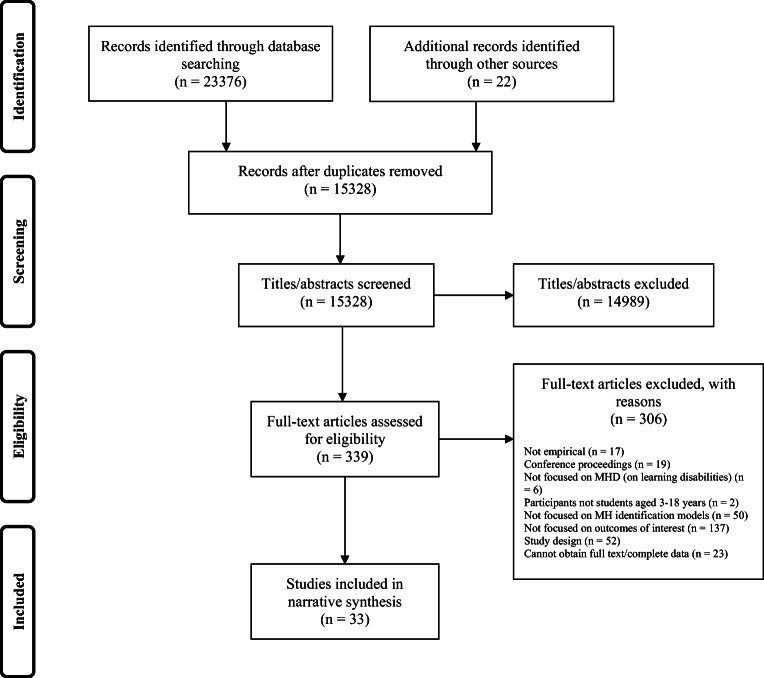
Under-identification of mental health difficulties (MHD) in children and young people contributes to the significant unmet need for mental health care. School-based programmes have the potential to improve identification rates. This systematic review aimed to determine the feasibility of various models of school-based identification of MHD. We conducted systematic searches in Medline, Embase, PsycINFO, ERIC, British Education Index, and ASSIA using terms for mental health combined with terms for school-based identification. We included studies that assessed feasibility of school-based identification of students in formal education aged 3-18 with MHD, symptomatology of MHD, or exposed to risks for MHD. Feasibility was defined in terms of (1) intervention fit, (2) cost and resource implications, (3) intervention complexity, flexibility, manualisation, and time concerns, and (4) adverse events. Thirty-three studies met inclusion criteria. The majority focused on behavioural and socioemotional problems or suicide risk, examined universal screening models, and used cross-sectional designs. In general, school-based programmes for identifying MHD aligned with schools' priorities, but their appropriateness for students varied by condition. Time, resource, and cost concerns were the most common barriers to feasibility across models and conditions. The evidence base regarding feasibility is limited, and study heterogeneity prohibits definitive conclusions about the feasibility of different identification models. Education, health, and government agencies must determine how to allocate available resources to make the widespread adoption of school-based identification programmes more feasible. Furthermore, the definition and measurement of feasibility must be standardised to promote any future comparison between models and conditions.
儿童和青少年心理健康问题(MHD)识别不足导致了心理健康护理方面大量未得到满足的需求。基于学校的项目有提高识别率的潜力。本系统评价旨在确定各种基于学校的MHD识别模式的可行性。我们在Medline、Embase、PsycINFO、ERIC、英国教育索引和ASSIA中进行了系统检索,使用心理健康相关术语与基于学校的识别相关术语相结合。我们纳入了评估3至18岁接受正规教育的学生基于学校的MHD识别可行性、MHD症状学或面临MHD风险的研究。可行性从以下方面定义:(1)干预适配性;(2)成本和资源影响;(3)干预复杂性、灵活性、手册化和时间问题;(4)不良事件。33项研究符合纳入标准。大多数研究关注行为和社会情感问题或自杀风险,考察了普遍筛查模式,并采用横断面设计。总体而言,基于学校的MHD识别项目与学校的优先事项一致,但它们对学生的适用性因情况而异。时间、资源和成本问题是各模式和情况下可行性的最常见障碍。关于可行性的证据基础有限,研究的异质性使得无法就不同识别模式的可行性得出明确结论。教育、卫生和政府机构必须确定如何分配可用资源,以使基于学校的识别项目更广泛地得到采用变得更可行。此外,必须对可行性的定义和衡量进行标准化,以促进未来不同模式和情况之间的比较。