Division of Cancer Differentiation, National Cancer Center Research Institute, 5-1-1 Tsukiji, Chuo-ku, Tokyo, 104-0045, Japan.
Research Institute for Science & Technology, Tokyo University of Science, Noda, Chiba, 278-8510, Japan.
Sci Rep. 2021 Nov 22;11(1):22678. doi: 10.1038/s41598-021-02221-2.
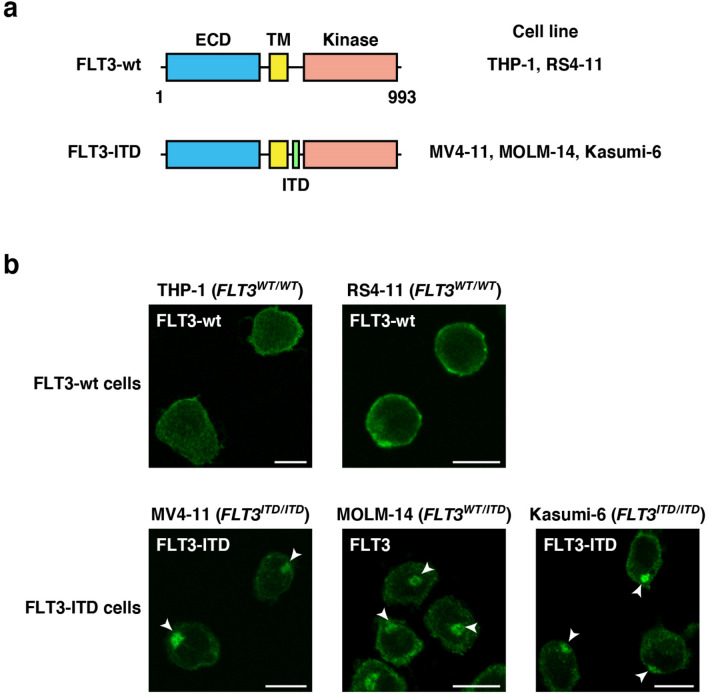
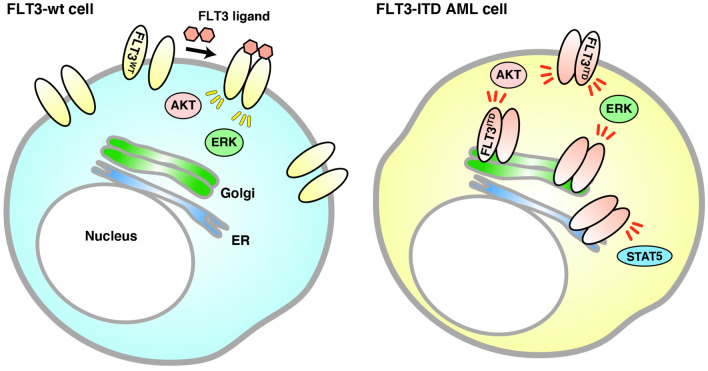
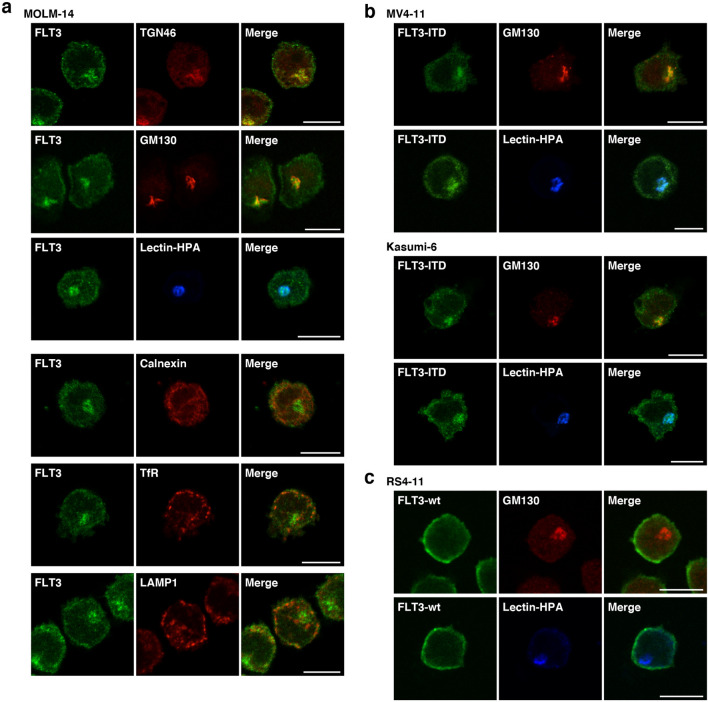
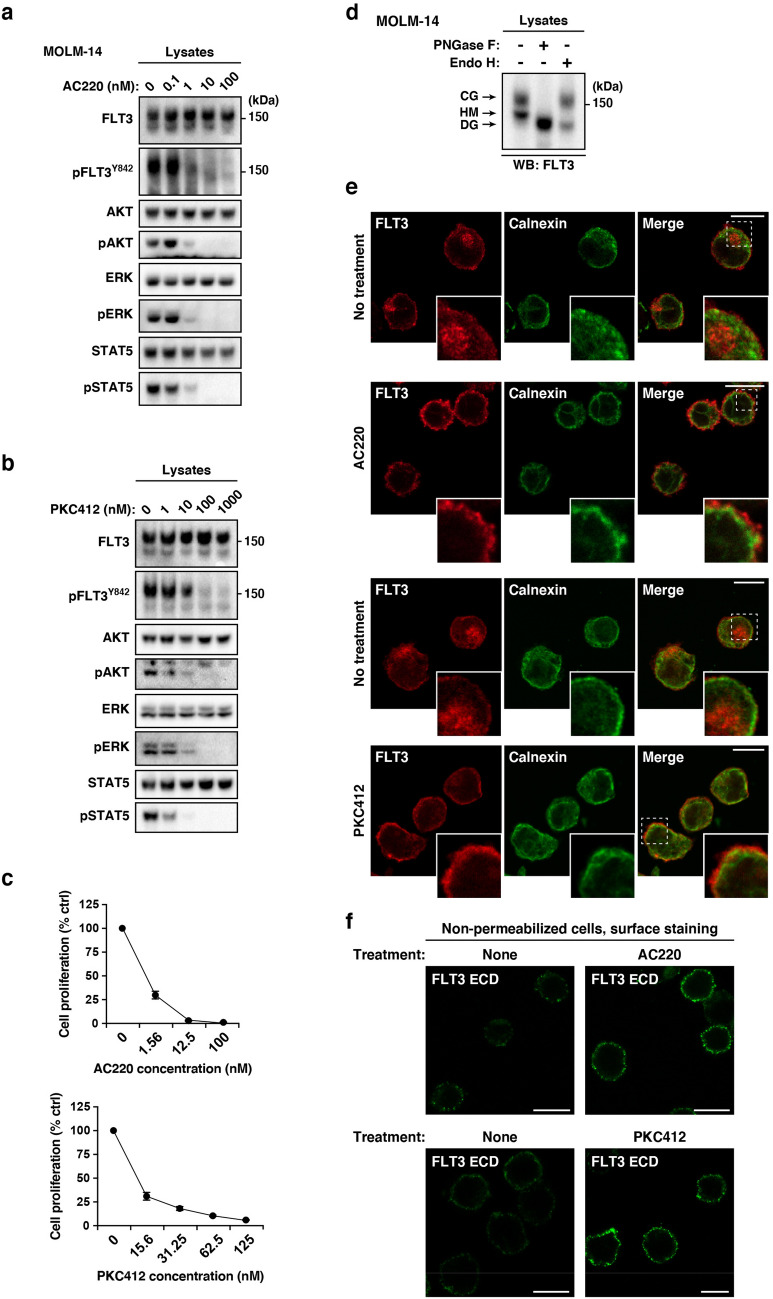
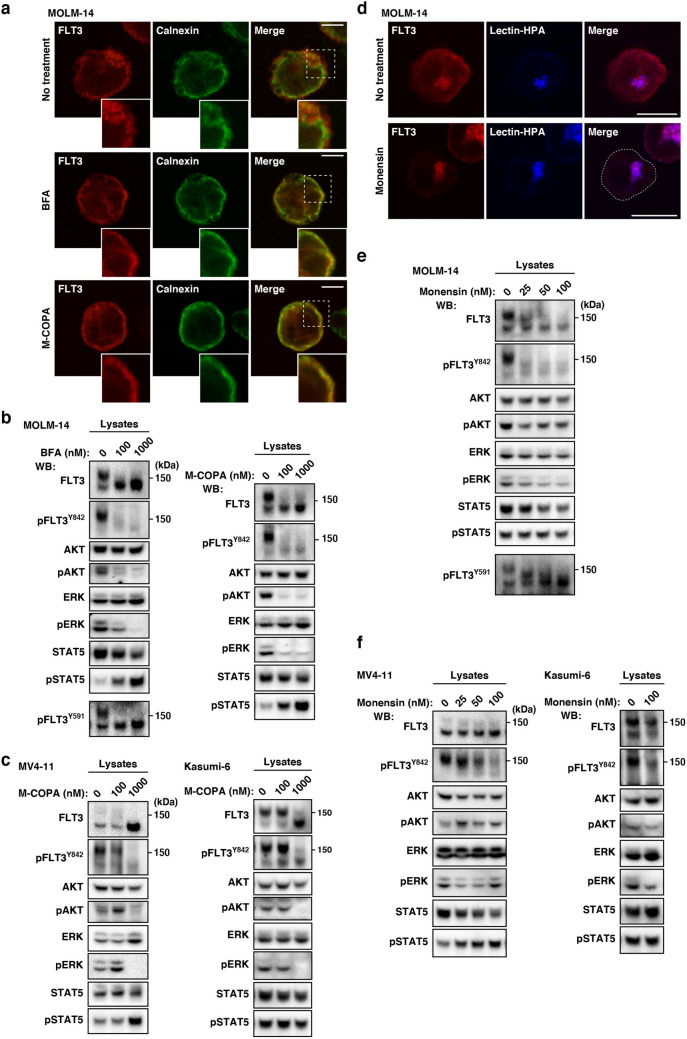
FMS-like tyrosine kinase 3 (FLT3) in hematopoietic cells binds to its ligand at the plasma membrane (PM), then transduces growth signals. FLT3 gene alterations that lead the kinase to assume its permanently active form, such as internal tandem duplication (ITD) and D835Y substitution, are found in 30-40% of acute myelogenous leukemia (AML) patients. Thus, drugs for molecular targeting of FLT3 mutants have been developed for the treatment of AML. Several groups have reported that compared with wild-type FLT3 (FLT3-wt), FLT3 mutants are retained in organelles, resulting in low levels of PM localization of the receptor. However, the precise subcellular localization of mutant FLT3 remains unclear, and the relationship between oncogenic signaling and the mislocalization is not completely understood. In this study, we show that in cell lines established from leukemia patients, endogenous FLT3-ITD but not FLT3-wt clearly accumulates in the perinuclear region. Our co-immunofluorescence assays demonstrate that Golgi markers are co-localized with the perinuclear region, indicating that FLT3-ITD mainly localizes to the Golgi region in AML cells. FLT3-ITD biosynthetically traffics to the Golgi apparatus and remains there in a manner dependent on its tyrosine kinase activity. Tyrosine kinase inhibitors, such as quizartinib (AC220) and midostaurin (PKC412), markedly decrease FLT3-ITD retention and increase PM levels of the mutant. FLT3-ITD activates downstream in the endoplasmic reticulum (ER) and the Golgi apparatus during its biosynthetic trafficking. Results of our trafficking inhibitor treatment assays show that FLT3-ITD in the ER activates STAT5, whereas that in the Golgi can cause the activation of AKT and ERK. We provide evidence that FLT3-ITD signals from the early secretory compartments before reaching the PM in AML cells.
FMS 样酪氨酸激酶 3(FLT3)在造血细胞中与质膜(PM)上的配体结合,然后转导生长信号。在 30-40%的急性髓系白血病(AML)患者中发现,导致激酶处于永久激活形式的 FLT3 基因改变,如内部串联重复(ITD)和 D835Y 取代。因此,已经开发了用于治疗 AML 的针对 FLT3 突变体的分子靶向药物。有几个研究小组报告称,与野生型 FLT3(FLT3-wt)相比,FLT3 突变体保留在细胞器中,导致受体在质膜上的定位水平较低。然而,突变型 FLT3 的精确亚细胞定位仍然不清楚,并且致癌信号与定位错误之间的关系尚不完全清楚。在这项研究中,我们表明,在从白血病患者建立的细胞系中,内源性 FLT3-ITD 而不是 FLT3-wt 明显积累在核周区域。我们的共免疫荧光分析表明,高尔基标志物与核周区域共定位,表明 FLT3-ITD 主要定位于 AML 细胞的高尔基区域。FLT3-ITD 生物合成运输到高尔基器,并以依赖其酪氨酸激酶活性的方式保留在那里。酪氨酸激酶抑制剂,如 quizartinib(AC220)和 midostaurin(PKC412),显著减少 FLT3-ITD 的保留并增加突变体的质膜水平。FLT3-ITD 在其生物合成运输过程中在 ER 和高尔基器中激活下游信号。我们的运输抑制剂处理试验结果表明,ER 中的 FLT3-ITD 激活 STAT5,而高尔基器中的 FLT3-ITD 可导致 AKT 和 ERK 的激活。我们提供的证据表明,在 AML 细胞中,FLT3-ITD 在到达质膜之前从早期分泌隔室发出信号。