Imperial College School of Medicine, Imperial College London, London, UK.
Warwick Medical School, University of Warwick, Coventry, UK.
Med Teach. 2022 Apr;44(4):401-409. doi: 10.1080/0142159X.2021.1998401. Epub 2021 Nov 23.
The University Clinical Aptitude Test (UCAT) is an admissions assessment used by a consortium of universities across the UK, Australia, and New Zealand, to aid the selection of applicants to medical and dental degree programmes. The UCAT aims to measure the mental aptitude and professional behaviours required to become successful doctors and dentists. We conducted a systematic review to establish the predictive value of the UCAT across measures of performance at undergraduate and post-graduate levels.
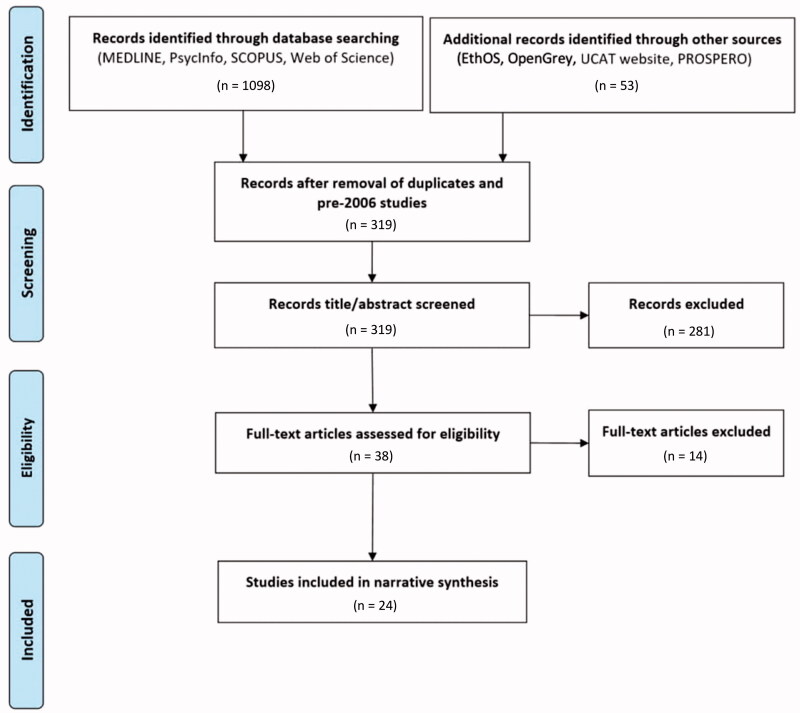
A literature search was conducted in April 2020 using eight electronic databases: MEDLINE, APA PsycInfo, SCOPUS, Web of Science, EThOS, OpenGrey, PROSPERO, and the UCAT website. Data were extracted from selected studies and tabulated as results matrices. A narrative synthesis was performed.
Twenty-four studies satisfied our inclusion criteria, 23 of which were deemed to be of good quality (using the Newcastle-Ottawa Scale). For over 70% of univariate data points, the UCAT exerted no statistically significant predictive validity; for the remainder, predictive power was weak. The cognitive total and verbal reasoning subtests had the largest evidence base as weakly positive predictors of academic performance. The SJT subtest was a weak predictor of professional behaviour during medical school. Studies specific to dental schools demonstrated variable findings across the five studies. Only 1 study looked at post-graduate outcome measures and demonstrated that the UCAT was not a predictor of health- or conduct-related fitness to practice declarations at GMC registration.
These data provide some support for the use of cognitive total and verbal reasoning subtests as part of medical school selection. Further research is needed to investigate outcomes beyond professional registration and for dental students.
英国、澳大利亚和新西兰的一些大学联盟使用大学临床能力倾向测验(UCAT)作为入学评估工具,以帮助选择医学和牙科学位课程的申请人。UCAT 的目的是衡量成为成功医生和牙医所需的心理能力和专业行为。我们进行了一项系统评价,以确定 UCAT 在本科和研究生水平的表现测量中的预测价值。
我们于 2020 年 4 月使用八个电子数据库进行了文献检索:MEDLINE、APA PsycInfo、SCOPUS、Web of Science、EThOS、OpenGrey、PROSPERO 和 UCAT 网站。从选定的研究中提取数据并制成结果矩阵。进行了叙述性综合。
有 24 项研究符合我们的纳入标准,其中 23 项被认为质量良好(使用纽卡斯尔-渥太华量表)。对于超过 70%的单变量数据点,UCAT 没有表现出统计学上显著的预测有效性;对于其余数据点,预测能力较弱。认知总分和语言推理子测试具有最大的证据基础,是学业成绩的弱正预测因子。SJT 子测试是医学生专业行为的弱预测因子。针对牙科学校的研究在五项研究中表现出不同的发现。只有一项研究关注研究生的结果测量,表明 UCAT 不是 GMC 注册时与健康或行为相关的适合实践声明的预测因子。
这些数据为将认知总分和语言推理子测试用作医学院选择的一部分提供了一些支持。需要进一步研究以调查注册后和牙科学生的结果。