Medical Education, Faculty of Medicine, University of Southampton, SO17 IBJ, Southampton, England.
General Medical Council, London, NW1 3JN, England.
BMC Med Educ. 2020 Jan 3;20(1):4. doi: 10.1186/s12909-019-1918-y.
Gateway courses are increasingly popular widening participation routes into medicine. These six year courses provide a more accessible entry route into medical school and aim to support under-represented students' progress and graduation as doctors. There is little evidence on the performance of gateway students and this study compares attainment and aptitude on entry, and outcomes at graduation of students on the UK's three longest running gateway courses with students studying on a standard entry medical degree (SEMED) course at the same institutions.
Data were obtained from the UK Medical Education Database for students starting between 2007 and 2012 at three UK institutions. These data included A-levels and Universities Clinical Aptitude Test scores on entry to medical school and the Educational Performance Measure (EPM) decile, Situational Judgement Test (SJT) and Prescribing Safety Assessment (PSA) scores as outcomes measures. Multiple regression models were used to test for difference in outcomes between the two types of course, controlling for attainment and aptitude on entry.
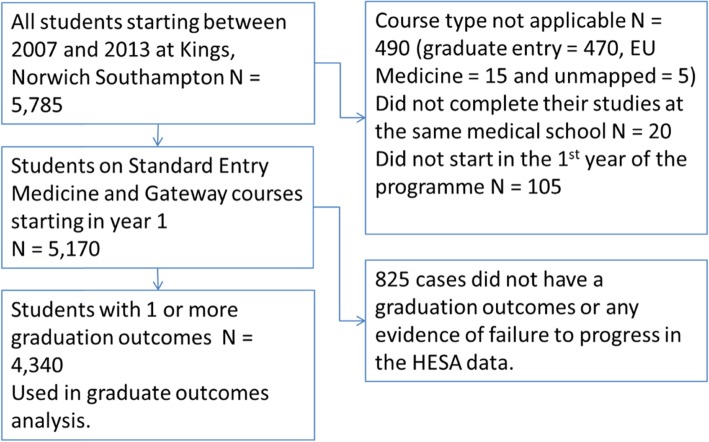
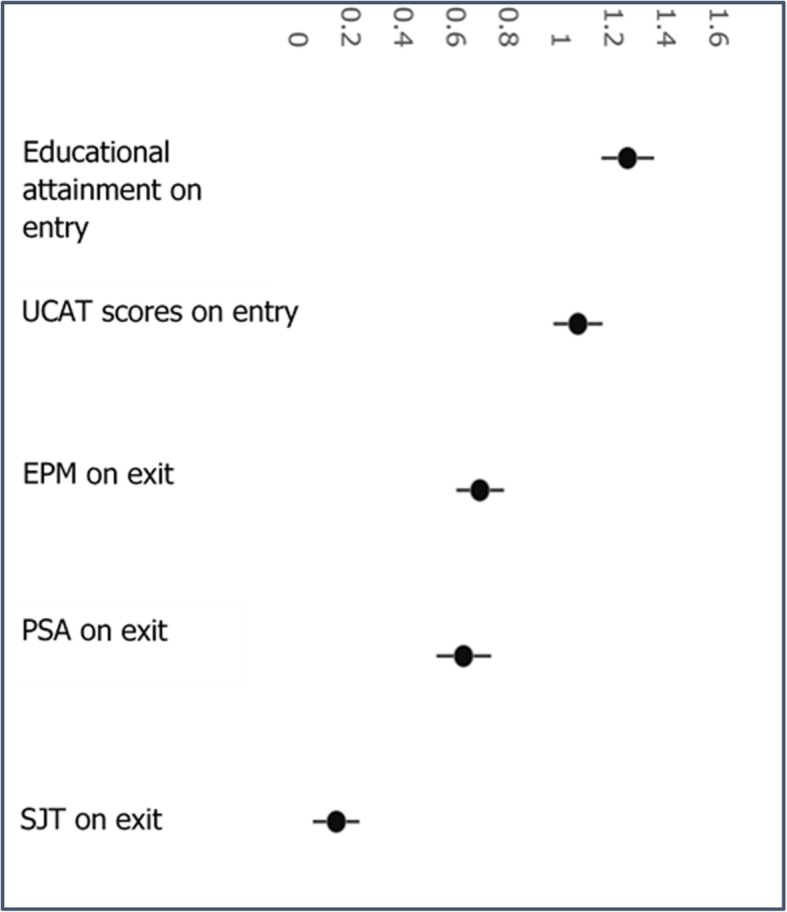
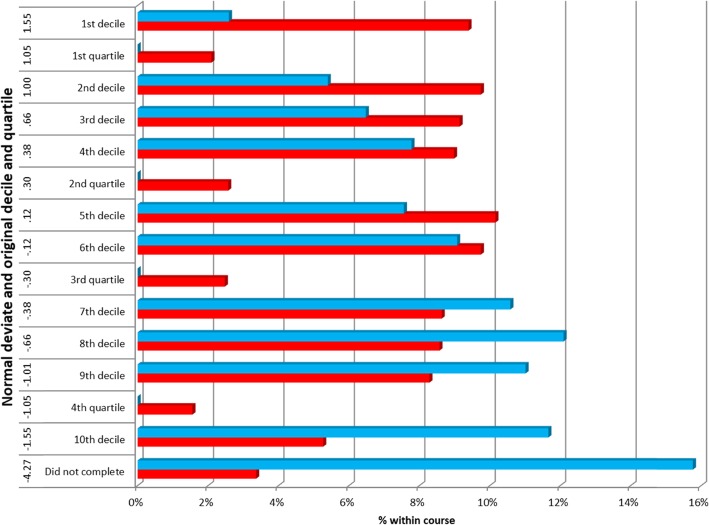
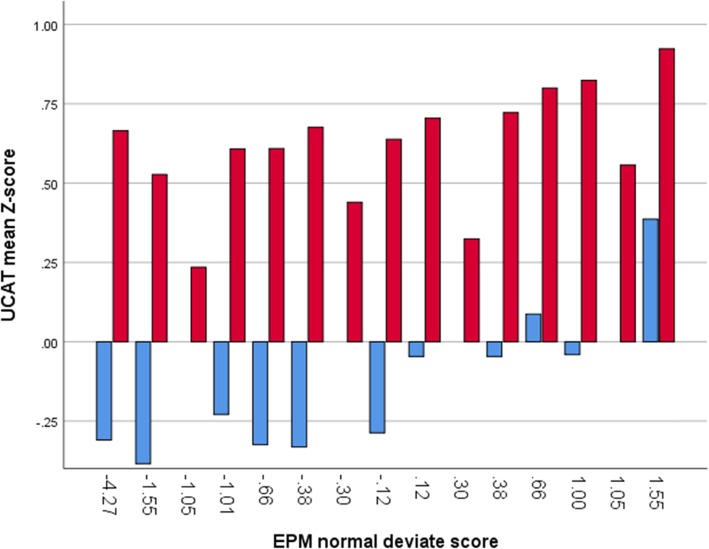
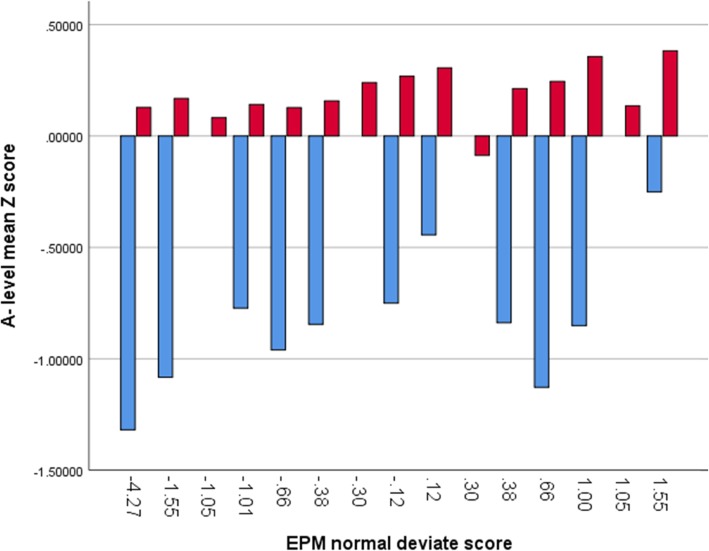
Four thounsand three hundred forty students were included in the analysis, 560 on gateway courses and 3785 on SEMED courses. Students on SEMED courses had higher attainment (Cohen's d = 1.338) and aptitude (Cohen's d = 1.078) on entry. On exit SEMED students had higher EPM scores (Cohen's d = 0.616) and PSA scores (Cohen's d = 0.653). When accounting for attainment and aptitude on entry course type is still a significant predictor of EPM and PSA, but the proportion of the variation in outcome explained by course type drops from 6.4 to 1.6% for EPM Decile and from 5.3% to less than 1% for the PSA score. There is a smaller significant difference in SJT scores, with SEMED having higher scores (Cohen's d = 0.114). However, when measures of performance on entry are accounted for, course type is no longer a significant predictor of SJT scores.
This study shows the differences of the available measures between gateway students and SEMED students on entry to their medical degrees are greater than the differences on exit. This provides modest evidence that gateway courses allow students from under-represented groups to achieve greater academic potential.
越来越多的门户课程正在拓宽参与医学的途径。这些六年制课程为进入医学院提供了更便捷的途径,旨在支持代表性不足的学生的进步和毕业成为医生。关于门户学生的表现几乎没有证据,本研究比较了英国三所历史最悠久的门户课程学生在入学时的成绩和能力,以及与同一机构标准入学医学学位(SEMED)课程学生在毕业时的成绩。
数据来自英国医学教育数据库,包括 2007 年至 2012 年期间在英国三所机构开始学习的学生。这些数据包括入学时的 A 级和大学临床能力测试成绩以及教育表现衡量标准(EPM)十分位数、情境判断测试(SJT)和处方安全评估(PSA)成绩作为衡量结果的指标。使用多元回归模型来测试两种课程类型之间的结果差异,控制入学时的成绩和能力。
共纳入分析的有 3434 名学生,其中 560 名学生在门户课程中,3785 名学生在 SEMED 课程中。SEMED 课程的学生入学时成绩(Cohen's d=1.338)和能力(Cohen's d=1.078)更高。在出口方面,SEMED 学生的 EPM 成绩(Cohen's d=0.616)和 PSA 成绩(Cohen's d=0.653)更高。当考虑入学时的成绩和能力时,课程类型仍然是 EPM 和 PSA 的重要预测因素,但课程类型对结果的解释比例从 EPM 十分位数的 6.4%降至 1.6%,从 PSA 分数的 5.3%降至不足 1%。SJT 分数的差异较小,SEMED 得分较高(Cohen's d=0.114)。然而,当考虑入学时的表现衡量标准时,课程类型不再是 SJT 成绩的重要预测因素。
本研究表明,门户学生和 SEMED 学生在进入医学学位时的可用衡量标准之间的差异大于毕业时的差异。这提供了适度的证据表明,门户课程使代表性不足的群体的学生能够发挥更大的学术潜力。