Department of Health Promotion and Education, School of Public Health, The University of Zambia, Lusaka, Zambia.
Department of Health Policy and Management, School of Public Health, The University of Zambia, Lusaka, Zambia.
Int J Health Policy Manag. 2022 Jan 1;11(1):80-89. doi: 10.34172/ijhpm.2021.133.
Surgery for hydrocele is commonly promoted as part of morbidity management and disability prevention (MMDP) services for lymphatic filariasis (LF). However, uptake of these surgeries has been suboptimal owing to several community level barriers that have triggered mistrust in such services. This study aimed at documenting mechanisms of unlocking trust in community health systems (CHSs) in the context of a LF hydrocele management project that was implemented in Luangwa District, Zambia.
Qualitative data was collected through in-depth interviews (IDIs) and focus group discussions (FGDs) (n=45) in February 2020 in Luangwa District. Thirty-one IDIs were conducted with hydrocele patients, community health workers (CHWs), health workers, traditional leaders and traditional healers. Two FGDs were also conducted with CHWs who had been involved in project implementation with seven participants per group. Data was analyzed using a thematic analysis approach.
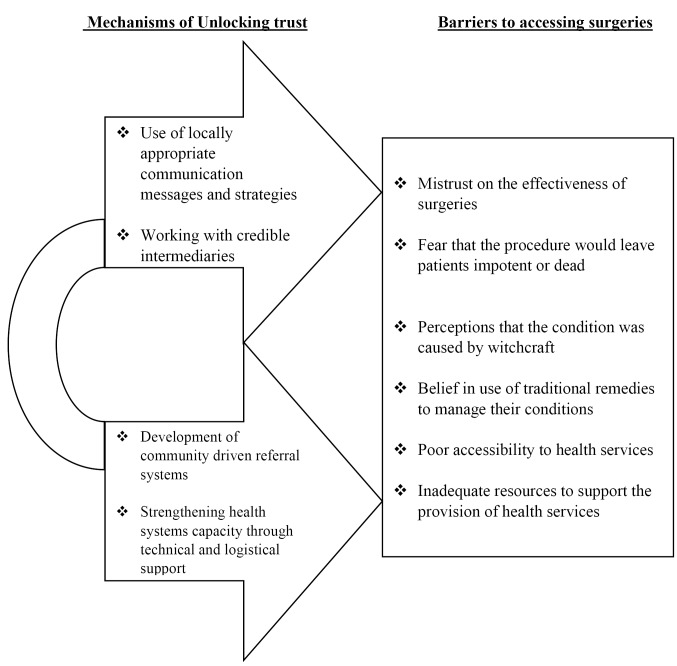
The use of locally appropriate communication strategies, development of community driven referral systems, working with credible community intermediaries as well as strengthening health systems capacity through providing technical and logistical support enhanced trust in surgery for hydrocele and uptake of the surgeries.
Implementation of community led communication and referral systems as well as strengthening health services are vital in unlocking trust in health systems as such mechanisms trigger authentic partnerships, including mutual respect and recognition in the CHS. The mechanisms also enhance confidence in health services among community members.
鞘膜积液手术通常被作为淋巴丝虫病(LF)发病率管理和残疾预防(MMDP)服务的一部分进行推广。然而,由于一些社区层面的障碍,这些手术的接受程度一直不尽如人意,这些障碍引发了对这类服务的不信任。本研究旨在记录在赞比亚卢安瓜区实施的 LF 鞘膜积液管理项目背景下,解锁社区卫生系统(CHS)信任的机制。
2020 年 2 月,在卢安瓜区收集了定性数据,包括深入访谈(IDIs)和焦点小组讨论(FGDs)(n=45)。对 31 名鞘膜积液患者、社区卫生工作者(CHWs)、卫生工作者、传统领袖和传统治疗师进行了 IDI。还对参与项目实施的 CHWs 进行了两次 FGD,每组有 7 名参与者。使用主题分析方法对数据进行分析。
使用当地适当的沟通策略、发展社区驱动的转诊系统、与可信的社区中介合作以及通过提供技术和后勤支持来加强卫生系统能力,增强了对鞘膜积液手术的信任,并提高了手术的接受程度。
实施社区主导的沟通和转诊系统以及加强卫生服务对于解锁对卫生系统的信任至关重要,因为这些机制引发了真正的伙伴关系,包括在 CHS 中相互尊重和认可。这些机制还增强了社区成员对卫生服务的信心。