Department of Veterinary and Animal Sciences, Faculty of Health and Medical Sciences, University of Copenhagen, Grønnegårdsvej 3, DK-1870, Frederiksberg C, Denmark.
Department of Agricultural, Food and Nutritional Science, University of Alberta, Edmonton, Alberta, T6G2P5, Canada.
Microbiome. 2021 Nov 23;9(1):229. doi: 10.1186/s40168-021-01147-1.
Carbohydrate-active enzymes (CAZymes) form the most widespread and structurally diverse set of enzymes involved in the breakdown, biosynthesis, or modification of lignocellulose that can be found in living organisms. However, the structural diversity of CAZymes has rendered the targeted discovery of novel enzymes extremely challenging, as these proteins catalyze many different chemical reactions and are sourced by a vast array of microbes. Consequently, many uncharacterized members of CAZyme families of interest have been overlooked by current methodologies (e.g., metagenomic screening) used to discover lignocellulolytic enzymes.
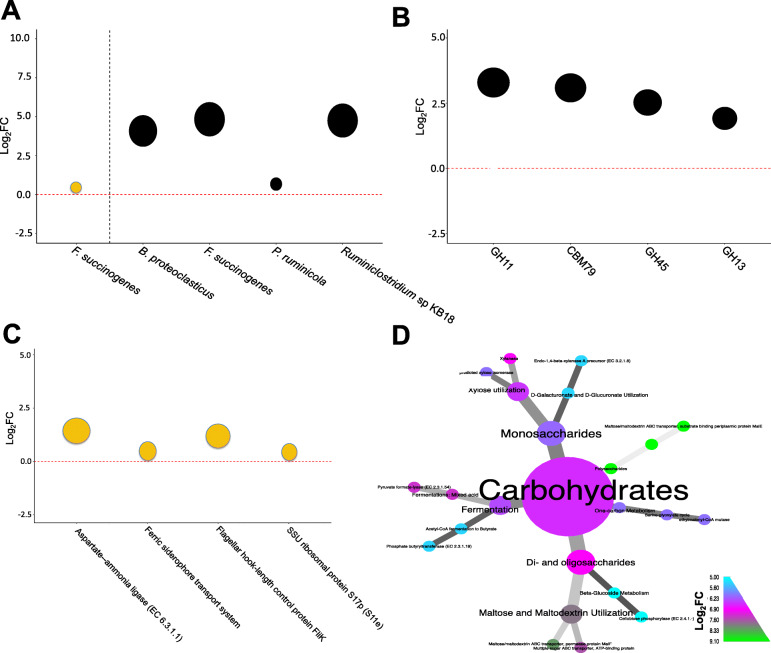
In the present study, we combined phenotype-based selective pressure on the rumen microbiota with targeted functional profiling to guide the discovery of unknown CAZymes. In this study, we found 61 families of glycoside hydrolases (GH) (out of 182 CAZymes) from protein sequences deposited in the CAZy database-currently associated with more than 20,324 microbial genomes. Phenotype-based selective pressure on the rumen microbiome showed that lignocellulolytic bacteria (e.g., Fibrobacter succinogenes, Butyrivibrio proteoclasticus) and three GH families (e.g., GH11, GH13, GH45) exhibited an increased relative abundance in the rumen of feed efficient cattle when compared to their inefficient counterparts. These results paved the way for the application of targeted functional profiling to screen members of the GH11 and GH45 families against a de novo protein reference database comprised of 1184 uncharacterized enzymes, which led to the identification of 18 putative xylanases (GH11) and three putative endoglucanases (GH45). The biochemical proof of the xylanolytic activity of the newly discovered enzyme validated the computational simulations and demonstrated the stability of the most abundant xylanase.
These findings contribute to the discovery of novel enzymes for the breakdown, biosynthesis, or modification of lignocellulose and demonstrate that the rumen microbiome is a source of promising enzyme candidates for the biotechnology industry. The combined approaches conceptualized in this study can be adapted to any microbial environment, provided that the targeted microbiome is easy to manipulate and facilitates enrichment for the microbes of interest. Video Abstract.
碳水化合物活性酶(CAZymes)是参与木质纤维素分解、生物合成或修饰的最广泛和结构最多样化的酶类,这些酶存在于生物体中。然而,CAZymes 的结构多样性使得靶向发现新的酶极具挑战性,因为这些蛋白质催化许多不同的化学反应,并且来自大量不同的微生物。因此,许多有兴趣的 CAZyme 家族的未被表征的成员被当前用于发现木质纤维素酶的方法(例如,宏基因组筛选)所忽视。
在本研究中,我们将瘤胃微生物群的基于表型的选择性压力与靶向功能分析相结合,以指导未知 CAZymes 的发现。在这项研究中,我们从 CAZy 数据库中已存入的蛋白质序列中发现了 61 个糖苷水解酶(GH)家族(在 182 个 CAZymes 中)-目前与超过 20324 个微生物基因组相关。基于表型的瘤胃微生物群选择性压力表明,木质纤维素分解细菌(例如,纤维丁酸弧菌、丁酸梭菌)和三个 GH 家族(例如,GH11、GH13、GH45)在与低效牛相比时,在饲料效率高的牛的瘤胃中相对丰度增加。这些结果为应用靶向功能分析筛选 GH11 和 GH45 家族成员对由 1184 个未表征酶组成的从头蛋白质参考数据库提供了依据,从而鉴定出 18 种假定的木聚糖酶(GH11)和三种假定的内切葡聚糖酶(GH45)。新发现的酶的木聚糖裂解活性的生化证明验证了计算模拟,并证明了最丰富的木聚糖酶的稳定性。
这些发现有助于发现木质纤维素分解、生物合成或修饰的新酶,并证明瘤胃微生物群是生物技术产业有前途的酶候选物的来源。本研究中提出的组合方法可以适应任何微生物环境,只要目标微生物群易于操作并且有利于富集感兴趣的微生物。