Center for Cell and Gene Therapy, Baylor College of Medicine, Houston, Texas, USA
Center for Cell and Gene Therapy, Baylor College of Medicine, Houston, Texas, USA.
J Immunother Cancer. 2021 Nov;9(11). doi: 10.1136/jitc-2021-003237.
Successful targeting of solid tumors such as breast cancer (BC) using chimeric antigen receptor (CAR) T cells has proven challenging, largely attributed to the immunosuppressive tumor microenvironment (TME). Myeloid-derived suppressor cells (MDSCs) inhibit CAR T cell function and persistence within the breast TME. To overcome this challenge, we have developed CAR T cells targeting tumor-associated mucin 1 (MUC1) with a novel chimeric costimulatory receptor that targets tumor necrosis factor-related apoptosis-inducing ligand receptor 2 (TR2) expressed on MDSCs.
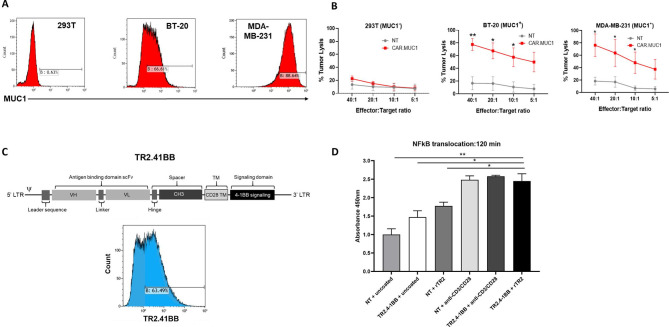
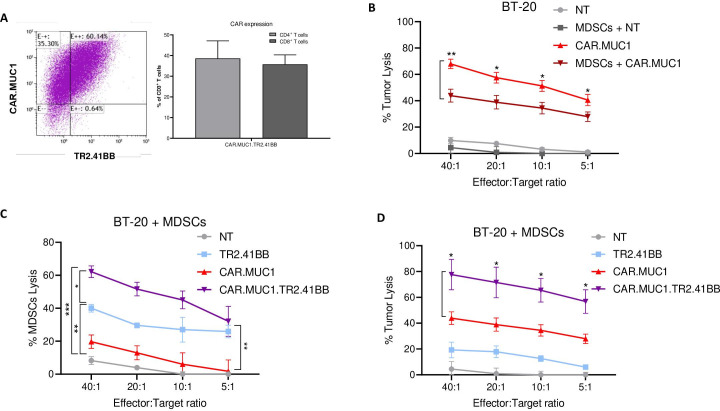
The function of the TR2.41BB costimulatory receptor was assessed by exposing non-transduced (NT) and TR2.41BB transduced T cells to recombinant TR2, after which nuclear translocation of NFκB was measured by ELISA and western blot. The cytolytic activity of CAR.MUC1/TR2.41BB T cells was measured in a 5-hour cytotoxicity assay using MUC1+ tumor cells as targets in the presence or absence of MDSCs. In vivo antitumor activity was assessed using MDSC-enriched tumor-bearing mice treated with CAR T cells with or without TR2.41BB.
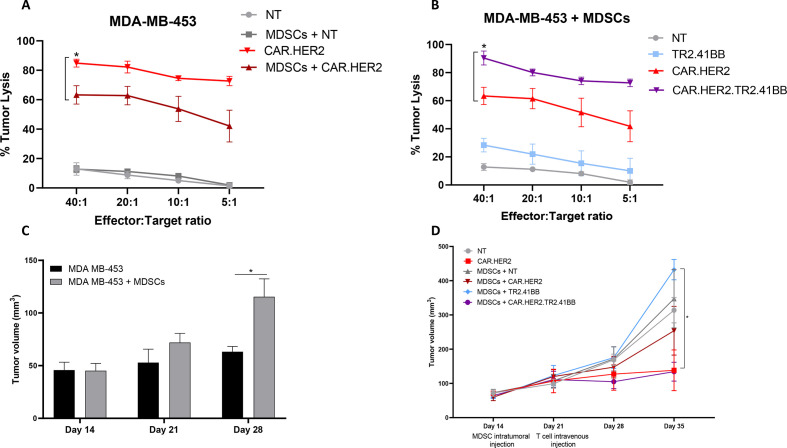
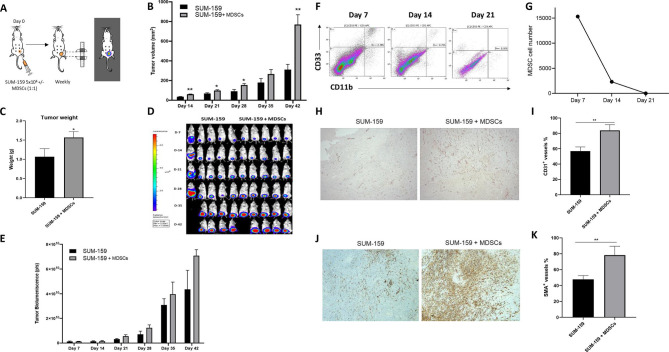
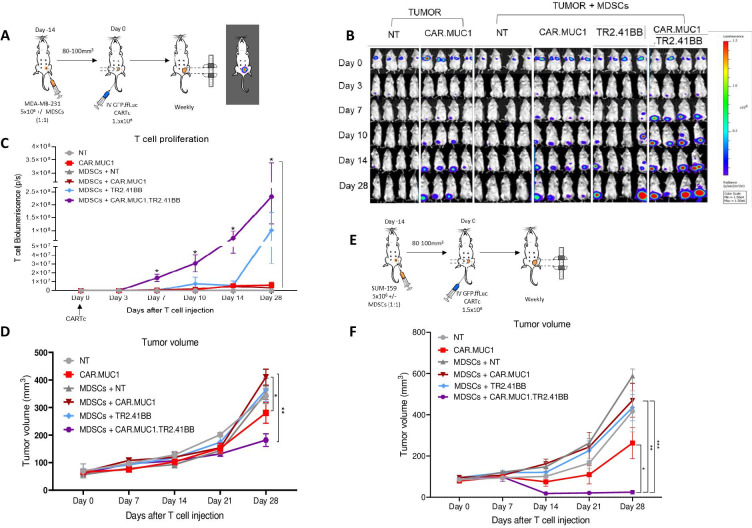
Nuclear translocation of NFκB in response to recombinant TR2 was detected only in TR2.41BB T cells. The presence of MDSCs diminished the cytotoxic potential of CAR.MUC1 T cells against MUC1+ BC cell lines by 25%. However, TR2.41BB expression on CAR.MUC1 T cells induced MDSC apoptosis, thereby restoring the cytotoxic activity of CAR.MUC1 T cells against MUC1+ BC lines. The presence of MDSCs resulted in an approximately twofold increase in tumor growth due to enhanced angiogenesis and fibroblast accumulation compared with mice with tumor alone. Treatment of these MDSC-enriched tumors with CAR.MUC1.TR2.41BB T cells led to superior tumor cell killing and significant reduction in tumor growth (24.54±8.55 mm) compared with CAR.MUC1 (469.79±81.46 mm) or TR2.41BB (434.86±64.25 mm) T cells alone. CAR.MUC1.TR2.41BB T cells also demonstrated improved T cell proliferation and persistence at the tumor site, thereby preventing metastases. We observed similar results using CAR.HER2.TR2.41BB T cells in a HER2+ BC model.
Our findings demonstrate that CAR T cells that coexpress the TR2.4-1BB receptor exhibit superior antitumor potential against breast tumors containing immunosuppressive and tumor promoting MDSCs, resulting in TME remodeling and improved T cell proliferation at the tumor site.
使用嵌合抗原受体 (CAR) T 细胞成功靶向实体瘤,如乳腺癌 (BC),一直具有挑战性,这主要归因于免疫抑制性肿瘤微环境 (TME)。髓系来源的抑制细胞 (MDSCs) 抑制了 CAR T 细胞在乳腺 TME 中的功能和持久性。为了克服这一挑战,我们开发了针对肿瘤相关粘蛋白 1 (MUC1) 的 CAR T 细胞,该细胞具有新型嵌合共刺激受体,可靶向 MDSC 上表达的肿瘤坏死因子相关凋亡诱导配体受体 2 (TR2)。
通过暴露于重组 TR2 来评估 TR2.41BB 共刺激受体的功能,之后通过 ELISA 和 Western blot 测量核转位的 NFκB。使用含有 MDSCs 的情况下或不存在 MDSCs 的情况下,在 5 小时细胞毒性测定中使用 MUC1+肿瘤细胞作为靶标,测量 CAR.MUC1/TR2.41BB T 细胞的细胞溶解活性。使用富含 MDSC 的荷瘤小鼠评估 CAR T 细胞的体内抗肿瘤活性,这些 CAR T 细胞接受或不接受 TR2.41BB 的治疗。
仅在 TR2.41BB T 细胞中检测到对重组 TR2 反应的 NFκB 核易位。MDSCs 的存在使 CAR.MUC1 T 细胞对 MUC1+BC 细胞系的细胞毒性潜力降低了 25%。然而,CAR.MUC1 T 细胞上表达的 TR2.41BB 诱导 MDSC 凋亡,从而恢复了 CAR.MUC1 T 细胞对 MUC1+BC 细胞系的细胞毒性活性。与仅患有肿瘤的小鼠相比,由于增强的血管生成和成纤维细胞积累,MDSCs 的存在导致肿瘤生长增加约两倍。用 CAR.MUC1.TR2.41BB T 细胞治疗这些富含 MDSC 的肿瘤可导致肿瘤细胞杀伤更好,并显著减少肿瘤生长(24.54±8.55mm),与 CAR.MUC1(469.79±81.46mm)或 TR2.41BB(434.86±64.25mm)T 细胞单独治疗相比。CAR.MUC1.TR2.41BB T 细胞还在肿瘤部位显示出改善的 T 细胞增殖和持久性,从而防止转移。我们在 HER2+BC 模型中使用 CAR.HER2.TR2.41BB T 细胞观察到类似的结果。
我们的研究结果表明,共表达 TR2.4-1BB 受体的 CAR T 细胞对含有免疫抑制和促进肿瘤的 MDSC 的乳腺肿瘤具有更好的抗肿瘤潜力,从而导致 TME 重塑和肿瘤部位 T 细胞增殖的改善。