State Key Laboratory of Oncogenes and Related Genes, Shanghai Cancer Institute, Renji Hospital, Shanghai Jiaotong University School of Medicine, Shanghai 200032, China.
State Key Laboratory of Oncogenes and Related Genes, Shanghai Cancer Institute, Renji Hospital, Shanghai Jiaotong University School of Medicine, Shanghai 200032, China; State Key Laboratory of Oncogenes and Related Genes, Renji Hospital, School of Biomedical Engineering, Shanghai Jiao Tong University, Shanghai 200032, China.
Mol Ther. 2021 Jan 6;29(1):60-74. doi: 10.1016/j.ymthe.2020.09.034. Epub 2020 Sep 26.
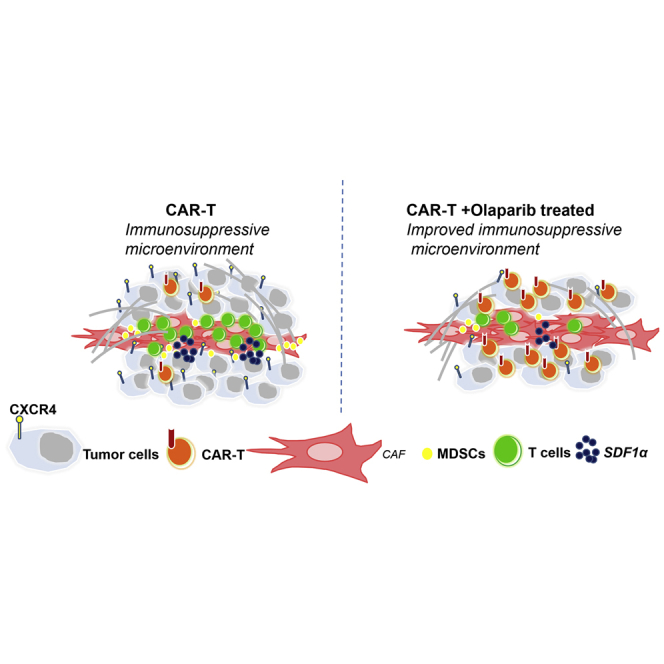
A hostile tumor microenvironment is one of the major obstacles for the efficacy of chimeric antigen receptor modified T (CAR-T) cells, and combination treatment might be a potential way to overcome this obstacle. Poly(ADP-ribose) polymerase inhibitor (PARPi) has demonstrated tremendous potential in breast cancer. In this study, we explored the possible combination of the PAPRi olaparib with EGFRvIII-targeted CAR (806-28Z CAR) T cells in immunocompetent mouse models of breast cancer. The results indicated that the administration of olaparib could significantly enhance the efficacy of 806-28Z CAR-T cells in vivo. Interestingly, we observed that olaparib could suppress myeloid-derived suppressor cell (MDSC) migration and promote the survival of CD8 T cells in tumor tissue. Mechanistically, olaparib was shown to reduce the expression of SDF1α released from cancer-associated fibroblasts (CAFs) and thereby decreased MDSC migration through CXCR4. Taken together, this study demonstrated that olaparib could increase the antitumor activities of CAR-T cell therapy at least partially through inhibiting MDSC migration via the SDF1α/CXCR4 axis. These findings uncover a novel mechanism of PARPi function and provide additional mechanistic rationale for combining PARPi with CAR-T cells for the treatment of breast cancer.
肿瘤微环境的免疫抑制是嵌合抗原受体修饰 T(CAR-T)细胞疗效的主要障碍之一,联合治疗可能是克服这一障碍的潜在方法。聚(ADP-核糖)聚合酶抑制剂(PARPi)在乳腺癌中显示出巨大的潜力。在这项研究中,我们探索了 PARPi 奥拉帕利与针对 EGFRvIII 的 CAR(806-28Z CAR)T 细胞联合应用于乳腺癌免疫活性小鼠模型的可能性。结果表明,奥拉帕利用药可显著增强 806-28Z CAR-T 细胞在体内的疗效。有趣的是,我们观察到奥拉帕利可以抑制髓系来源的抑制细胞(MDSC)迁移,并促进肿瘤组织中 CD8 T 细胞的存活。机制上,奥拉帕利被证明可以降低癌症相关成纤维细胞(CAF)释放的 SDF1α 的表达,从而通过 CXCR4 减少 MDSC 的迁移。总之,这项研究表明,奥拉帕利至少部分通过抑制 SDF1α/CXCR4 轴抑制 MDSC 迁移,从而增加 CAR-T 细胞治疗的抗肿瘤活性。这些发现揭示了 PARPi 功能的新机制,并为 PARPi 与 CAR-T 细胞联合治疗乳腺癌提供了额外的机制依据。