Department of Neurosurgery, The Affiliated Jingmen First People's Hospital of Hubei Minzu University, Jingmen, China.
Department of Neurosurgery, The Second People's Hospital of Jingmen, Jingmen, China.
Aging (Albany NY). 2021 Nov 23;13(22):24675-24685. doi: 10.18632/aging.203708.
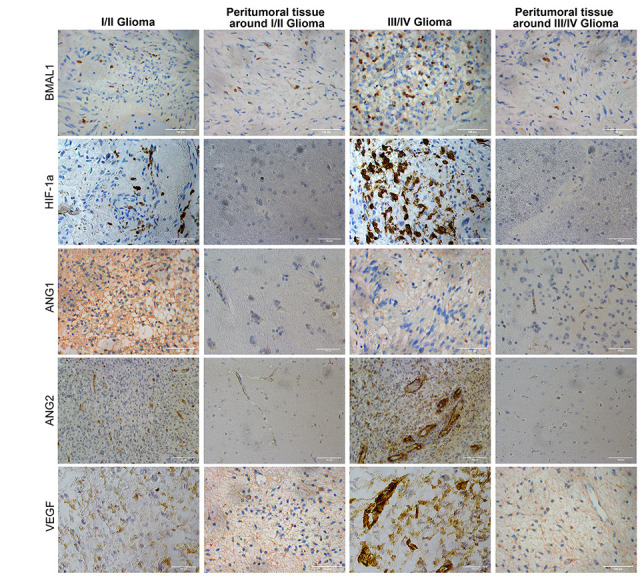
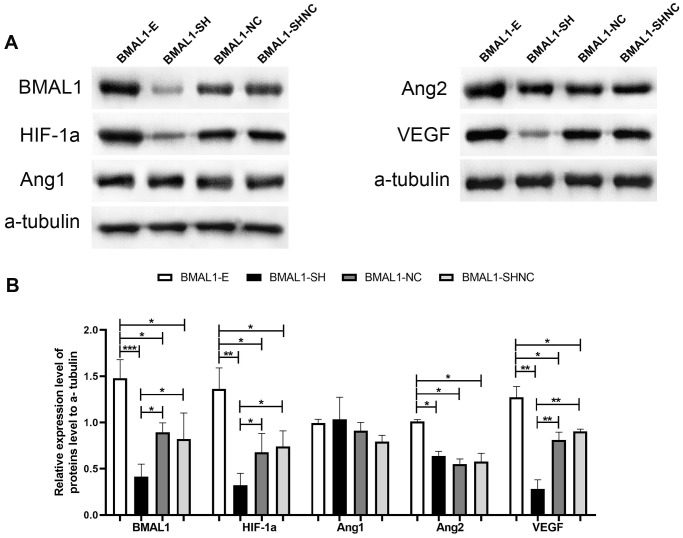
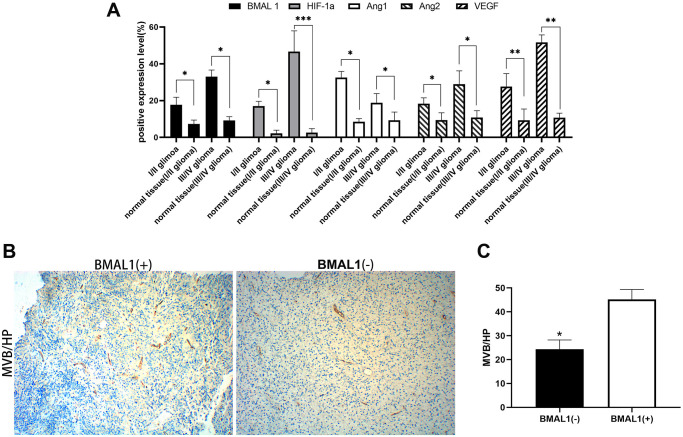
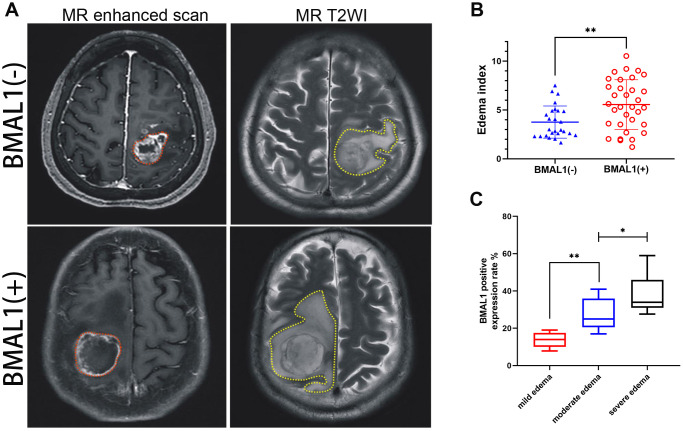
The rhythm gene (Brain and Muscle ARNT-Like 1) may play an important role in glioma tolerance for anti-angiogenesis therapy. In humans with glioma of different pathological grades, expression was significantly different, and the expression of (Angiopoietin 2) and (Vascular endothelial growth factor) was positively correlated with the expression of . Additionally, expression is positively correlated with the microvascular density and peritumoral edema of glioma. According to experiments, silencing the expression of in primary glioma cells results in a decrease in the expression of . In contrast, overexpression of promotes the expression of and via pathway. Therefore, likely participates in the angiogenesis of glioma by modulating and expression, alters the therapeutic effect of anti-angiogenic treatments, and promotes peritumoral brain edema of glioma.
节律基因(脑和肌肉 ARNT 样蛋白 1)可能在神经胶质瘤对血管生成抑制治疗的耐受性中发挥重要作用。在不同病理分级的神经胶质瘤患者中, 表达水平存在显著差异,且 (血管生成素 2)和 (血管内皮生长因子)的表达与 的表达呈正相关。此外, 表达与神经胶质瘤的微血管密度和瘤周水肿呈正相关。根据相关实验,在原代神经胶质瘤细胞中沉默 的表达会导致 的表达降低。相反,过表达 通过 途径促进 和 的表达。因此, 通过调节 和 的表达参与神经胶质瘤的血管生成,改变抗血管生成治疗的疗效,并促进神经胶质瘤瘤周脑水肿。