Department of Molecular and Cell Biology, University of California Berkeley, Berkeley, CA, USA.
Howard Hughes Medical Institute, University of California, Berkeley, CA, USA.
Sci Rep. 2021 Nov 23;11(1):22810. doi: 10.1038/s41598-021-01932-w.
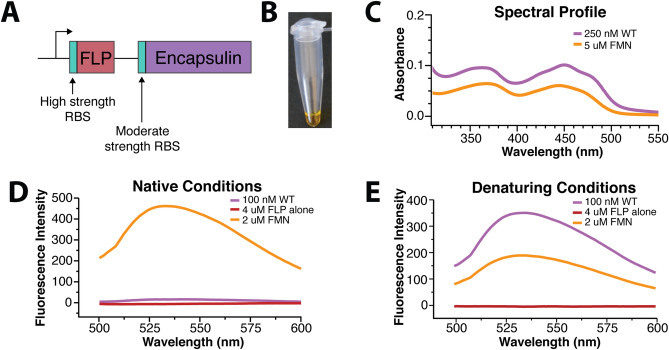
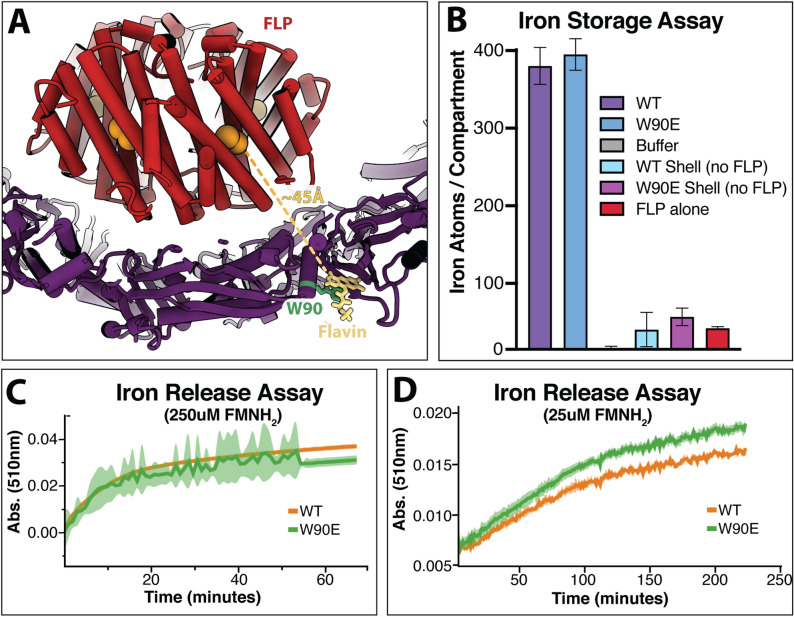
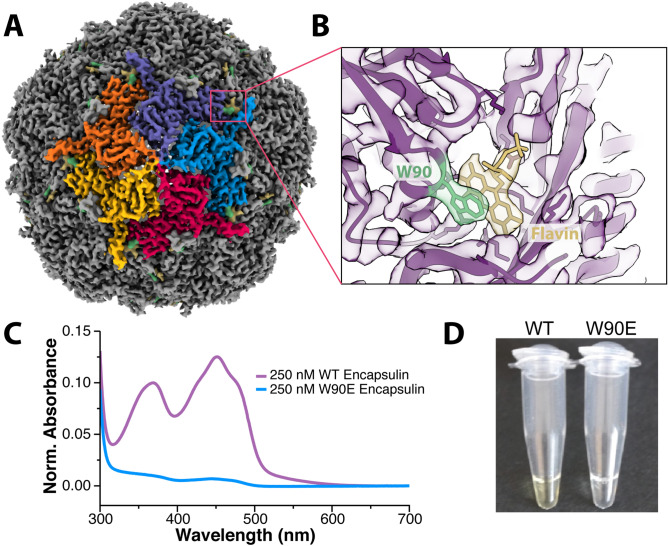
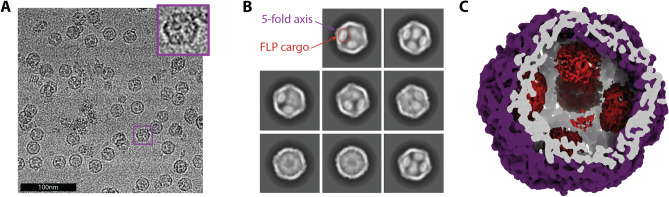
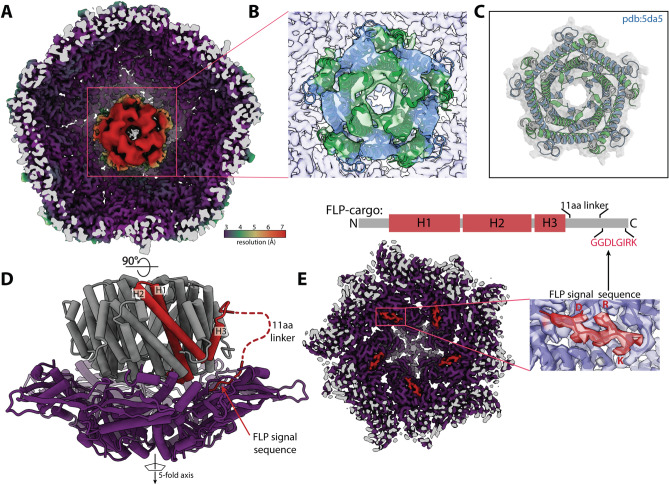
Bacterial nanocompartments, also known as encapsulins, are an emerging class of protein-based 'organelles' found in bacteria and archaea. Encapsulins are virus-like icosahedral particles comprising a ~ 25-50 nm shell surrounding a specific cargo enzyme. Compartmentalization is thought to create a unique chemical environment to facilitate catalysis and isolate toxic intermediates. Many questions regarding nanocompartment structure-function remain unanswered, including how shell symmetry dictates cargo loading and to what extent the shell facilitates enzymatic activity. Here, we explore these questions using the model Thermotoga maritima nanocompartment known to encapsulate a redox-active ferritin-like protein. Biochemical analysis revealed the encapsulin shell to possess a flavin binding site located at the interface between capsomere subunits, suggesting the shell may play a direct and active role in the function of the encapsulated cargo. Furthermore, we used cryo-EM to show that cargo proteins use a form of symmetry-matching to facilitate encapsulation and define stoichiometry. In the case of the Thermotoga maritima encapsulin, the decameric cargo protein with fivefold symmetry preferentially binds to the pentameric-axis of the icosahedral shell. Taken together, these observations suggest the shell is not simply a passive barrier-it also plays a significant role in the structure and function of the cargo enzyme.
细菌纳米隔间,也称为被膜小体,是一类新兴的蛋白基“细胞器”,存在于细菌和古菌中。被膜小体是类似于病毒的二十面体颗粒,由一个约 25-50nm 的壳包围着特定的货物酶。分隔被认为创造了一个独特的化学环境,以促进催化和隔离有毒中间体。关于纳米隔间的结构-功能仍有许多问题尚未得到解答,包括壳对称性如何决定货物装载以及壳在多大程度上促进酶活性。在这里,我们使用已知封装氧化还原活性铁蛋白样蛋白的模型 Thermotoga maritima 纳米隔间来探索这些问题。生化分析表明,被膜小体壳具有位于衣壳亚基界面处的黄素结合位点,这表明壳可能在封装货物的功能中发挥直接和积极的作用。此外,我们使用 cryo-EM 显示货物蛋白使用一种对称匹配形式来促进封装并定义化学计量。在 Thermotoga maritima 被膜小体的情况下,具有五重对称的 decameric 货物蛋白优先结合到二十面体壳的五聚体轴上。总之,这些观察结果表明壳不仅是一个被动的障碍,它还在货物酶的结构和功能中发挥重要作用。