Institute of Physical Chemistry, Department of Chemistry, University of Hamburg, Hamburg 20146, Germany.
The Hamburg Centre for Ultrafast Imaging, University of Hamburg, Hamburg 20146, Germany.
ACS Nano. 2024 Sep 10;18(36):25325-25336. doi: 10.1021/acsnano.4c09551. Epub 2024 Aug 27.
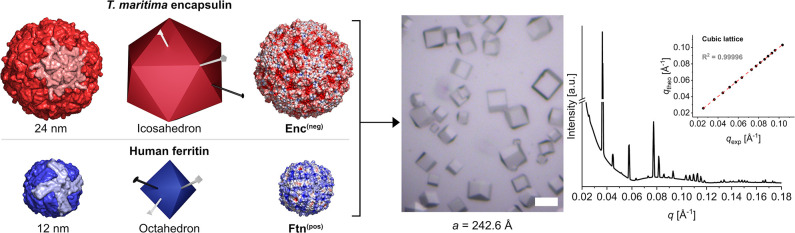
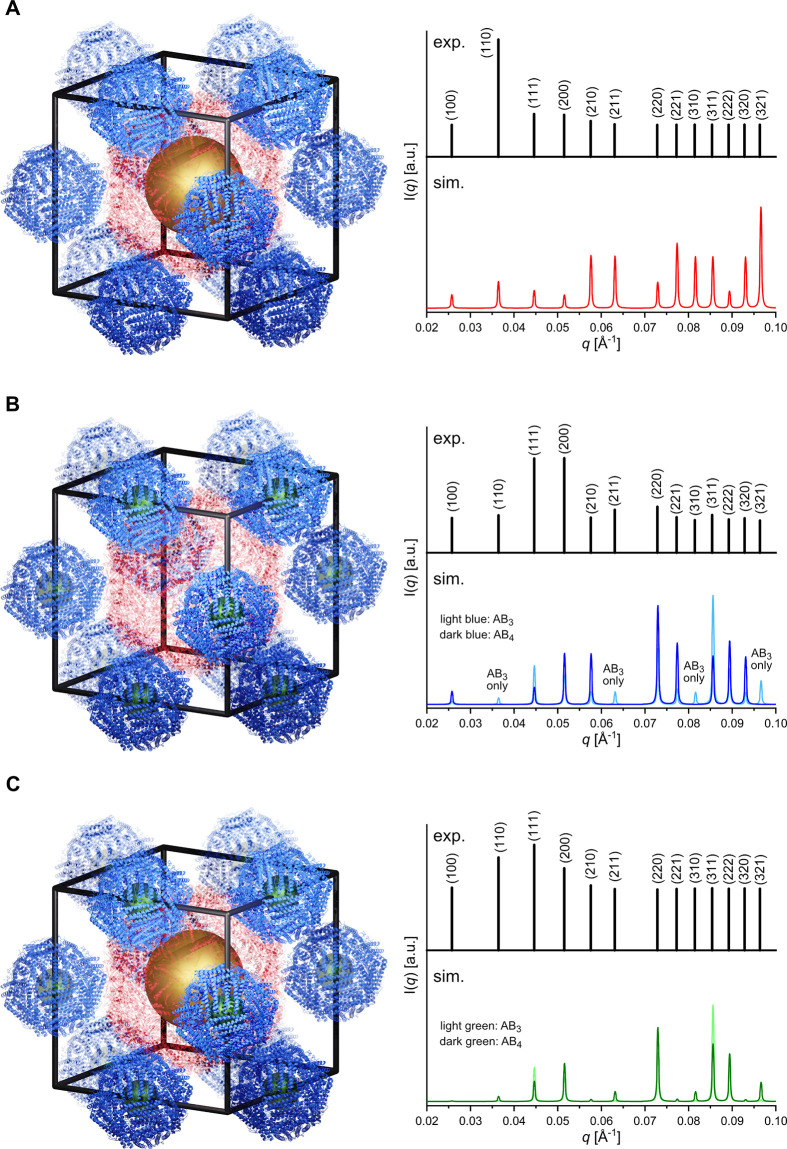
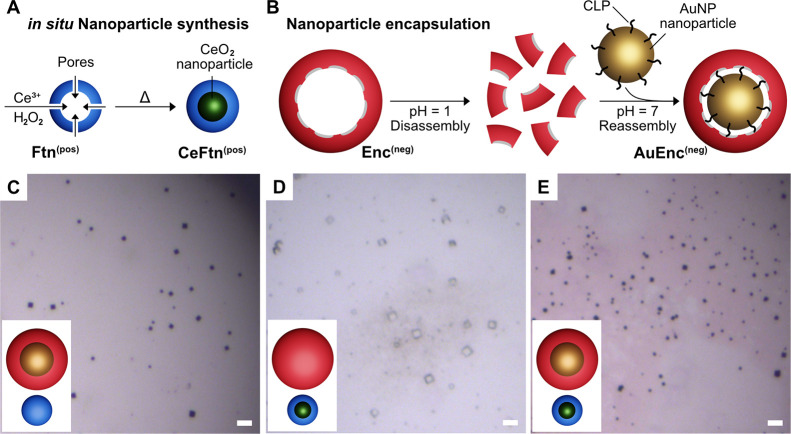
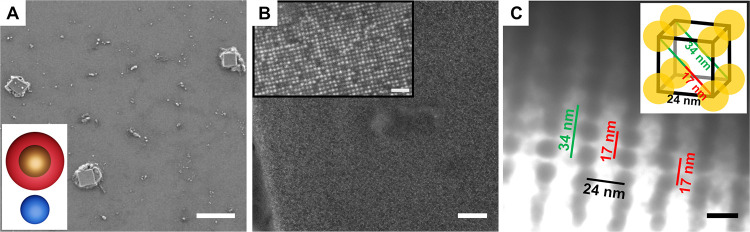
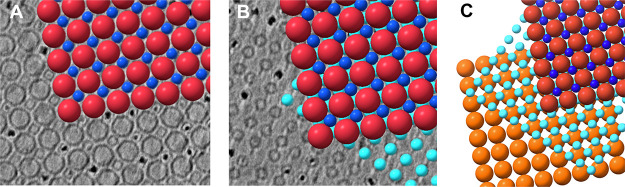
This study focuses on the design and characterization of binary nanoparticle superlattices: Two differently sized, supercharged protein nanocages are used to create a matrix for nanoparticle arrangement. We have previously established the assembly of protein nanocages of the same size. Here, we present another approach for multicomponent biohybrid material synthesis by successfully assembling two differently sized supercharged protein nanocages with different symmetries. Typically, the ordered assembly of objects with nonmatching symmetry is challenging, but our electrostatic-based approach overcomes the symmetry mismatch by exploiting electrostatic interactions between oppositely charged cages. Moreover, our study showcases the use of nanoparticles as a contrast enhancer in an elegant way to gain insights into the structural details of crystalline biohybrid materials. The assembled materials were characterized with various methods, including transmission electron microscopy (TEM) and single-crystal small-angle X-ray diffraction (SC-SAXD). We employed cryo-plasma-focused ion beam milling (cryo-PFIB) to prepare lamellae for the investigation of nanoparticle sublattices via electron cryo-tomography. Importantly, we refined superlattice structure data obtained from single-crystal SAXD experiments, providing conclusive evidence of the final assembly type. Our findings highlight the versatility of protein nanocages for creating distinctive types of binary superlattices. Because the nanoparticles do not influence the type of assembly, protein cage matrices can combine various nanoparticles in the solid state. This study not only contributes to the expanding repertoire of nanoparticle assembly methods but also demonstrates the power of advanced characterization techniques in elucidating the structural intricacies of these biohybrid materials.
使用两种不同尺寸、超荷电的蛋白质纳米笼来构建纳米颗粒排列的基质。我们之前已经建立了相同尺寸的蛋白质纳米笼的组装。在这里,我们通过成功组装两种具有不同对称性的不同尺寸的超荷电蛋白质纳米笼,提出了另一种用于多组分生物杂化材料合成的方法。通常,具有不匹配对称性的物体的有序组装具有挑战性,但我们基于静电的方法通过利用带相反电荷的笼之间的静电相互作用克服了对称性不匹配。此外,我们的研究展示了使用纳米颗粒作为对比增强剂的一种巧妙方法,以深入了解结晶生物杂化材料的结构细节。使用各种方法对组装材料进行了表征,包括透射电子显微镜 (TEM) 和单晶小角 X 射线衍射 (SC-SAXD)。我们采用冷冻等离子体聚焦离子束铣削 (cryo-PFIB) 来制备用于通过电子冷冻断层扫描研究纳米颗粒亚晶格的薄片。重要的是,我们对单晶 SAXD 实验获得的超晶格结构数据进行了精修,提供了最终组装类型的确凿证据。我们的发现强调了蛋白质纳米笼在创建独特类型的二元超晶格方面的多功能性。由于纳米颗粒不会影响组装类型,蛋白质笼基质可以在固态下组合各种纳米颗粒。本研究不仅为扩展的纳米颗粒组装方法提供了贡献,还展示了先进表征技术在阐明这些生物杂化材料结构复杂性方面的强大功能。