Division of Gastroenterology and Hepatology, University of Pennsylvania, Philadelphia, PA, USA.
Penn Image-Guided Interventions Laboratory, University of Pennsylvania, Philadelphia, PA, USA.
Sci Rep. 2021 Nov 23;11(1):22763. doi: 10.1038/s41598-021-02093-6.
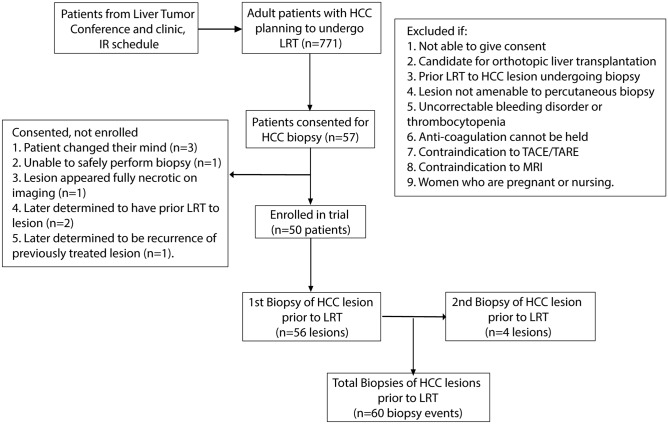
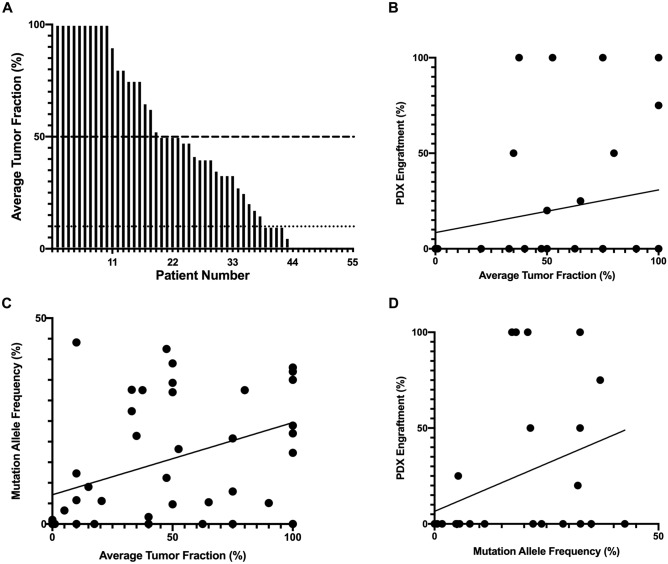
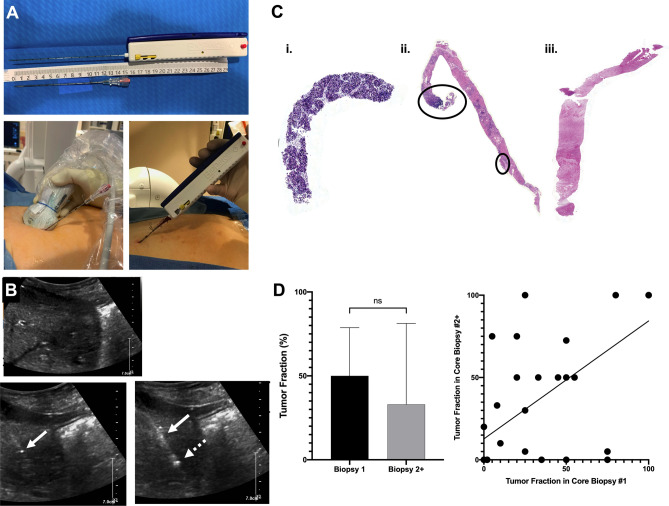
In the era of precision medicine, biopsies are playing an increasingly central role in cancer research and treatment paradigms; however, patient outcomes and analyses of biopsy quality, as well as impact on downstream clinical and research applications, remain underreported. Herein, we report biopsy safety and quality outcomes for percutaneous core biopsies of hepatocellular carcinoma (HCC) performed as part of a prospective clinical trial. Patients with a clinical diagnosis of HCC were enrolled in a prospective cohort study for the genetic, proteomic, and metabolomic profiling of HCC at two academic medical centers from April 2016 to July 2020. Under image guidance, 18G core biopsies were obtained using coaxial technique at the time of locoregional therapy. The primary outcome was biopsy quality, defined as tumor fraction in the core biopsy. 56 HCC lesions from 50 patients underwent 60 biopsy events with a median of 8 core biopsies per procedure (interquartile range, IQR, 7-10). Malignancy was identified in 45/56 (80.4%, 4 without pathology) biopsy events, including HCC (40/56, 71.4%) and cholangiocarcinoma (CCA) or combined HCC-CCA (5/56, 8.9%). Biopsy quality was highly variable with a median of 40% tumor in each biopsy core (IQR 10-75). Only 43/56 (76.8%) and 23/56 (41.1%) samples met quality thresholds for genomic or metabolomic/proteomic profiling, respectively, requiring expansion of the clinical trial. Overall and major complication rates were 5/60 (8.3%) and 3/60 (5.0%), respectively. Despite uniform biopsy protocol, biopsy quality varied widely with up to 59% of samples to be inadequate for intended purpose. This finding has important consequences for clinical trial design and highlights the need for quality control prior to applications in which the presence of benign cell types may substantially alter findings.
在精准医学时代,活检在癌症研究和治疗模式中发挥着越来越核心的作用;然而,活检的患者结局和质量分析,以及对下游临床和研究应用的影响,仍报道不足。在此,我们报告了在两个学术医疗中心进行的一项前瞻性临床试验中,对肝细胞癌(HCC)进行的经皮核心活检的安全性和质量结果。在 2016 年 4 月至 2020 年 7 月期间,具有 HCC 临床诊断的患者被纳入了一项 HCC 的遗传、蛋白质组学和代谢组学分析的前瞻性队列研究。在图像引导下,在局部区域治疗时使用同轴技术获得 18G 核心活检。主要结局是活检质量,定义为核心活检中的肿瘤分数。50 名患者的 56 个 HCC 病变共进行了 60 次活检,中位数为每个手术 8 个核心活检(四分位距 IQR,7-10)。45/56(80.4%,4 例无病理学)活检事件中发现了恶性肿瘤,包括 HCC(40/56,71.4%)和胆管癌(CCA)或 HCC-CCA 混合癌(5/56,8.9%)。活检质量差异很大,每个活检核心的中位数为 40%肿瘤(IQR 10-75)。只有 43/56(76.8%)和 23/56(41.1%)的样本分别满足基因组或代谢组学/蛋白质组学分析的质量阈值,需要扩大临床试验。总的和主要并发症发生率分别为 5/60(8.3%)和 3/60(5.0%)。尽管有统一的活检方案,但活检质量差异很大,多达 59%的样本不适合预期目的。这一发现对临床试验设计有重要影响,并强调了在可能会显著改变研究结果的良性细胞类型存在的情况下,在应用前进行质量控制的必要性。