Xu Deming, Zhou Changbi, Lin Juanyun, Cai Wenhui, Lin Wei
Department of Anesthesiology, The Affiliated Hospital of Putian University, Putian, Fujian 351100, P.R. China.
Department of General Surgery, The Affiliated Hospital of Putian University, Putian, Fujian 351100, P.R. China.
Exp Ther Med. 2022 Jan;23(1):9. doi: 10.3892/etm.2021.10931. Epub 2021 Oct 28.
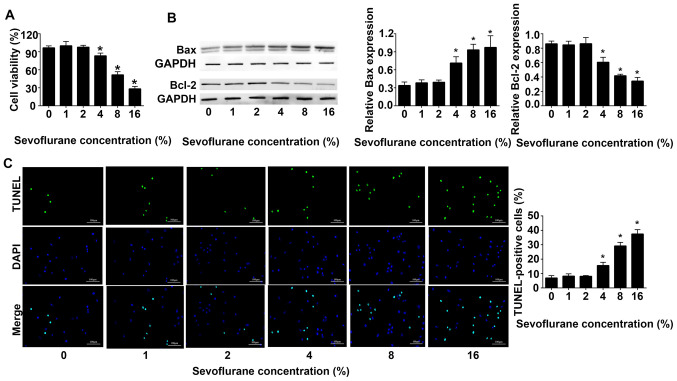
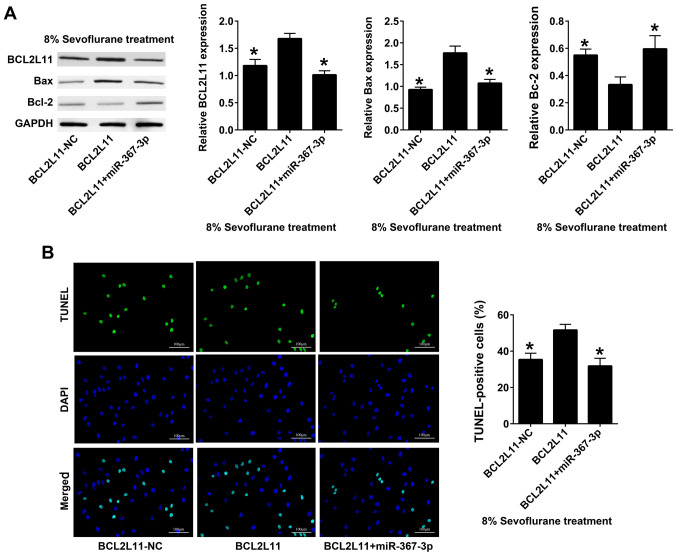
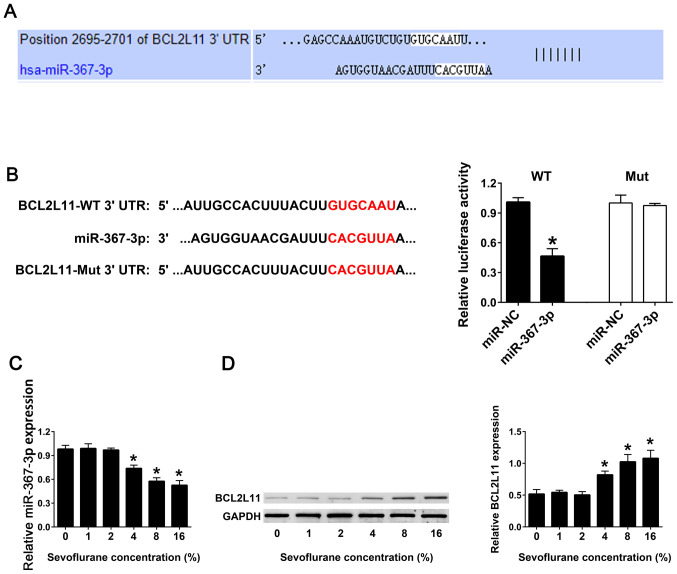
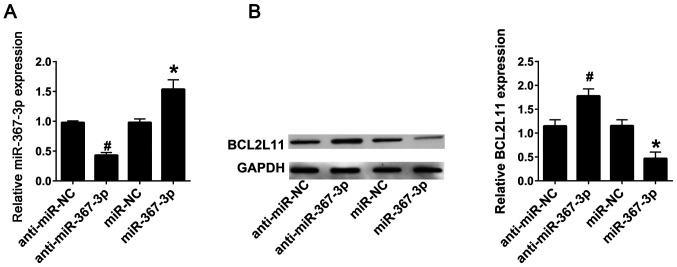
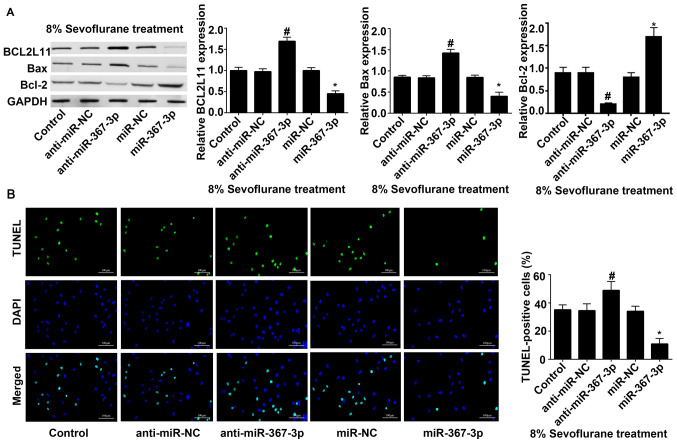
The present study aimed to characterize the effect of microRNA (miR)-367-3p on sevoflurane anesthesia and elucidate the underlying mechanism. A total of 36 4-month-old adult Sprague-Dawley rats were divided into six groups. Sevoflurane was inhaled at concentrations of 0, 1, 2, 4, 8 and 16% for a total of 6 h; the hippocampus of the brain was subsequently minced and digested, and astrocytes were isolated. Various methods, including reverse transcription-quantitative (RT-q)PCR, western blotting and TUNEL staining, were used to determine the expression levels of Bax, BCL-2 and BCL-2-like protein 11 (BCL2L11), as well as the level of apoptosis. The rats were treated with 8% sevoflurane and the astrocytes from the rats were transfected with miR-367-3p or anti-miR-367-3p. The present study demonstrated that sevoflurane promoted astrocytes apoptosis. Western blotting revealed that with an increase of sevoflurane concentration, the expression levels of the apoptotic proteins Bax and BCL2L11 were significantly increased, whereas the protein expression levels of BCL-2 were significantly decreased. However, overexpression of miR-367-3p reversed these effects. TUNEL staining revealed that sevoflurane promoted the apoptosis of astrocytes, while apoptosis was reversed by miR-367-3p overexpression. RT-qPCR demonstrated that sevoflurane inhibited the expression of miR-367-3p. Notably, miR-367-3p reduced the expression of BCL2L11, thereby inhibiting the apoptosis of astrocytes originating from the hippocampal area of adult rats induced by sevoflurane. Therefore, miR-367-3p and BCL2L11 may act as effective targets for the study of anesthesia.
本研究旨在表征微小RNA(miR)-367-3p对七氟醚麻醉的影响,并阐明其潜在机制。总共36只4个月大的成年Sprague-Dawley大鼠被分为六组。分别以0%、1%、2%、4%、8%和16%的浓度吸入七氟醚,共6小时;随后将大脑海马体切碎并消化,分离出星形胶质细胞。采用逆转录定量(RT-q)PCR、蛋白质印迹法和TUNEL染色等多种方法,测定Bax、BCL-2和BCL-2样蛋白11(BCL2L11)的表达水平以及凋亡水平。用8%的七氟醚处理大鼠,并将大鼠的星形胶质细胞用miR-367-3p或抗miR-367-3p进行转染。本研究表明,七氟醚可促进星形胶质细胞凋亡。蛋白质印迹法显示,随着七氟醚浓度的增加,凋亡蛋白Bax和BCL2L11的表达水平显著升高,而BCL-2的蛋白表达水平显著降低。然而,miR-367-3p的过表达逆转了这些作用。TUNEL染色显示,七氟醚可促进星形胶质细胞凋亡,而miR-367-3p的过表达可逆转凋亡。RT-qPCR表明,七氟醚可抑制miR-367-3p的表达。值得注意的是,miR-367-3p降低了BCL2L11的表达,从而抑制了七氟醚诱导的成年大鼠海马区星形胶质细胞凋亡。因此,miR-367-3p和BCL2L11可能作为麻醉研究的有效靶点。