Didactics and Educational Research in Health Care, Faculty of Health, School of Medicine, Witten/Herdecke University, Witten, Germany.
Faculty of Health, School of Medicine, Witten/Herdecke University, Witten, Germany.
JMIR Mhealth Uhealth. 2021 Nov 23;9(11):e33012. doi: 10.2196/33012.
In October 2020, Germany became the first country, worldwide, to approve certain mobile health (mHealth) apps, referred to as DiGA (Digitale Gesundheitsanwendungen, in German, meaning digital health applications), for prescription with costs covered by standard statutory health insurance. Yet, this option has only been used to a limited extent so far.
The aim of this study was to investigate physicians' and psychotherapists' current attitudes toward mHealth apps, barriers to adoption, and potential remedies.
We conducted a two-stage sequential mixed methods study. In phase one, semistructured interviews were conducted with physicians and psychotherapists for questionnaire design. In phase two, an online survey was conducted among general practitioners, physicians, and psychotherapists.
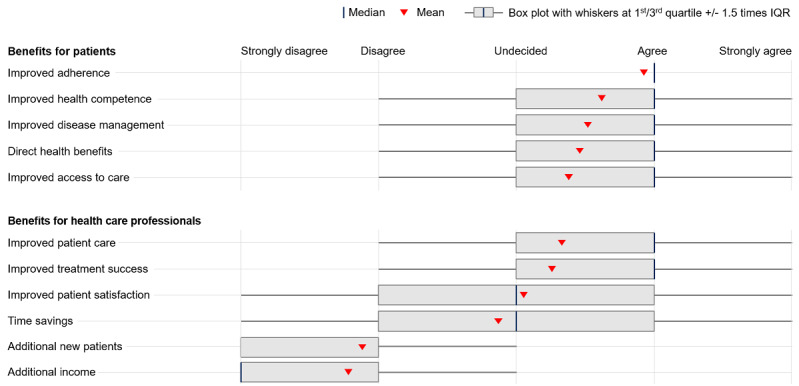
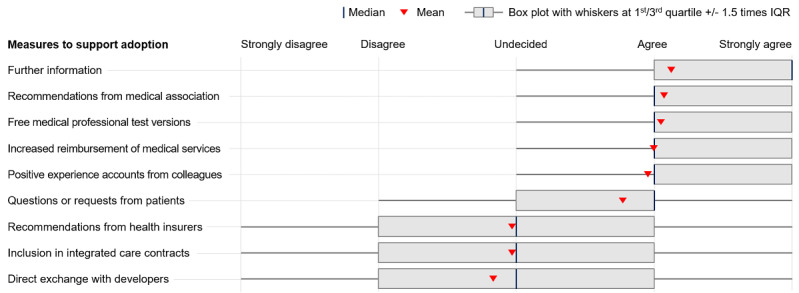
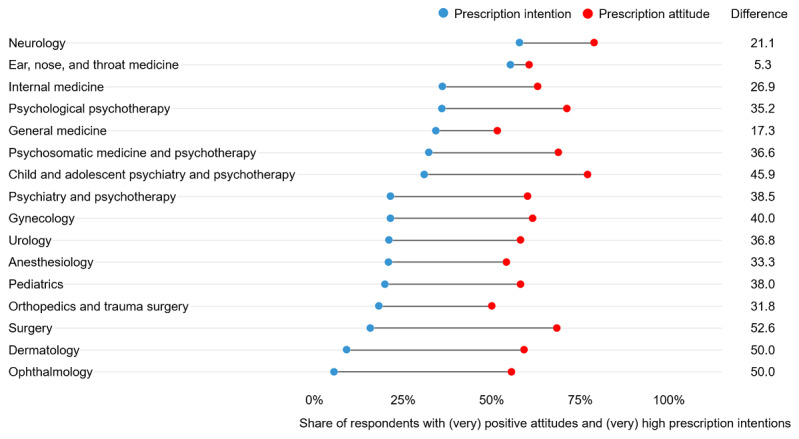
A total of 1308 survey responses by mostly outpatient-care general practitioners, physicians, and psychotherapists from across Germany who could prescribe DiGA were recorded, making this the largest study on mHealth prescriptions to date. A total of 62.1% (807/1299) of respondents supported the opportunity to prescribe DiGA. Improved adherence (997/1294, 77.0%), health literacy (842/1294, 65.1%), and disease management (783/1294, 60.5%) were most frequently seen as benefits of DiGA. However, only 30.3% (393/1299) of respondents planned to prescribe DiGA, varying greatly by medical specialty. Professionals are still facing substantial barriers, such as insufficient information (1135/1295, 87.6%), reimbursement for DiGA-related medical services (716/1299, 55.1%), medical evidence (712/1298, 54.9%), legal uncertainties (680/1299, 52.3%), and technological uncertainties (658/1299, 50.7%). To support professionals who are unsure of prescribing DiGA, extended information campaigns (1104/1297, 85.1%) as well as recommendations from medical associations (1041/1297, 80.3%) and medical colleagues (1024/1297, 79.0%) were seen as the most impactful remedies.
To realize the benefits from DiGA through increased adoption, additional information sharing about DiGA from trusted bodies, reimbursement for DiGA-related medical services, and further medical evidence are recommended.
2020 年 10 月,德国成为全球首个批准某些移动医疗(mHealth)应用程序(称为 DiGA,德语为数字化健康应用程序)处方的国家,这些应用程序的费用由法定健康保险承担。然而,到目前为止,这种选择的使用范围还很有限。
本研究旨在调查医生和心理治疗师对 mHealth 应用程序的当前态度、采用障碍以及潜在的补救措施。
我们进行了一项两阶段顺序混合方法研究。在第一阶段,对医生和心理治疗师进行了半结构化访谈,以设计问卷。在第二阶段,对德国各地的全科医生、医生和心理治疗师进行了在线调查。
记录了来自德国各地的可开具 DiGA 的门诊医生、医生和心理治疗师的 1308 份调查回复,这是迄今为止关于 mHealth 处方的最大研究。共有 62.1%(807/1299)的受访者支持开具 DiGA 的机会。改善依从性(997/1294,77.0%)、健康素养(842/1294,65.1%)和疾病管理(783/1294,60.5%)是最常被视为 DiGA 益处的因素。然而,只有 30.3%(393/1299)的受访者计划开具 DiGA,这在不同医疗专业之间差异很大。专业人员仍然面临着许多障碍,例如信息不足(1135/1295,87.6%)、DiGA 相关医疗服务的报销(716/1299,55.1%)、医学证据(712/1298,54.9%)、法律不确定性(680/1299,52.3%)和技术不确定性(658/1299,50.7%)。为了支持对开具 DiGA 不确定的专业人员,建议开展扩展信息宣传活动(1104/1297,85.1%),以及来自医学协会(1041/1297,80.3%)和医学同事(1024/1297,79.0%)的推荐。
为了通过增加采用来实现 DiGA 的益处,建议从可信赖的机构进一步分享关于 DiGA 的信息、DiGA 相关医疗服务的报销以及更多的医学证据。