LREN, Centre for Research in Neuroscience, Department of Clinical Neurosciences, Lausanne University Hospital and University of Lausanne, Mont Paisible 16, 1011, Lausanne, Switzerland.
EEG and Epilepsy Unit, Department of Neurology, Department of Clinical Neurosciences, University Hospitals and Faculty of Medicine Geneva, Geneva, Switzerland.
Brain Struct Funct. 2022 Apr;227(3):901-911. doi: 10.1007/s00429-021-02428-z. Epub 2021 Nov 24.
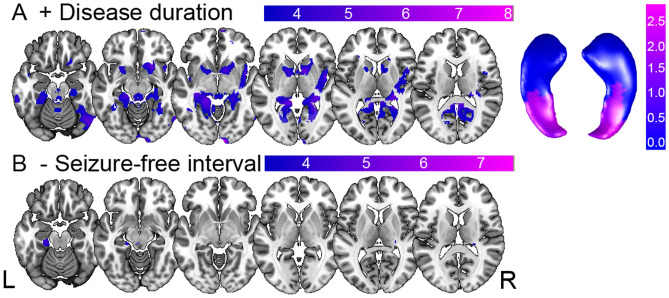
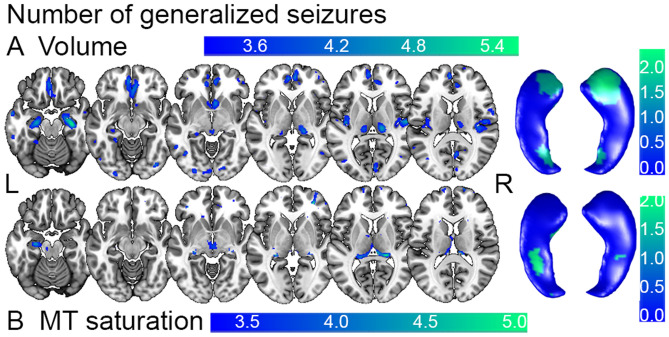
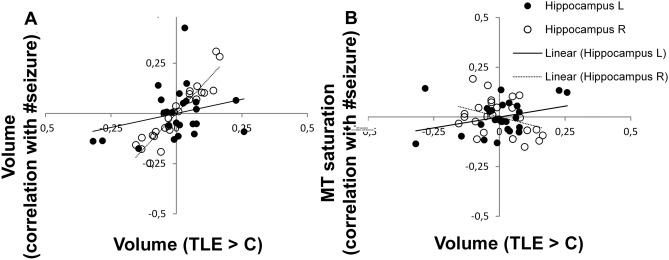
Temporal lobe epilepsy (TLE) is associated with brain pathology extending beyond temporal lobe structures. We sought to look for informative patterns of brain tissue properties in TLE that go beyond the established morphometry differences. We hypothesised that volume differences, particularly in hippocampus, will be paralleled by changes in brain microstructure. The cross-sectional study included TLE patients (n = 25) from a primary care center and sex-/age-matched healthy controls (n = 55). We acquired quantitative relaxometry-based magnetic resonance imaging (MRI) data yielding whole-brain maps of grey matter volume, magnetization transfer (MT) saturation, and effective transverse relaxation rate R2* indicative for brain tissue myelin and iron content. For statistical analysis, we used the computational anatomy framework of voxel-based morphometry and voxel-based quantification. There was a positive correlation between seizure activity and MT saturation measures in the ipsilateral hippocampus, paralleled by volume differences bilaterally. Disease duration correlated positively with iron content in the mesial temporal lobe, while seizure freedom was associated with a decrease of iron in the very same region. Our findings demonstrate the link between TLE clinical phenotype and brain anatomy beyond morphometry differences to show the impact of disease burden on specific tissue properties. We provide direct evidence for the differential effect of clinical phenotype characteristics on processes involving tissue myelin and iron in mesial temporal lobe structures. This study offers a proof-of-concept for the investigation of novel imaging biomarkers in focal epilepsy.
颞叶癫痫(TLE)与超出颞叶结构的脑病理学有关。我们试图寻找 TLE 中超出既定形态测量差异的有意义的脑组织特性模式。我们假设,体积差异,特别是海马体的体积差异,将与脑微观结构的变化相平行。这项横断面研究包括来自初级保健中心的 TLE 患者(n=25)和性别/年龄匹配的健康对照组(n=55)。我们获得了基于定量弛豫率的磁共振成像(MRI)数据,生成了全脑灰质体积、磁化传递(MT)饱和度和有效横向弛豫率 R2*的图谱,这些指标分别代表脑组织结构的髓鞘和铁含量。为了进行统计分析,我们使用了基于体素的形态学和基于体素的定量计算解剖框架。在同侧海马体中,癫痫活动与 MT 饱和度测量呈正相关,双侧海马体体积存在差异。疾病持续时间与内侧颞叶的铁含量呈正相关,而无癫痫发作与同一区域的铁含量减少相关。我们的发现表明,TLE 临床表型与脑解剖之间存在联系,超出了形态测量差异,以显示疾病负担对特定组织特性的影响。我们提供了直接证据,证明临床表型特征对涉及内侧颞叶结构中组织髓鞘和铁的过程有不同的影响。这项研究为局灶性癫痫的新型成像生物标志物的研究提供了概念验证。