Department of Veterinary Sciences; Department of Medical and Surgical Sciences, University of Bologna.
Department of Veterinary Sciences, University of Bologna.
Eur J Histochem. 2021 Nov 25;65(s1):3289. doi: 10.4081/ejh.2021.3289.
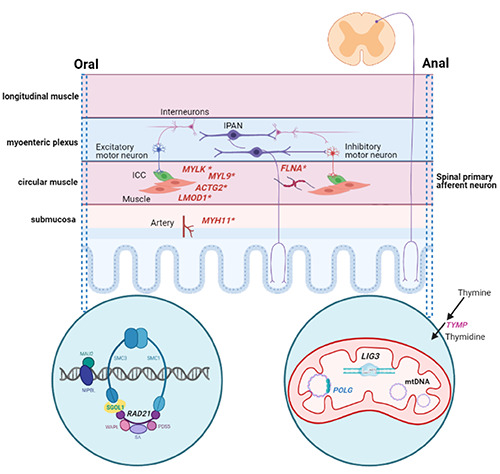
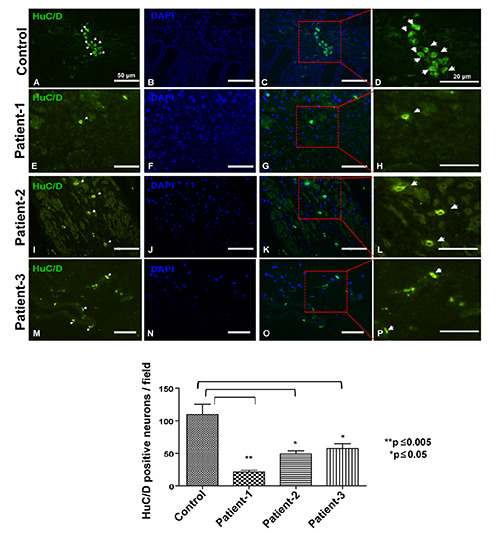
The enteric nervous system (ENS) is the third division of the autonomic autonomic nervous system and the largest collection of neurons outside the central nervous system (CNS). The ENS has been referred to as "the brain in the gut" or "the second brain of the human body" because of its highly integrated neural circuits controlling a vast repertoire of gut functions, including absorption/secretion, splanchnic blood vessels, some immunological aspects, intestinal epithelial barrier, and gastrointestinal (GI) motility. The latter function is the result of the ENS fine-tuning over smooth musculature, along with the contribution of other key cells, such as enteric glia (astrocyte like cells supporting and contributing to neuronal activity), interstitial cells of Cajal (the pacemaker cells of the GI tract involved in neuromuscular transmission), and enteroendocrine cells (releasing bioactive substances, which affect gut physiology). Any noxa insult perturbing the ENS complexity may determine a neuropathy with variable degree of neuro-muscular dysfunction. In this review, we aim to cover the most recent update on genetic mechanisms leading to enteric neuropathies ranging from Hirschsprung's disease (characterized by lack of any enteric neurons in the gut wall) up to more generalized form of dysmotility such as chronic intestinal pseudo-obstruction (CIPO) with a significant reduction of enteric neurons. In this line, we will discuss the role of the RAD21 mutation, which we have demonstrated in a family whose affected members exhibited severe gut dysmotility. Other genes contributing to gut motility abnormalities will also be presented. In conclusion, the knowledge on the molecular mechanisms involved in enteric neuropathy may unveil strategies to better manage patients with neurogenic gut dysmotility and pave the way to targeted therapies.
肠神经系统 (ENS) 是自主神经系统的第三部分,也是中枢神经系统 (CNS) 外最大的神经元集合。由于其高度整合的神经回路控制着广泛的肠道功能,包括吸收/分泌、内脏血管、某些免疫方面、肠道上皮屏障和胃肠道 (GI) 蠕动,ENS 被称为“肠道中的大脑”或“人体的第二个大脑”。后者的功能是 ENS 对平滑肌进行微调的结果,同时还有其他关键细胞的贡献,如肠胶质细胞(支持和促进神经元活动的星形胶质样细胞)、Cajal 间质细胞(参与神经肌肉传递的胃肠道起搏细胞)和肠内分泌细胞(释放影响肠道生理学的生物活性物质)。任何破坏 ENS 复杂性的有害物质刺激都可能导致神经病变,导致不同程度的神经肌肉功能障碍。在这篇综述中,我们旨在涵盖导致肠神经病的最新遗传机制,从先天性巨结肠(肠道壁缺乏任何肠神经元)到更广泛的运动障碍形式,如慢性肠假性梗阻 (CIPO),肠神经元明显减少。在这方面,我们将讨论 RAD21 突变的作用,我们已经在一个家族中证明了该突变,该家族的受累成员表现出严重的肠道运动障碍。还将介绍其他导致肠道运动异常的基因。总之,对肠神经病涉及的分子机制的了解可能揭示出更好地管理神经源性肠道运动障碍患者的策略,并为靶向治疗铺平道路。