Donders Institute for Brain, Cognition and Behaviour, Artificial Intelligence Department, Radboud University, Thomas van Aquinostraat 4, 6525 GD, Nijmegen, The Netherlands.
Institute for Cognitive Systems, Technical University of Munich, Munich, Germany.
Sci Rep. 2021 Nov 24;11(1):22844. doi: 10.1038/s41598-021-02200-7.
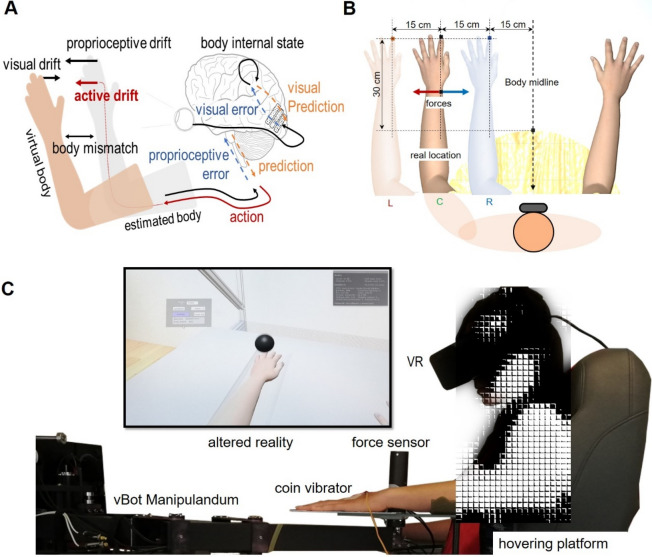
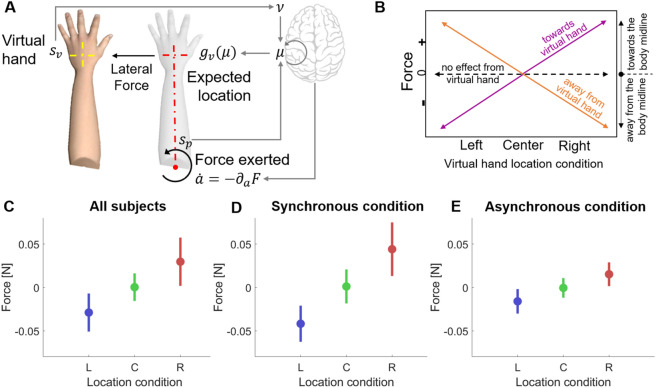
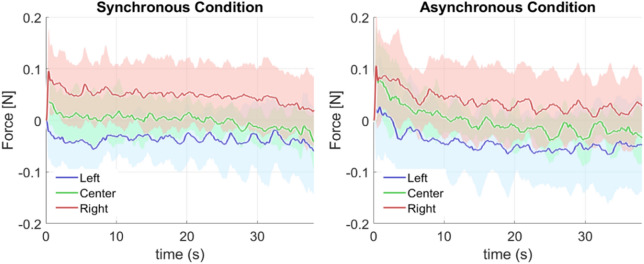
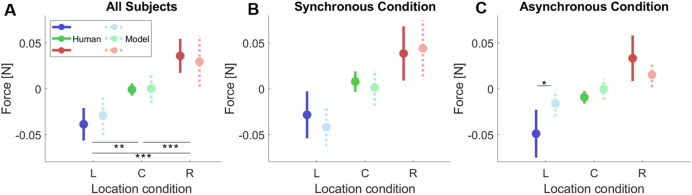
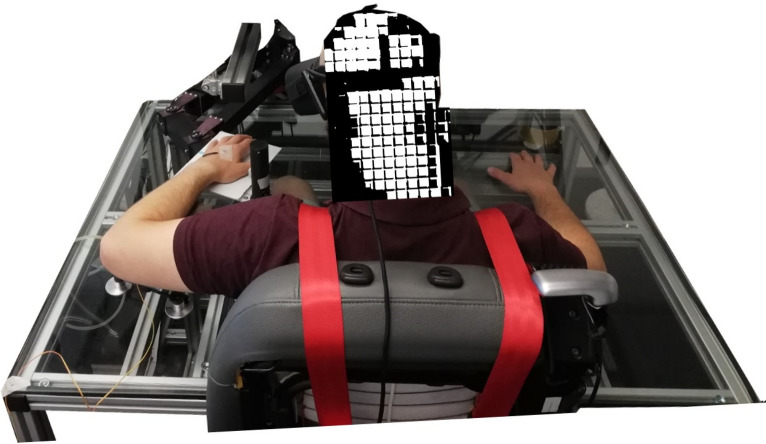
The perception of our body in space is flexible and manipulable. The predictive brain hypothesis explains this malleability as a consequence of the interplay between incoming sensory information and our body expectations. However, given the interaction between perception and action, we might also expect that actions would arise due to prediction errors, especially in conflicting situations. Here we describe a computational model, based on the free-energy principle, that forecasts involuntary movements in sensorimotor conflicts. We experimentally confirm those predictions in humans using a virtual reality rubber-hand illusion. Participants generated movements (forces) towards the virtual hand, regardless of its location with respect to the real arm, with little to no forces produced when the virtual hand overlaid their physical hand. The congruency of our model predictions and human observations indicates that the brain-body is generating actions to reduce the prediction error between the expected arm location and the new visual arm. This observed unconscious mechanism is an empirical validation of the perception-action duality in body adaptation to uncertain situations and evidence of the active component of predictive processing.
我们对空间中身体的感知是灵活且可塑的。预测大脑假说将这种可塑性质解释为传入感觉信息和我们对身体的预期之间相互作用的结果。然而,鉴于感知和行动之间的相互作用,我们可能也会期望行动会因预测错误而产生,尤其是在冲突的情况下。在这里,我们描述了一个基于自由能原理的计算模型,该模型可以预测感觉运动冲突中的无意识运动。我们使用虚拟现实橡胶手错觉在人类身上进行了实验验证。参与者朝着虚拟手(用力)移动,无论虚拟手相对于真实手臂的位置如何,当虚拟手与他们的物理手重叠时,产生的力很小或几乎没有。我们的模型预测和人类观察结果的一致性表明,大脑-身体正在产生动作以减少预期手臂位置和新视觉手臂之间的预测误差。这种观察到的无意识机制是对身体适应不确定情况时感知-动作二元性的实证验证,也是预测处理中主动成分的证据。