Zu Yue, Yang Jinyu, Zhang Chengliang, Liu Dong
Tongji Hospital, Tongji Medical College, Huazhong University of Science and Technology, Wuhan, China.
Front Pharmacol. 2021 Nov 8;12:761255. doi: 10.3389/fphar.2021.761255. eCollection 2021.
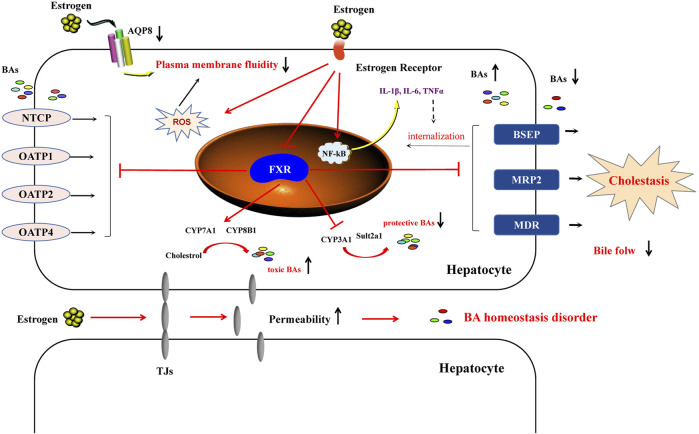
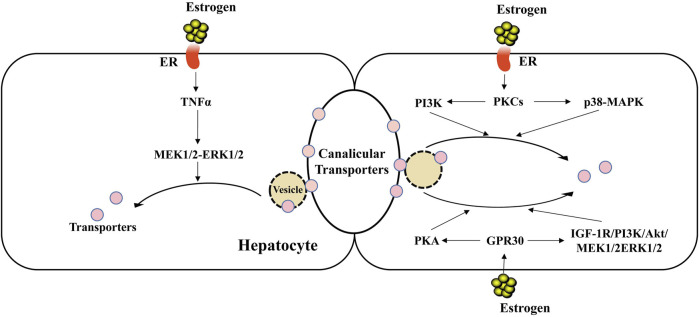
Estrogens are steroid hormones with a wide range of biological activities. The excess of estrogens can lead to decreased bile flow, toxic bile acid (BA) accumulation, subsequently causing intrahepatic cholestasis. Estrogen-induced cholestasis (EIC) may have increased incidence during pregnancy, and within women taking oral contraception and postmenopausal hormone replacement therapy, and result in liver injury, preterm birth, meconium-stained amniotic fluid, and intrauterine fetal death in pregnant women. The main pathogenic mechanisms of EIC may include deregulation of BA synthetic or metabolic enzymes, and BA transporters. In addition, impaired cell membrane fluidity, inflammatory responses and change of hepatocyte tight junctions are also involved in the pathogenesis of EIC. In this article, we review the role of estrogens in intrahepatic cholestasis, and outlined the mechanisms of EIC, providing a greater understanding of this disease.
雌激素是具有广泛生物活性的甾体激素。雌激素过量会导致胆汁流量减少、毒性胆汁酸(BA)蓄积,进而引起肝内胆汁淤积。雌激素诱导的胆汁淤积(EIC)在孕期、服用口服避孕药的女性以及绝经后激素替代治疗期间的发病率可能会增加,并导致肝损伤、早产、羊水胎粪污染以及孕妇宫内胎儿死亡。EIC的主要致病机制可能包括BA合成或代谢酶以及BA转运体的失调。此外,细胞膜流动性受损、炎症反应和肝细胞紧密连接的改变也参与了EIC的发病机制。在本文中,我们综述了雌激素在肝内胆汁淤积中的作用,并概述了EIC的机制,以期对该疾病有更深入的了解。