Ruwanpura Varunika Sonani Hapuwatte, Nowak Spike, Gerth-Guyette Emily, Theodora Minerva, Dysoley Lek, Haile Mebratom, Peeters Grietens Koen, Price Ric Norman, Lynch Caroline Anita, Thriemer Kamala
Global and Tropical Health Division Menzies School of Health Research and Charles Darwin University Darwin Australia.
PATH Seattle WA USA.
Asia Pac Policy Stud. 2021 May;8(2):208-242. doi: 10.1002/app5.314. Epub 2021 Jan 12.
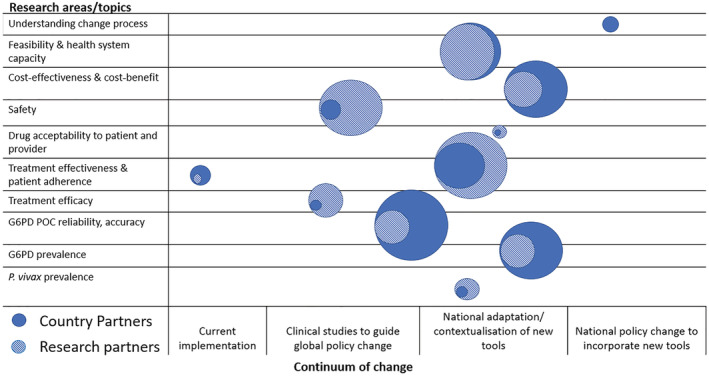
New diagnostics and treatment options for the radical cure of malaria are now available. At the 2019 annual meeting of the Vivax Working Group of the Asia Pacific Malaria Elimination Network, participants took part in a roundtable discussion to identify further evidence required to introduce these new tools into policy and practice. Key gaps identified were accuracy and reliability of glucose-6-phosphate-dehydrogenase deficiency tests, health system capacity, and feasibility and cost effectiveness of novel treatment strategies in routine clinical practice. As expected, there were differences in the priorities between country partners and researcher partners. To achieve the 2030 target for the regional elimination of malaria, evidence to address these issues should be generated as a matter of priority. Review of global guidelines alongside locally generated data will help to ensure the timely revision and optimisation of national treatment guidelines that will be vital to meet regional elimination goals.
现在有了用于根治疟疾的新诊断方法和治疗方案。在亚太疟疾消除网络间日疟工作组2019年年会上,与会者参加了一次圆桌讨论,以确定将这些新工具引入政策和实践所需的进一步证据。确定的主要差距包括葡萄糖-6-磷酸脱氢酶缺乏症检测的准确性和可靠性、卫生系统能力,以及新治疗策略在常规临床实践中的可行性和成本效益。不出所料,国家伙伴和研究伙伴之间的优先事项存在差异。为实现2030年区域消除疟疾的目标,应优先生成解决这些问题的证据。对全球指南以及本地生成的数据进行审查,将有助于确保及时修订和优化国家治疗指南,这对于实现区域消除目标至关重要。