Ogiwara Toshiki, Kawazoe Hitoshi, Egami Saeka, Hashimoto Hironobu, Saito Yoshimasa, Sakiyama Naomi, Ohe Yuichiro, Yamaguchi Masakazu, Furukawa Tetsuya, Hara Azusa, Hiraga Yui, Jibiki Aya, Yokoyama Yuta, Suzuki Sayo, Nakamura Tomonori
Division of Pharmaceutical Care Sciences, Center for Social Pharmacy and Pharmaceutical Care Sciences, Keio University Faculty of Pharmacy, Tokyo, Japan.
Division of Pharmaceutical Care Sciences, Keio University Graduate School of Pharmaceutical Sciences, Tokyo, Japan.
Front Oncol. 2021 Nov 8;11:770268. doi: 10.3389/fonc.2021.770268. eCollection 2021.
Nivolumab and pembrolizumab are the standard treatments for patients with advanced non-small-cell lung cancer (NSCLC). While there are reports on several inflammatory indices and the prognosis of patients with cancer, no study has combined baseline medication with the neutrophil-to-lymphocyte ratio (NLR) to predict clinical outcomes. This study investigated the efficacy of baseline medications plus NLR to predict the effectiveness of nivolumab and pembrolizumab in a real-world clinical setting.
We conducted a single-center retrospective observational study of consecutive patients with advanced NSCLC who received nivolumab or pembrolizumab as first-line, second-line, or beyond treatment between December 2015 and November 2018 at the National Cancer Center Hospital in Japan. Progression-free survival (PFS) and overall survival (OS) were estimated using the Kaplan-Meier method. The drug-based prognostic score for baseline medications plus NLR was weighed based on the regression β coefficients. The multivariable Cox proportional hazard model was used to assess the association between the prognostic score-stratified groups and survival outcomes.
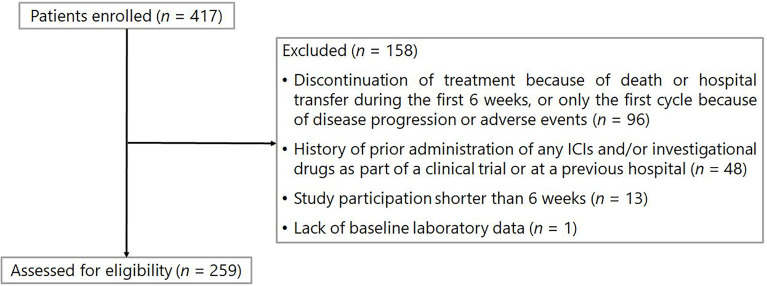
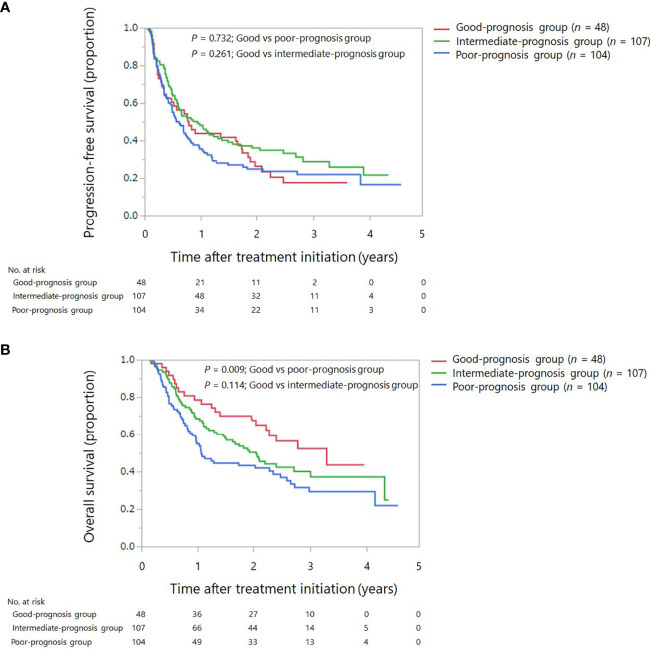
In total, 259 patients were evaluated in this study. A prognostic score calculated from the baseline medications plus NLR was used to categorize the patients into good (score 0), intermediate (scores 1-2), and poor (scores 3-6) -prognosis groups. The multivariable Cox proportional hazard model revealed a significant association between the poor-prognosis group and reduced OS. The hazard ratio of OS was 1.75 (95% confidence interval: 1.07-2.99; = 0.031). In contrast, no association between these prognosis groups and PFS was observed.
The findings suggest that the baseline medications with nivolumab or pembrolizumab plus NLR could lead to progressively shorter survival outcomes in patients with advanced NSCLC and could be used as a prognostic index for poor outcomes. However, to ascertain the clinical application of these findings, these concomitant medications need further validation in a large-scale multicenter study.
纳武利尤单抗和帕博利珠单抗是晚期非小细胞肺癌(NSCLC)患者的标准治疗药物。虽然有关于几种炎症指标与癌症患者预后的报道,但尚无研究将基线用药与中性粒细胞与淋巴细胞比值(NLR)相结合来预测临床结局。本研究在真实临床环境中调查了基线用药加NLR预测纳武利尤单抗和帕博利珠单抗疗效的有效性。
我们对2015年12月至2018年11月期间在日本国立癌症中心医院接受纳武利尤单抗或帕博利珠单抗作为一线、二线或后续治疗的晚期NSCLC连续患者进行了单中心回顾性观察研究。采用Kaplan-Meier方法估计无进展生存期(PFS)和总生存期(OS)。基于回归β系数对基线用药加NLR的药物预后评分进行加权。采用多变量Cox比例风险模型评估预后评分分层组与生存结局之间的关联。
本研究共纳入259例患者。根据基线用药加NLR计算的预后评分将患者分为预后良好(评分0)、中等(评分1-2)和较差(评分3-6)组。多变量Cox比例风险模型显示,预后较差组与OS降低之间存在显著关联。OS的风险比为1.75(95%置信区间:1.07-2.99;P = 0.031)。相比之下,未观察到这些预后组与PFS之间存在关联。
研究结果表明,纳武利尤单抗或帕博利珠单抗联合基线用药加NLR可能导致晚期NSCLC患者的生存结局逐渐缩短,并可作为不良结局的预后指标。然而,为确定这些研究结果的临床应用,这些联合用药需要在大规模多中心研究中进一步验证。