Wagner Todd H, Lo Jeanie, Beilstein-Wedel Erin, Vanneman Megan E, Shwartz Michael, Rosen Amy K
Health Economics Resource Center, VA Palo Alto Health Care System, Menlo Park, California.
Center for Healthcare Organization and Implementation Research (CHOIR), VA Boston Healthcare System, Boston, Massachusetts.
MDM Policy Pract. 2021 Nov 16;6(2):23814683211057902. doi: 10.1177/23814683211057902. eCollection 2021 Jul-Dec.
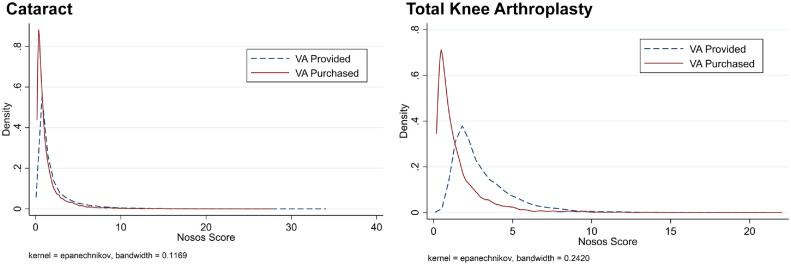
Veterans' access to Veterans Affairs (VA)-purchased community care expanded due to large increases in funding provided in the 2014 Veterans Choice Act. To compare costs between VA-delivered care and VA payments for purchased care for two commonly performed surgeries: total knee arthroplasties (TKAs) and cataract surgeries. Descriptive statistics and regressions examining costs in VA-delivered and VA-purchased care (fiscal year [FY] 2018 [October 2017 to September 2018]). A total of 13,718 TKAs, of which 6,293 (46%) were performed in VA. A total of 91,659 cataract surgeries, of which 65,799 (72%) were performed in VA. Costs of VA-delivered care based on activity-based cost estimates; costs of VA-purchased care based on approved and paid claims. Ninety-eight percent of VA-delivered TKAs occurred in inpatient hospitals, with an average cost of $28,969 (SD $10,778). The majority (86%) of VA-purchased TKAs were also performed at inpatient hospitals, with an average payment of $13,339 (SD $23,698). VA-delivered cataract surgeries were performed at hospitals as outpatient procedures, with an average cost of $4,301 (SD $2,835). VA-purchased cataract surgeries performed at hospitals averaged $1,585 (SD $629); those performed at ambulatory surgical centers cost an average of $1,346 (SD $463). We also found significantly higher Nosos risk scores for patients who used VA-delivered versus VA-purchased care. Costs of VA-delivered care were higher than payments for VA-purchased care, but this partly reflects legislative caps limiting VA payments to community providers to Medicare amounts. Higher patient risk scores in the VA could indicate that community providers are reluctant to accept high-risk patients because of Medicare reimbursements, or that VA providers prefer to keep the more complex patients in VA.
由于2014年《退伍军人选择法案》提供的资金大幅增加,退伍军人获得退伍军人事务部(VA)购买的社区护理的机会有所扩大。为比较VA提供的护理与VA为两种常见手术(全膝关节置换术(TKA)和白内障手术)购买护理的费用。进行描述性统计和回归分析,以研究VA提供的护理和VA购买的护理(2018财年[2017年10月至2018年9月])的成本。共有13718例TKA手术,其中6293例(46%)在VA进行。共有91659例白内障手术,其中65799例(72%)在VA进行。VA提供的护理成本基于作业成本估计;VA购买的护理成本基于批准和支付的索赔。98%的VA提供的TKA手术在住院医院进行,平均成本为28969美元(标准差10778美元)。VA购买的TKA手术大多数(86%)也在住院医院进行,平均支付为13339美元(标准差23698美元)。VA提供的白内障手术在医院作为门诊手术进行,平均成本为4301美元(标准差2835美元)。VA购买的在医院进行的白内障手术平均为1585美元(标准差629美元);在门诊手术中心进行的平均成本为1346美元(标准差463美元)。我们还发现,使用VA提供的护理与VA购买的护理的患者,其Nosos风险评分显著更高。VA提供的护理成本高于VA购买的护理的支付费用,但这部分反映了立法上限将VA向社区提供者的支付限制在医疗保险金额。VA中较高的患者风险评分可能表明,由于医疗保险报销,社区提供者不愿接受高风险患者,或者VA提供者更愿意将更复杂的患者留在VA。