Key Laboratory of Agricultural Information Acquisition Technology, Ministry of Agriculture and Rural Affairs, China Agricultural University, Beijing 100083, China.
Key Laboratory of Modern Precision Agriculture System Integration Research, Ministry of Education, China Agricultural University, Beijing 100083, China.
Biosensors (Basel). 2021 Nov 11;11(11):447. doi: 10.3390/bios11110447.
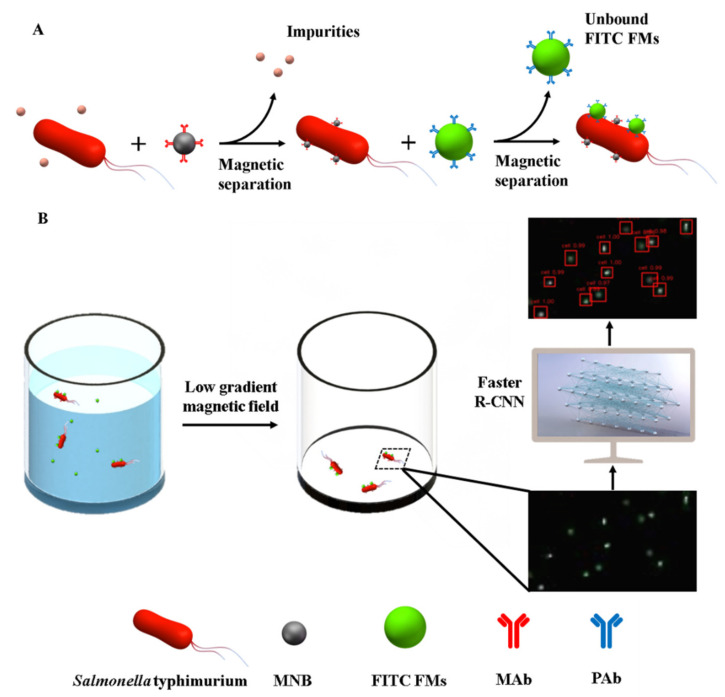
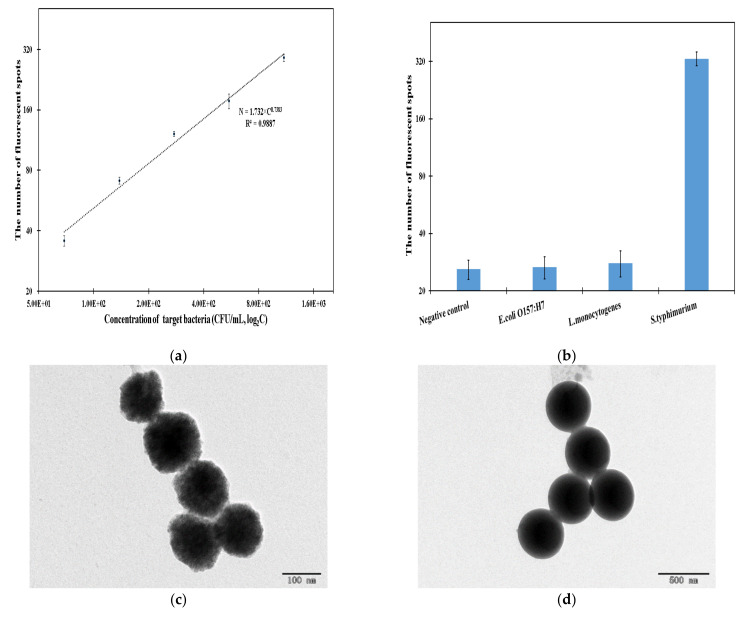
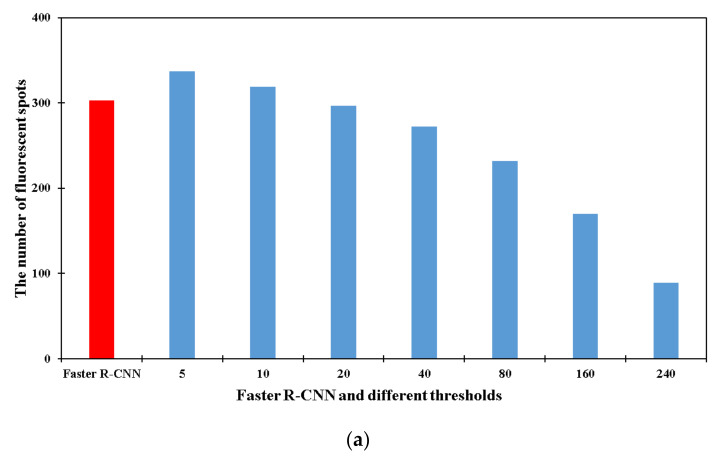
In this study, a fluorescent biosensor was developed for the sensitive detection of typhimurium using a low-gradient magnetic field and deep learning via faster region-based convolutional neural networks (R-CNN) to recognize the fluorescent spots on the bacterial cells. First, magnetic nanobeads (MNBs) coated with capture antibodies were used to separate target bacteria from the sample background, resulting in the formation of magnetic bacteria. Then, fluorescein isothiocyanate fluorescent microspheres (FITC-FMs) modified with detection antibodies were used to label the magnetic bacteria, resulting in the formation of fluorescent bacteria. After the fluorescent bacteria were attracted against the bottom of an ELISA well using a low-gradient magnetic field, resulting in the conversion from a three-dimensional (spatial) distribution of the fluorescent bacteria to a two-dimensional (planar) distribution, the images of the fluorescent bacteria were finally collected using a high-resolution fluorescence microscope and processed using the faster R-CNN algorithm to calculate the number of the fluorescent spots for the determination of target bacteria. Under the optimal conditions, this biosensor was able to quantitatively detect typhimurium from 6.9 × 10 to 1.1 × 10 CFU/mL within 2.5 h with the lower detection limit of 55 CFU/mL. The fluorescent biosensor has the potential to simultaneously detect multiple types of foodborne bacteria using MNBs coated with their capture antibodies and different fluorescent microspheres modified with their detection antibodies.
在这项研究中,开发了一种荧光生物传感器,用于使用低梯度磁场和基于更快区域卷积神经网络 (R-CNN) 的深度学习来灵敏检测鼠伤寒沙门氏菌,以识别细菌细胞上的荧光斑点。首先,用捕获抗体涂覆的磁性纳米珠 (MNB) 用于从样品背景中分离目标细菌,从而形成磁性细菌。然后,用检测抗体修饰的异硫氰酸荧光素荧光微球 (FITC-FM) 用于标记磁性细菌,从而形成荧光细菌。在使用低梯度磁场将荧光细菌吸引到底部的 ELISA 孔后,荧光细菌从三维(空间)分布转变为二维(平面)分布,最后使用高分辨率荧光显微镜收集荧光细菌的图像,并使用更快的 R-CNN 算法进行处理,以计算荧光斑点的数量,用于检测目标细菌。在最佳条件下,该生物传感器能够在 2.5 小时内定量检测浓度范围为 6.9×10 至 1.1×10 CFU/mL 的鼠伤寒沙门氏菌,检测限为 55 CFU/mL。荧光生物传感器有望通过用其捕获抗体涂覆的磁性纳米珠和用其检测抗体修饰的不同荧光微球同时检测多种食源性病原体细菌。