Duan Heying, Baratto Lucia, Hatami Negin, Liang Tie, Mari Aparici Carina, Davidzon Guido Alejandro, Iagaru Andrei
Department of Radiology, Division of Nuclear Medicine and Molecular Imaging, Stanford University, Stanford, CA, United States.
Department of Radiology, Division of Nuclear Medicine and Molecular Imaging, Stanford University, Stanford, CA, United States.
Transl Oncol. 2022 Jan;15(1):101293. doi: 10.1016/j.tranon.2021.101293. Epub 2021 Nov 22.
Ga-PSMA11 PET/CT is excellent for evaluating biochemically recurrent prostate cancer (BCR PC). Here, we compared the positivity rates of dual-time point imaging using a PET/CT scanner (DMI) with silicon photomultiplier (SiPM) detectors and a PET/CT scanner (D690) with photomultiplier tubes (PMT), in patients with BCR PC.
Fifty-eight patients were prospectively recruited and randomized to receive scans on DMI followed by D690 or vice-versa. Images from DMI were reconstructed using the block sequential regularized expectation maximization (BSREM) algorithm and images from D690 were reconstructed using ordered subset expectation maximization (OSEM), according to the vendor's recommendations. Two readers independently reviewed all images in randomized order, recorded the number and location of lesions, as well as standardized uptake value (SUV) measurements.
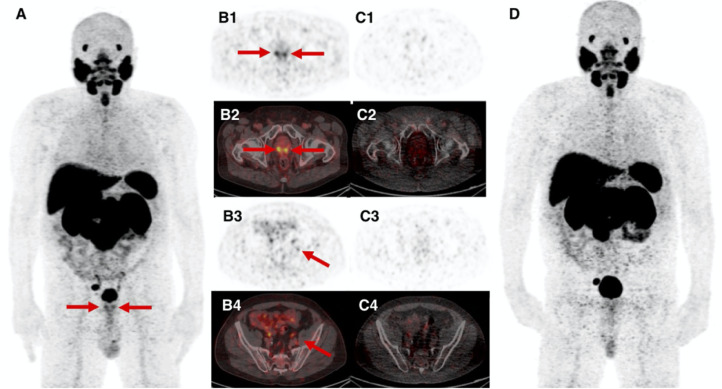
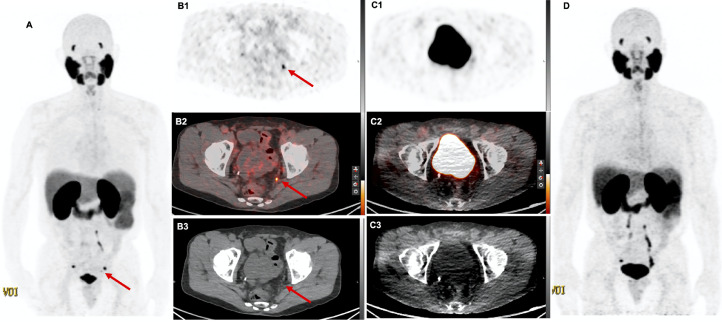
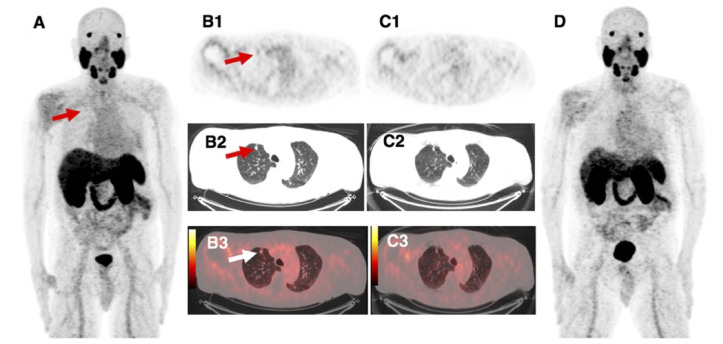
Twenty-eight patients (group A) had DMI as first scanner followed by D690, while 30 patients (group B) underwent scans in reversed order. Mean PSA was 30±112.9 (range 0.3-600.66) ng/mL for group A and 41.5 ± 213.2 (range 0.21-1170) ng/mL for group B (P = 0.796). The positivity rate in group A was 78.6% (22/28 patients) vs. 73.3% (22/30 patients) in group B. Although the performance of the two scanners was equivalent on a per-patient basis, DMI identified 5 additional sites of suspected recurrent disease when used as first scanner. The second scan time point did not reveal additional abnormal uptake.
The delayed time point in Ga-PSMA11 PET/CT did not show a higher positivity rate. SiPM-based PET/CT identified additional lesions. Further studies with larger cohorts are needed to confirm these results.
镓-PSMA11正电子发射断层扫描/计算机断层扫描(Ga-PSMA11 PET/CT)在评估生化复发前列腺癌(BCR PC)方面表现出色。在此,我们比较了使用配备硅光电倍增管(SiPM)探测器的PET/CT扫描仪(DMI)和配备光电倍增管(PMT)的PET/CT扫描仪(D690)对BCR PC患者进行双时相成像的阳性率。
前瞻性招募58例患者并随机分组,一组先接受DMI扫描,随后接受D690扫描,另一组顺序相反。根据设备供应商的建议,DMI图像使用块序贯正则化期望最大化(BSREM)算法重建,D690图像使用有序子集期望最大化(OSEM)算法重建。两名阅片者以随机顺序独立审阅所有图像,记录病变的数量和位置以及标准化摄取值(SUV)测量结果。
28例患者(A组)先使用DMI扫描仪,随后使用D690,30例患者(B组)扫描顺序相反。A组患者的平均前列腺特异性抗原(PSA)为30±112.9(范围0.3 - 600.66)ng/mL,B组为41.5±213.2(范围0.21 - 1170)ng/mL(P = 0.796)。A组的阳性率为78.6%(22/28例患者),B组为73.3%(22/30例患者)。虽然两台扫描仪在每位患者基础上的表现相当,但当DMI作为首次扫描设备时,它额外发现了5个疑似复发疾病的部位。第二次扫描时间点未发现额外的异常摄取。
Ga-PSMA11 PET/CT的延迟时间点并未显示出更高的阳性率。基于SiPM的PET/CT发现了更多病变。需要更大样本量的队列研究来证实这些结果。