Clinical Pharmacy Group, Division of Pharmacology and Pharmacotherapy, Faculty of Pharmacy, University of Helsinki, Viikinkaari 5 E, P.O. box 56, 00014, Helsinki, Finland.
BMC Health Serv Res. 2021 Nov 25;21(1):1274. doi: 10.1186/s12913-021-07291-6.
New competence requirements have emerged for pharmacists as a result of changing societal needs towards more patient-centred practices. Today, medication review competence can be considered as basic pharmaceutical competence. Medication review specific competence criteria and tools for self-assessing the competence are essential in building competences and a shared understanding of medication reviews as a collaborative practice. The aim of this study was to develop and pilot a self-assessment tool for medication review competence among practicing pharmacists in Finland.
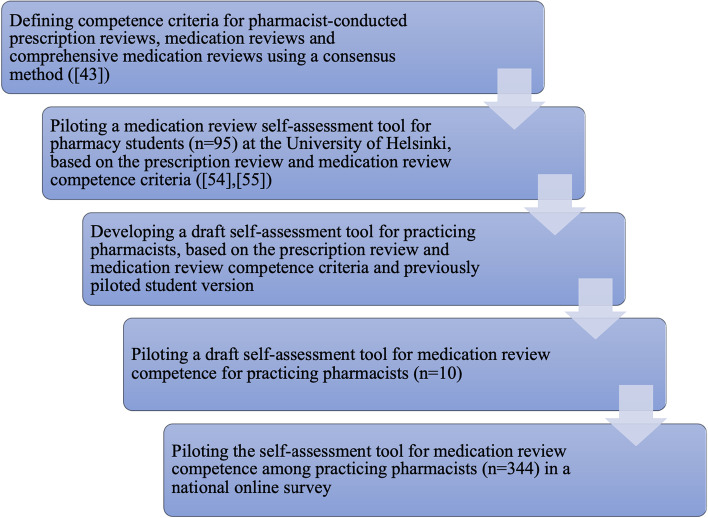
The development of the self-assessment tool was based on the national medication review competence criteria for pharmacists established in Finland in 2017 and piloting the tool among practicing pharmacists in a national online survey in October 2018. The pharmacists self-assessed their medication review competence with a five-point Likert scale ranging from 1 for "very poor/not at all" to 5 for "very good".
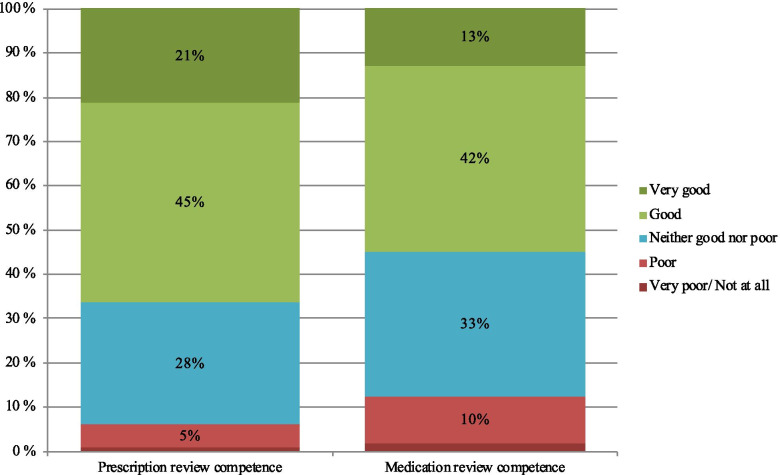
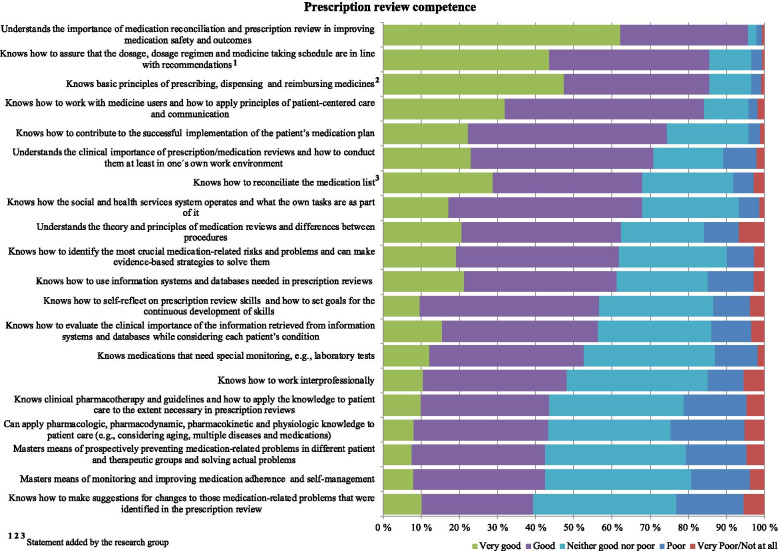
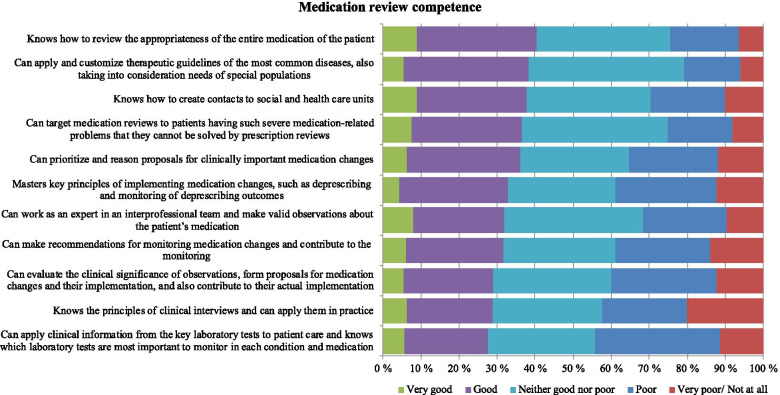
The internal consistency of the self-assessment tool was high as the range of the competence areas' Cronbach's alpha was 0.953-0.973. The competence areas consisted of prescription review competence (20 items, Cronbach's alpha 0.953), additional statements for medication review competence (11 additional items, Cronbach's alpha 0.963) and medication review as a whole, including both the statements of prescription review and medication review competence (31 items, Cronbach's alpha 0.973). Competence items closely related to routine dispensing were most commonly self-estimated to be mastered by the practicing pharmacists who responded (n = 344), while the more clinical and patient-centred competence items had the lowest self-estimates. This indicates that the self-assessment tool works logically and differentiates pharmacists according to competence. The self-assessed medication review competence was at a very good or good level among more than half (55%) of the respondents (n = 344).
A self-assessment tool for medication review competence was developed and validated. The piloted self-assessment tool can be used for regular evaluation of practicing pharmacists' medication review competence which is becoming an increasingly important basis for their contribution to patient care and society.
由于社会对以患者为中心的实践的需求不断变化,药师需要具备新的能力要求。如今,药物审查能力可以被视为基本药学能力。药物审查特定能力标准和自我评估能力的工具对于建立能力和对药物审查作为一种协作实践的共同理解至关重要。本研究的目的是为芬兰的执业药师开发和试点一种药物审查能力的自我评估工具。
自我评估工具的开发基于 2017 年在芬兰建立的药师药物审查能力国家标准,并于 2018 年 10 月在全国在线调查中对执业药师进行试点。药师使用五点李克特量表对他们的药物审查能力进行自我评估,范围从 1(非常差/完全没有)到 5(非常好)。
自我评估工具的内部一致性很高,因为能力领域的克朗巴赫α范围为 0.953-0.973。能力领域包括处方审查能力(20 项,克朗巴赫α 0.953)、药物审查能力的附加说明(11 项附加项,克朗巴赫α 0.963)以及药物审查作为一个整体,包括处方审查和药物审查能力的说明(31 项,克朗巴赫α 0.973)。与常规配药密切相关的能力项目最常被回复的执业药师自我评估为掌握(n=344),而更具临床和以患者为中心的能力项目自我评估最低。这表明自我评估工具逻辑上有效,并根据能力区分药师。超过一半(55%)的受访者(n=344)的自我评估药物审查能力处于非常好或良好水平。
开发并验证了一种药物审查能力的自我评估工具。试点的自我评估工具可用于定期评估执业药师的药物审查能力,这对于他们为患者护理和社会做出贡献变得越来越重要。